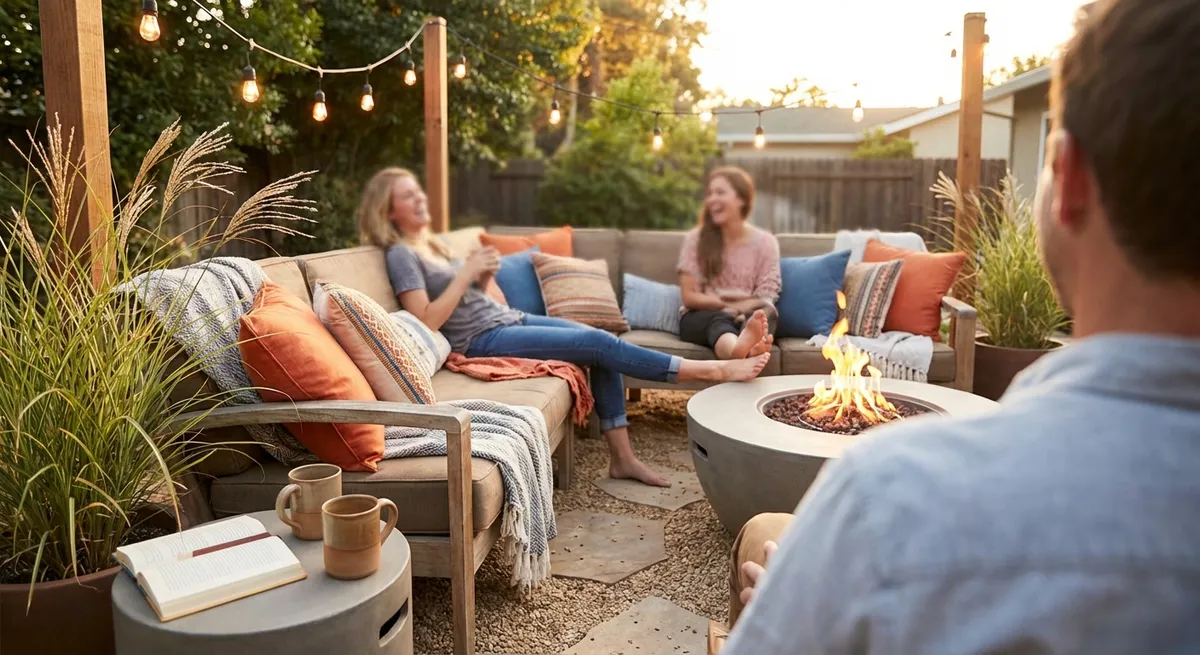
Below are five outdoor furniture design ideas crafted for people who see their porch, balcony, or backyard as more than square footage—it’s their daily invitation to live wider, slower, and more beautifully.
Idea 1: The Dawn Corner – A Chair That Makes You a Morning Person
Imagine a chair that doesn’t just hold you, but orients your entire day. Place a deeply comfortable lounge chair or small loveseat where the first light lands: east-facing porch, balcony rail, or the one patch of yard that glows at sunrise.
Layer it with textures that feel like kindness: a breathable outdoor cushion, a throw that lives out there year-round, maybe a small lumbar pillow in a color that reminds you of the sky before it fully wakes—soft peach, quiet blue, muted lavender.
Add a tiny side table for the details that make mornings real: a steaming mug, a dog-eared book, a journal, or nothing more than a glass of water catching the light. Choose furniture with curved lines and soft edges—no sharp angles, nothing that says “office” or “task,” everything that whispers “stay.”
Over time, this becomes less “just a chair” and more a ritual anchor. You’re training your body to recognize: when I sit here, the day starts gently. It’s outdoor furniture as a reset button, a physical reminder that you deserve a soft entry into your own life.
Idea 2: The Long Table of Ordinary Magic
Some tables are for holidays and big speeches. This one is for everything else.
Think of a long outdoor table as a living timeline, not just a dining surface. It holds laptop afternoons, late-night card games, messy craft projects, quiet solo dinners, and accidental gatherings that go on way too late.
Choose a material that feels honest to your climate and your style: weathered wood that shows every season, powder-coated metal that reflects the sky, or a composite surface that shrugs off spilled wine and kids’ paint. Bench seating on one side invites closeness, while mixed chairs on the other side tell your story—maybe a thrifted metal chair, a woven rattan piece, a modern stacking chair you adore.
String lights overhead or set a row of lanterns down the center like a glowing spine. Add cushions that can live outside, and let them fade beautifully with the sun. Over time, the table will collect tiny memories: ring marks from hot mugs, faint scratches from board games, wax drips from candles that burned too long.
Outdoor furniture becomes a kind of shared memory device here. The table doesn’t need to be perfect; it needs to be welcoming enough that people wander outside and forget to go back in.
Idea 3: The Conversation Nest Under Open Sky
Not every outdoor space needs a focal point; some just need a center of gravity. Create a “conversation nest” that magnetizes people—somewhere that makes everyone drop their phones and lean closer without even realizing it.
Start with a cluster of seating arranged in a loose circle or soft U-shape: low lounge chairs, a compact outdoor sofa, or even a pair of chaise lounges turned toward each other instead of the view. The exact pieces matter less than the feeling: nobody should have to twist awkwardly to be part of the moment.
Add a central piece that encourages gathering: a round coffee table, a sturdy ottoman, or a large fire pit table. The shape matters—circles suggest equality; everyone is in, nobody is on the edge of the scene.
Now build in layers of comfort that make conversations stretch: lanterns with warm light, an outdoor rug that invites bare feet, a basket of blankets within arm’s reach, maybe a small speaker tucked away for soft music.
In this nest, outdoor furniture is less about “decor” and more about invisible choreography. You’re arranging seats so stories can breathe, confessions can land, and laughter has a place to echo against the night.
Idea 4: The Solo Sanctuary in Plain Sight
Not every moment outdoors needs company. Some are just between you and the wind.
Design a single, unapologetic “just for me” spot, and let the furniture announce that intention clearly. This might be a hanging chair swaying on the edge of the porch, a deep chaise hidden by tall planters, or a simple Adirondack chair tucked behind a screen of grasses or trellised vines.
Choose comfort that feels like exhale: a cushion that doesn’t fight your body, a headrest that invites you to lean back and watch clouds. Place a tiny side table for the small companions that turn solitude into sanctuary: a book, a candle, a sketchbook, a cup of tea.
If your space is small—a balcony, a narrow stoop, a shared courtyard—go vertical and delicate. A slim bistro chair with a foldable side table can still feel like a throne if you give it intention. Plants in railing planters, hanging baskets, or a single potted tree can soften the edges and turn the noise down, even in a city.
This is outdoor furniture as boundary-setting. A visible, physical reminder that you are allowed to take up space, even in stillness. You may find that just seeing your empty sanctuary from indoors is enough to remind you: you have a place to go when the world gets too loud.
Idea 5: The Daybed That Refuses to Choose a Season
There’s something quietly radical about napping outdoors. It says: I trust this moment enough to close my eyes in it.
Introduce an outdoor daybed or deep bench that’s generous enough for full-body lounging. It might be a built-in bench with layered cushions, a modular outdoor sofa configured into a bed, or an actual weather-resistant daybed designed for porches and patios.
Dress it in materials that can handle real life: outdoor fabrics that resist fading and moisture, cushions with removable covers, and throws that love a bit of weather. Add side tables or wall shelves within easy reach for water, books, hats, or sunscreen. Install a canopy, pergola, or shade sail above to soften the light and make the space feel cocooned, even though it’s open to the air.
Use this piece as a shape-shifter: it can be a reading nook on weekday afternoons, a stargazing spot wrapped in blankets at night, extra seating during parties, or the quiet place you retreat to when everyone finally goes home.
In a world that glorifies productivity, an outdoor daybed is a gentle act of defiance. The furniture itself becomes a teacher, reminding you: rest is not an interruption of life—it’s part of the life you are building out here.
Conclusion
Outdoor furniture isn’t just about what looks good in photos; it’s about what makes you stay long enough to feel something. The right chair can turn you into a morning person. The right table can turn ordinary evenings into rituals. The right nest, corner, or daybed can turn a simple porch or patch of yard into the most emotionally expensive square footage you own—without ever appearing on a real estate listing.
Design your outdoor space as if you’re building a life, not a catalog spread. Let your furniture invite slow mornings, loud dinners, barefoot conversations, and unapologetic naps. Because the most beautiful thing your outdoor space can hold isn’t a plant, or a pillow, or the perfect light.
It’s you, fully present, finally breathing like you have all the sky in the world.
Sources
- Environmental Protection Agency: Green Spaces and Health - Overview of how access to green and outdoor spaces supports mental and physical wellbeing
- Harvard Health Publishing: A Prescription for Better Health—Go Alfresco - Discusses benefits of spending time outdoors for mood and stress reduction
- American Society of Landscape Architects (ASLA): Outdoor Rooms - Explores design principles for creating functional, livable outdoor “rooms”
- Mayo Clinic: Stress Management and the Outdoors - Explains how outdoor environments and relaxation spaces can reduce stress
- University of Minnesota: How Nature Impacts Our Wellbeing - Summarizes research on the psychological benefits of spending time outside