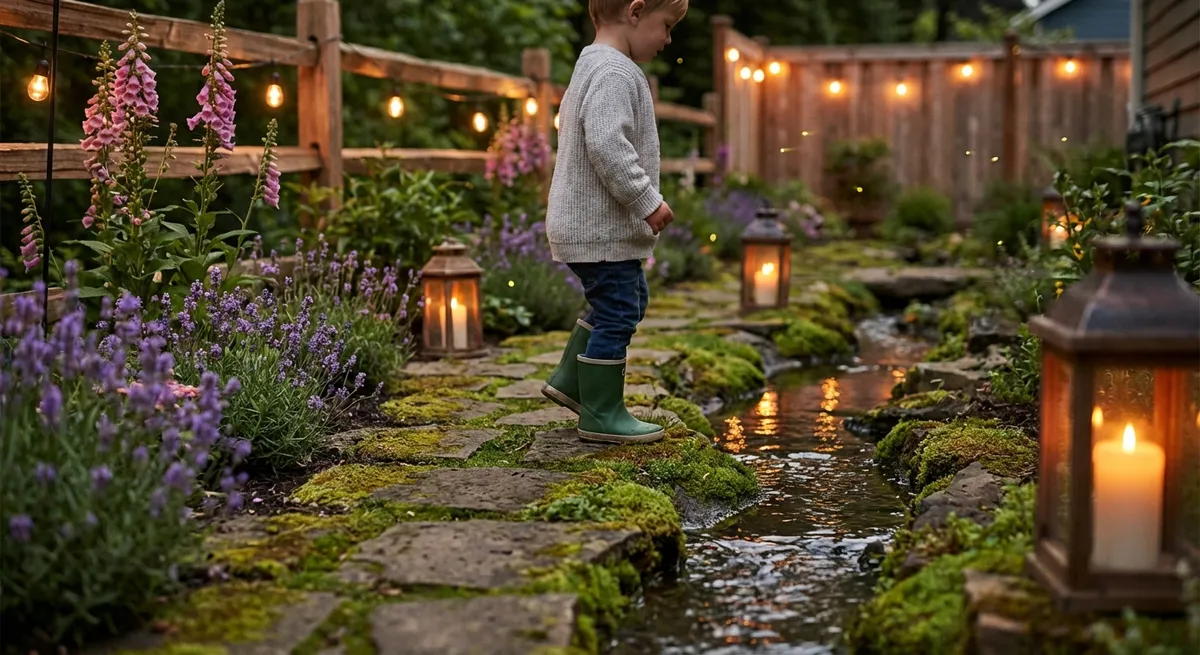
Below are five design ideas that don’t just decorate your yard—they give it a soul.
1. The Quiet Green Room: Layered Planting That Wraps, Not Just Frames
Think of your yard not as a flat picture, but as a series of gentle green curtains you can walk through.
Start by building layers from the ground up: low groundcovers and soft grasses, mid-height shrubs, then small trees or taller perennials behind them. This layered approach creates a sense of depth, so even a modest yard feels expansive. Instead of placing plants in a straight border, let them drift in slightly irregular clusters—like nature would.
Mix textures the way an artist mixes brushes: feathery ornamental grasses against broad hydrangea leaves, glossy evergreens beside silvery, fuzzy lamb’s ear. Choose a simple color family—cool blues and purples, or warm golds and soft pinks—so the space feels calm rather than chaotic.
The magic is in the edges. Soften the borders where grass meets bed with curved lines instead of rigid angles. A gently bending edge invites you to walk along it, to follow it, to see what’s around the next green corner. You’re not just looking at your landscape; you’re moving through it.
2. The Ember Heart: A Fire-Focused Gathering Nook
Every outdoor story needs a hearth—somewhere the evening collects and lingers.
Design a dedicated fire nook that feels tucked-in, even if you’re working with an open yard. Use gravel, decomposed granite, or stone to define a circular or oval “room,” then border it with low plantings: lavender, rosemary, or other fragrant herbs that release scent when brushed by passing feet.
Choose seating that feels like it wants to stay put—heavy Adirondack chairs, a low masonry bench, or built-in seating along a low retaining wall. Add cushions and throws that can come inside when the weather turns, and a side table or two for mugs, books, and glowing lanterns.
Around the edge, plant for what happens when the sun goes down: white flowers that catch the twilight, grasses that shimmer in firelight, and a small tree or two to silhouette against the dark. That way, your fire nook doesn’t exist just for the flames—it’s a destination at dusk, even before the first match is struck.
Here, time slows. Stories stretch. And your yard begins to earn a new, whispered name: “Let’s meet at the fire.”
3. The Living Canvas: Seasonal Color That Never Stops Speaking
A truly alive landscape doesn’t just peak in June and fade. It turns like a wheel through the whole year.
Begin with your backbone: trees and shrubs that show up in every season. A small ornamental tree with spring blossoms and fall color, evergreen structure to hold shape through winter, and shrubs that berry, bloom, or bring bold foliage. Then layer in perennials and bulbs that tag-team the year, each taking a turn on the stage.
Picture it like a calendar you can walk into:
Early spring: daffodils, tulips, and hellebores pushing through the last cool days.
High summer: coneflower, salvia, yarrow and native wildflowers buzzing with pollinators.
Fall: asters, grasses, and foliage that catches fire in amber and crimson.
Winter: dried seed heads, sculptural branches, and evergreens dusted with frost.
Don’t be afraid of repetition. Plant your favorites in generous drifts rather than one of everything; repetition is what makes a yard feel intentional and restful. When you step outside in any month and something is blooming, glowing, or catching light, you’re reminded that your yard isn’t a project—it’s a living, ongoing relationship.
4. The Everyday Escape: Tiny Retreats Hidden in Plain Sight
Not every outdoor moment has to orbit the deck or the patio. The most magical spaces are often the ones that feel discovered.
Look for a quiet corner—a side yard strip, the far end of a fence line, the shaded spot beneath a tree. Claim it as your micro-retreat. Lay down a small paver pad, a wooden platform, or even a simple crushed-gravel patch. Place a single chair or a small bench, and suddenly this forgotten space becomes a destination.
Frame it with planting that offers a bit of privacy without full isolation: tall grasses that whisper, a trellis with a climbing vine, or a pair of shrubs that create a soft green threshold you pass through. Add one focal piece—a birdbath, a sculptural pot, a low water feature—something quietly beautiful that tells you, “You’ve arrived.”
This isn’t the place for entertaining. It’s for morning coffee, solo sunsets, whispered phone calls, and pages of half-finished novels. A pocket of space that asks nothing of you but presence. When your own yard offers you a hideaway, you need fewer escapes elsewhere.
5. The Path of Intention: Walkways That Tell You Where to Wander
A path is more than a way to get from door to garden bed—it’s a gentle suggestion for how to experience your space.
Instead of a single straight run from porch to gate, consider branching paths that offer options. One leads to the fire nook, another to the tiny retreat, a third looping around your planting beds. Each path doesn’t have to be grand; even a simple band of stepping stones through groundcover can feel like an invitation.
Vary path materials to change the mood: stone for a grounded, timeless feel; brick for charm; gravel for that satisfying underfoot crunch that announces each step. Use low plants like thyme, creeping Jenny, or groundcovers between or along the edges to blur the line between “path” and “garden.”
Lighting is where the path becomes a story after dark. Low, warm fixtures that graze along the edges, solar markers at gentle intervals, or string lights crossing overhead can turn a simple walk to the back gate into an experience. You’re not just moving across your property; you’re traveling through your own small world.
Conclusion
Landscaping isn’t about copying the perfect yard you scrolled past last night. It’s about listening to the land you actually have—the slope, the soil, the light—and then listening to yourself. What kind of quiet do you want? What kind of gathering? What kind of daily ritual?
When you layer your plants like a green room, anchor your nights around a hearth, spin color through the seasons, hide tiny retreats in the folds of your yard, and lay down paths that ask you to wander, your outdoor space stops being “somewhere out back.” It becomes a living story you step into every time you open the door.
Your yard doesn’t need to be big to be transformative. It just needs to feel like it was made for the life you’re actually living—and the life you’re still daring to imagine.
Sources
- U.S. Forest Service – Landscaping for a Healthy Planet – Guidance on thoughtful planting, biodiversity, and sustainable yard design
- University of Minnesota Extension – Principles of Landscape Design – Explains layering, repetition, and focal points in residential landscapes
- Royal Horticultural Society (RHS) – Designing a Garden for Year-Round Interest – Practical ideas for creating seasonal color and structure
- Cornell University – Creating a Backyard Habitat – Tips on designing landscapes that support birds, pollinators, and other wildlife
- International Dark-Sky Association – Outdoor Lighting Basics – Best practices for atmospheric, low-impact garden and pathway lighting