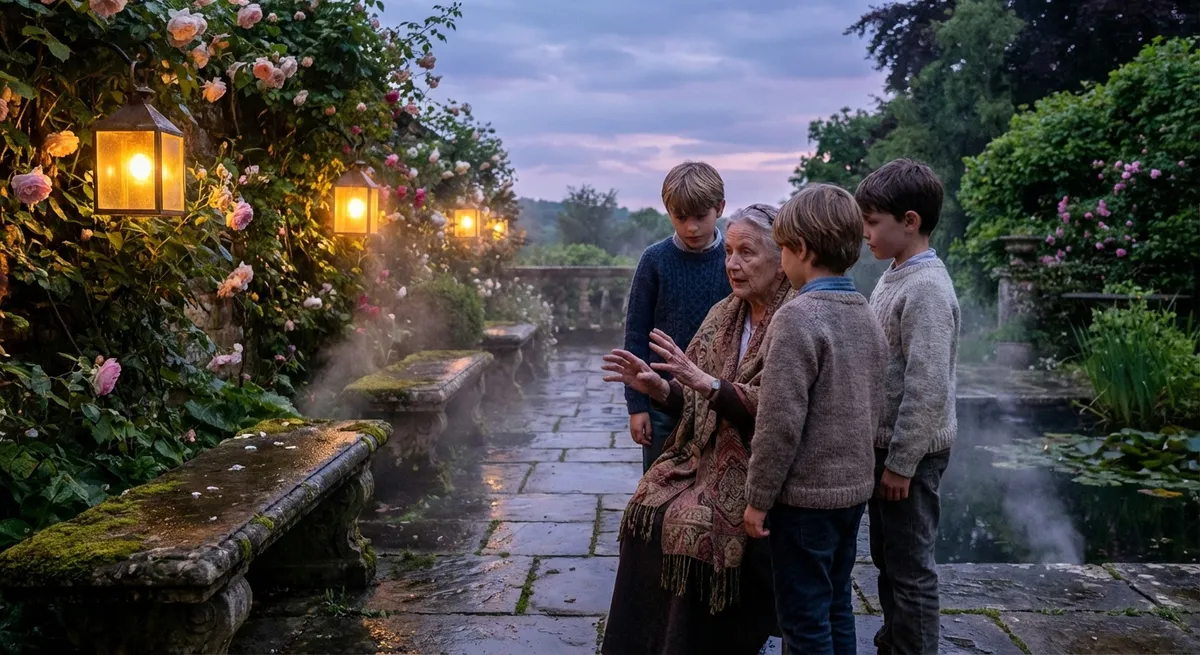
Landscaping isn’t about perfection. It’s about composing a place where birds feel welcome, your shoulders drop an inch, and time moves at a kinder pace. Below are five design ideas that help you shape a landscape that doesn’t just sit there—it lives with you.
1. The Meandering Story Path
Straight paths get you there. Meandering paths invite you to arrive.
Design a walkway that curves gently, obscuring what comes next so that every few steps feel like a small reveal. Use materials with character: crushed gravel that crunches underfoot, flagstone softened by creeping thyme, or wood slices that echo the rings of old stories.
Plant low-growing herbs along the edges—thyme, chamomile, or mint—so each step releases scent. Tuck in solar lanterns or low-voltage path lights that glow like a dotted line at dusk, guiding you deeper into your own space.
Think of your path as a narrative arc: begin near something familiar (your back door, a porch), bend it toward a small destination (a bench, a birdbath, a single sculptural tree), then let it continue past that point, hinting that the story isn’t over. The path doesn’t have to be long; it just has to feel like an invitation instead of a commute.
2. The Layered Sanctuary Garden
Instead of a flat patch of plants, imagine your yard as a layered sanctuary—ceiling, walls, and floor crafted from living things.
Start with the “ceiling”: small trees or tall shrubs that filter light. Serviceberry, Japanese maple, or native understory trees can soften the sky into a green canopy. Next, build the “walls” with mixed-height shrubs and tall perennials. They don’t need to form a solid barrier; they just need to suggest an enclosure where you feel cradled, not boxed in.
The “floor” is where your feet and eyes rest: groundcovers, mossy patches, stepping stones, and low flowering plants. Use repetition—a drift of the same grass here, the same lavender there—to create a visual rhythm that calms the mind.
Incorporate a single focal point: a weathered urn, a stone, a single large pot overflowing with something abundant. Let the plant palette lean into softness: feathery grasses, generous foliage, flowers that move in the wind. This layered approach doesn’t just look lush; it muffles the sound of the world and wraps you in a sense of arrival every time you step outside.
3. The Edible Border That Feels Like Abundance
Food gardens don’t have to hide in neat rectangles at the back of the yard. An edible border lets your landscape look ornamental and taste like summer.
Line paths or fences with blueberries, currants, or espaliered apple trees that grow flat against a wall, like living tapestries. Underplant them with fragrant herbs—rosemary, basil, sage—that brush your ankles and fingers as you walk by, and toss in edible flowers like nasturtiums or violas for color that can jump straight to your plate.
Use raised planters or large containers as sculptural elements, filling them with leafy greens and trailing strawberries. When arranged in repeating shapes or mirrored pairs, vegetables and fruits become design tools, not just pantry fillers.
This kind of landscaping shifts your relationship with your yard: it becomes a place where you harvest color, scent, and flavor as easily as you gather moments of quiet. Each ripening berry, each leaf of basil, is a reminder that beauty isn’t just something to look at—it’s something to share, taste, and pass around a table.
4. The Water Whisper Corner
You don’t need a sprawling pond to let water change the entire mood of your landscape. A small, intentional water feature can turn even a compact corner into a place that feels gently enchanted.
Imagine a simple ceramic basin fed by a hidden pump, water spilling over the edge in a continuous hush. Or a narrow rill—a shallow, straight channel—that runs along a path, catching sky reflections between plants. Even a birdbath, placed at eye level instead of on the ground, becomes a stage where finches and robins become daily performers.
Surround your water with plants that thrive in the slightly cooler, more humid microclimate it creates: ferns, hostas, sedges, or native moisture-loving species. Keep at least one viewing spot—chair, step, or flat stone—close enough that you can hear the water clearly while reading, talking, or simply doing nothing.
The gift of water in a landscape isn’t just visual; it’s auditory. It blends with wind, leaves, and distant traffic, softening edges and reminding you, in low whispers, that you belong to a larger, flowing world.
5. The Twilight Rooms of Light and Shadow
When the sun slips away, a thoughtfully lit landscape becomes a completely different place—quieter, more intimate, almost cinematic.
Instead of trying to blast the whole yard with brightness, think in terms of “twilight rooms.” Choose a few pockets to gently illuminate: a cluster of ornamental grasses backlit so their seed heads glow, the trunk of a favorite tree washed in soft light, stairs and paths traced by warm, low fixtures.
String lights can turn a simple seating area into an evening retreat, but restraint is powerful. Use them where they feel like stars gathered close, not a runway. Add a lantern on a side table, a candle in a glass hurricane by the steps, or a cluster of solar stake lights woven into a planting bed.
The dark spaces between your lighted areas matter; they create depth and mystery. In this patchwork of glow and shadow, your outdoor space stops being just a yard. It becomes a place where conversations linger, where the day exhales, where you learn that night doesn’t erase your landscape—it reveals a softer, secret version of it.
Conclusion
Landscaping is not about “getting it done.” It’s about learning how your home wants to meet the sky, how your footsteps want to move through the day, how you rest, gather, and dream. A curving path, a layered sanctuary, a border you can taste, a corner that whispers with water, a yard that glows at dusk—each idea is just a seed.
You don’t have to do everything at once. Begin with one change that feels like it belongs to your life right now. Plant it, shape it, listen to it. Over time, your outdoor space will stop feeling like a project and start feeling like a living story you get to step into every day.
Sources
- U.S. Forest Service – Benefits of Urban Trees - Discusses how trees and layered plantings improve well-being, cooling, and habitat
- Royal Horticultural Society – Designing a Garden - Practical guidance on structure, paths, focal points, and planting for visual flow
- Lady Bird Johnson Wildflower Center – Native Plants for Landscaping - Searchable database to choose regionally appropriate plants for sanctuary gardens
- Cornell University – Edible Landscaping - Explores how to combine edible plants with ornamental design
- Environmental Protection Agency (EPA) – Water Efficient Landscaping - Information on designing water features and planting plans that conserve water while enhancing outdoor spaces