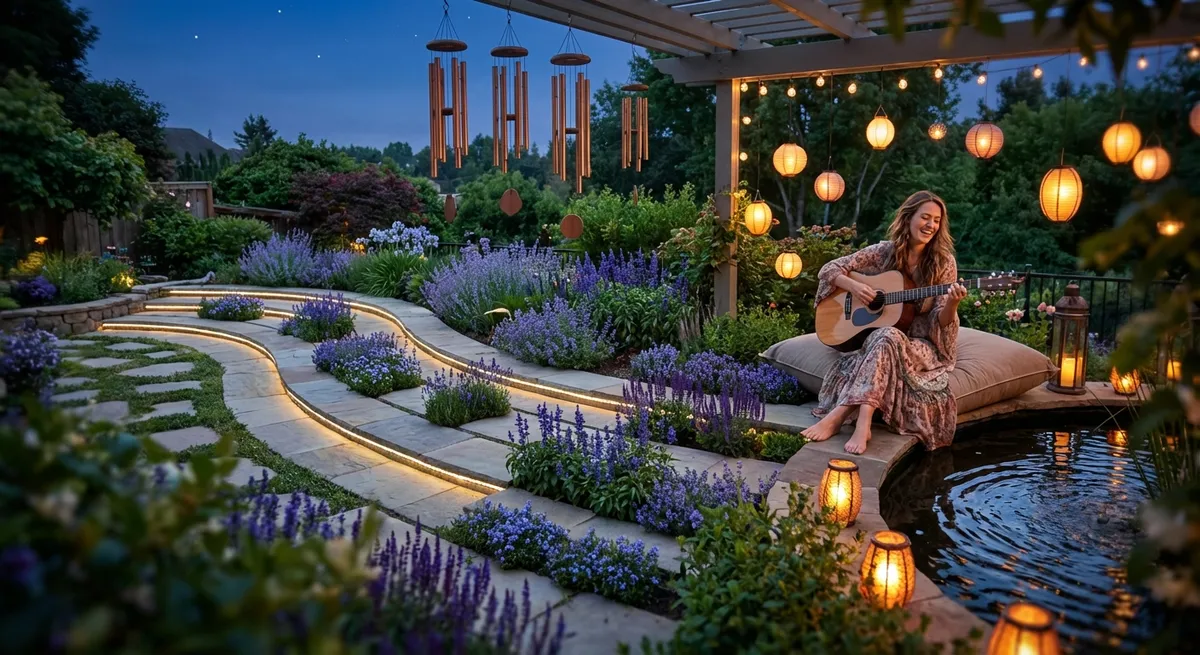
Let’s imagine your outdoor space not as a project, but as a living composition—layered with light, texture, and movement. Below are five design ideas to help you “write” a landscape that sings to you every time you step outside.
Planting in Layers: Painting With Depth and Shadow
Think of your yard as a canvas and your plants as brushstrokes. Layering plants—tall, medium, and low—creates depth, shadow, and a sense of discovery that a flat lawn could never offer.
Start with a “backdrop” layer: small trees, tall grasses, or large shrubs that frame your view and gently hold the space, the way a distant mountain line holds a horizon. In front of that, add a middle layer: flowering shrubs, medium grasses, and perennials that bring color and movement to eye level. Finally, soften the edges with groundcovers, creeping thyme, low sedums, or mossy patches that feel like nature’s carpet.
As light shifts throughout the day, those layers catch the sun differently—morning glow on ornamental grasses, afternoon shade on hostas, twilight glimmer on silvery foliage. Suddenly, your yard isn’t just “green”; it’s a living gradient of tones and textures.
To keep it all harmonious, choose a simple color palette: maybe soft whites and blues for a calm, moonlit feel, or rusty oranges, magentas, and golds for a more bohemian garden. Repeating the same plants in several places ties everything together, like a chorus that keeps returning in your favorite song.
Pathways With Purpose: Let Your Yard Tell You Where to Wander
A well-placed path doesn’t just help you get from point A to point B—it invites you on a tiny journey. The moment you define where feet will go, you define where eyes and hearts will follow.
Imagine a narrow gravel path curving gently around a corner of tall grasses, disappearing from sight just enough to spark curiosity. Or broad stepping stones laid through a bed of thyme, releasing fragrance as you walk to your favorite chair. Even a simple mulched trail leading to a small bench can feel like a private route to a personal ritual.
Design your paths to:
- Suggest a pace: Tight curves and varied textures slow you down; straight lines encourage purposeful movement.
- Frame views: Align a path so that it leads to something worth pausing for—a potted tree, a birdbath, a sculpture, or a framed slice of sky.
- Engage the senses: Edge your walkways with plants that brush your legs, catch the wind, or spill fragrance (lavender, rosemary, lemon balm, and native flowers are wonderful allies).
Over time, these paths become more than functional—they become memory lanes, where everyday moments (a morning coffee walk, a barefoot evening loop) slowly stitch into the story of your home.
Light as a Brushstroke: Illuminating Your Landscape After Dark
Landscaping doesn’t go to sleep when the sun sets; it simply changes key. Thoughtful lighting turns your yard into an evening sanctuary where shadows deepen, leaves glow, and your porch or patio becomes a softly lit stage for quiet conversations.
Rather than flood everything with brightness, treat light as a series of gentle brushstrokes:
- Glow from below: Use low, warm uplights to graze the trunks of trees or the texture of stone walls. It adds drama without feeling harsh.
- Guide with pinpoints: Tiny path lights or solar lanterns can mark steps and curves, creating a constellation at your feet.
- Highlight “islands” of interest: A favorite shrub, water feature, or seating area can be subtly spotlighted so the garden feels intimate, not overexposed.
Aim for warm, golden tones—like candlelight rather than a parking lot. The contrast between lit and unlit areas is what creates depth and a sense of magic.
On a summer night, with the crickets singing and leaves outlined in soft glow, your yard transforms into an open-air refuge where time feels looser and the day’s edges blur.
Quiet Corners: Micro-Sanctuaries Hidden in Plain Sight
Not every outdoor space has to be big to be meaningful. Some of the most restorative places in a landscape are tiny “micro-sanctuaries”—intimate nooks that feel like they were made just for one or two people at a time.
Look for underused corners: a narrow side yard, the spot under a tree, that awkward wedge between the house and the fence. With a bit of intention, these spaces can become:
- A single chair tucked beneath a small tree, layered with shade-loving plants and a low side table for your book and tea.
- A compact gravel pad with a bench and potted herbs, wrapped in a soft screen of tall grasses or bamboo.
- A small deck or platform with outdoor cushions, surrounded by climbing vines that climb fences, rails, or trellises.
Use plants and structures to “hug” the space—trellises with climbers, lattice screens, or even tall planters that subtly enclose. Add one sensory element: a wind chime, a small fountain, a cluster of scented plants. You’re creating a place your nervous system recognizes as safe, contained, and welcoming.
These quiet corners are where you might journal, meditate, call a friend, or simply watch the sky change—little refuge stations scattered around your yard.
Living Edges: Where Wildlife, Beauty, and Ease Meet
The edges of your yard—fence lines, borders, the place where lawn meets beds—are where your landscape can quietly do the most good, for you and the ecosystem around you.
Instead of a hard, razor-straight line of grass and mulch, imagine a soft, layered “living edge”:
- Native shrubs that bloom for pollinators, then feed birds with berries.
- Perennials that offer nectar across the seasons.
- Clumps of ornamental grasses that sway in the wind and provide winter shelter for insects.
These edges are lower-maintenance than thirsty lawns, especially if you choose regionally appropriate, drought-tolerant plants. They reduce the need for constant mowing, watering, and fertilizing, giving you back time and creating a more resilient landscape.
As you watch bees drift from flower to flower, hummingbirds hover near tubular blossoms, and finches perch on seed heads, your yard shifts from “kept” to “alive.” You’re not just decorating a property; you’re tending a tiny piece of earth that pulses with its own small wildness.
Conclusion
Your landscape doesn’t have to be perfect to be powerful. It doesn’t need to look like a catalog or a show garden. What matters is that it feels like you—more specifically, the you that breathes a bit easier outside.
By layering plants like brushstrokes, guiding your own wandering with thoughtful paths, painting the night with gentle light, tucking quiet corners into forgotten spots, and softening edges into living borders, you compose an outdoor space that feels less like a project and more like a poem.
Step outside, look around, and ask: What’s the first small note I can add to this song today? A single shrub, a few stones, a string of lights, a new chair in a quiet corner. Start there. Let the rest unfold, season after season, as your yard slowly becomes the sanctuary you’ve always imagined.
Sources
- U.S. Forest Service: Landscaping for Wildlife - Guidance on using native plants and layered planting to support birds, pollinators, and local ecosystems
- Royal Horticultural Society – Garden Lighting Ideas - Practical and aesthetic principles for using outdoor lighting to shape mood and highlight planting
- University of Minnesota Extension – Perennials for Different Light Conditions - Research-based advice on choosing plants that thrive in sun, shade, and mixed conditions
- Lady Bird Johnson Wildflower Center – Native Plant Database - Searchable database to find regionally appropriate native plants for layered, low-maintenance landscapes
- Environmental Protection Agency (EPA) – Green Landscaping With Native Plants - Explains environmental benefits of native planting and how to reduce water and maintenance needs