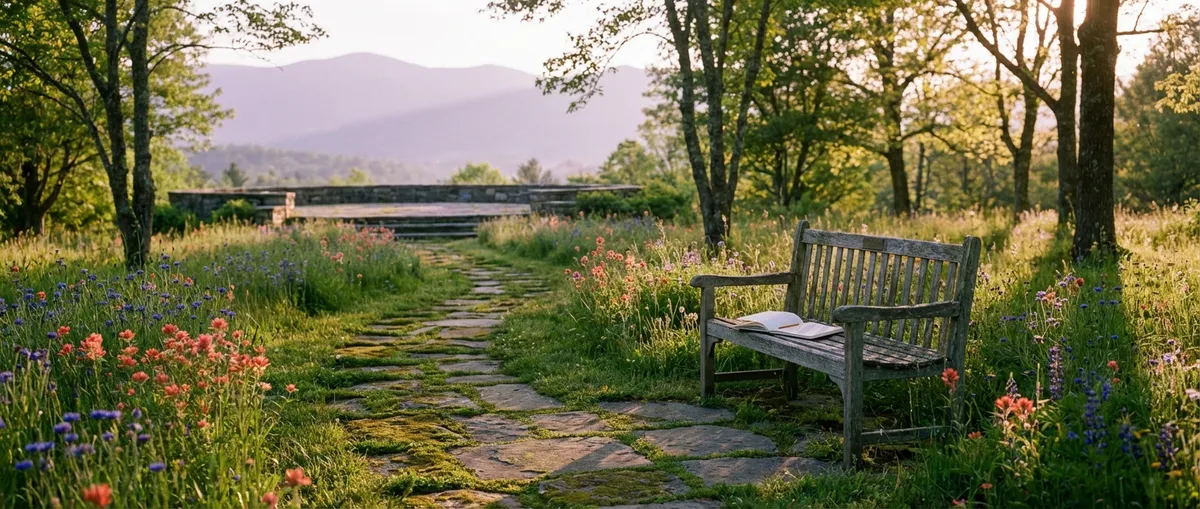
For outdoor living enthusiasts, the right design turns a yard into a place where memories grow almost as quickly as the flowers. Below are five idea-filled directions—less like rules, more like doorways—that can transform your landscape into a setting you can’t wait to step into every day.
Idea 1: The Meandering Story Path
Straight lines get you there. Curves make you feel the journey.
Design your main garden path as a gentle, meandering story rather than a direct route. Let it bend around a favorite tree, slip past a raised bed, or narrow slightly before opening to a small seating nook. Use mixed materials—flagstone framed with thyme, crushed gravel softened by ornamental grasses, or stepping stones set into moss—to make each step feel intentional.
Plant low, fragrant species along the edges so every footstep brushes up a bit of scent: lavender, creeping thyme, chamomile. Tuck in visual “punctuation marks” along the way—a birdbath here, a sculptural boulder there, a lantern that glows softly at dusk. As the path wanders, it invites you to slow down, to notice, to walk without rushing toward a destination. Over time, that path becomes the quiet narrator of your outdoor life, holding footprints from every season.
Idea 2: The Layered Sanctuary of Green
Think of your yard as a symphony of heights instead of a flat sheet of lawn. A layered sanctuary starts with canopy, understory, and ground level all having a voice.
Begin with your “ceiling”: small ornamental trees or tall shrubs that offer dappled shade and a sense of shelter. Underneath, create an understory of shrubs and tall perennials—hydrangeas, spirea, salvia, coneflowers—to build texture and depth. At ground level, weave in lush carpets of groundcovers, ornamental grasses, and seasonal flowers so your eye never hits a hard stop.
Choose a mostly green palette, then let color become the accent instead of the main act. Different shades of green—blue-green hostas, lime-green heuchera, dark evergreen hollies—create richness that feels restful rather than busy. The result is a cocooning effect: when you step into this layered space, the rest of the world recedes. It’s not just privacy; it’s emotional shelter.
Idea 3: The Edible Edges and Useful Beauty
Landscapes can feed you twice: once with food, once with joy.
Instead of tucking edibles away in a back corner, pull them into the main design. Line paths with blueberry bushes that blaze red in fall, frame a patio with columnar apple trees, or interplant rosemary and sage among your ornamental flowers. Let climbing beans share a trellis with sweet peas, their pods hanging like little exclamation points of abundance.
Design raised beds as architectural elements—clean lines in cedar or steel, softened by spilling nasturtiums and marigolds. Herbs can edge steps and sitting areas so that when you reach down, your hand brushes basil, mint, or lemon balm. Over time, you’ll find that stepping outside for parsley or a handful of cherry tomatoes becomes a small daily ritual—one that quietly rewires your relationship with your own land. Your garden stops being a picture and becomes a pantry, a pharmacy, and a friend.
Idea 4: The Water Whisper Corner
Not every yard can host a large pond, but nearly any space can hold a whisper of water.
Choose a small corner—a spot visible from both inside and out—and give it to water. This might be a compact, recirculating fountain, a ceramic urn that overflows into a hidden basin, or a shallow container water garden dotted with water lettuce and dwarf papyrus. Surround it with plants that amplify the mood: ferns that lean in, iris that spear the sky, grasses that nod and sway.
The sound doesn’t need to be loud; a gentle trickle is enough to soften traffic noise and invite birds. Add a simple bench or a single comfortable chair nearby, and you’ve just drawn a circle of calm within your landscape. This becomes a place for morning coffee, evening reflection, or the kind of conversations that only seem to happen when your eyes are resting on ripples instead of screens.
Idea 5: The Seasonal Theater Under the Sky
Every landscape has the potential to be a slow, unfolding performance—new acts in spring, intermissions in summer shade, a final golden encore in autumn.
Design your planting beds as if you’re casting characters for a year-round play. Choose early bulbs and flowering trees to announce spring, mid-season perennials and roses to carry the warmth, and late bloomers like asters and sedums to hold the stage when the air turns crisp. Interweave evergreens and structural plants (like boxwood, ornamental grasses, and dwarf conifers) so that even in winter, your yard has bones and presence.
Anchor this evolving theater with a simple, flexible “audience area”: maybe a gravel terrace with movable chairs, or a deck with space for blankets and lanterns. As the seasons shift, you can rearrange seating, add cushions and throws, or string up soft lights. The landscape becomes something you don’t just look at—you show up for it, again and again, like a beloved performance that’s never exactly the same twice.
Conclusion
Landscaping isn’t about achieving a single, perfect snapshot. It’s about setting in motion a living, changing experience: paths that remember your footsteps, plants that mark your seasons, small corners that know your favorite times of day.
When you design your outdoor space as an open invitation—to slow down, to savor, to gather—you’re doing more than arranging plants. You’re building a place where your life can stretch out a little, breathe deeper, and feel more fully at home under the open sky.
Sources
- American Society of Landscape Architects (ASLA) – Residential Design Trends - Overview of current approaches and priorities in residential landscape design
- Cornell University – Creating a Garden Path - Practical guidance on path materials, layout, and garden integration
- University of Minnesota Extension – Edible Landscaping - Research-based information on incorporating food plants into ornamental landscapes
- Royal Horticultural Society – Water in the Garden - Ideas and considerations for adding water features of various scales
- Missouri Botanical Garden – Designing a Four-Season Garden - Guidance on structuring plantings for interest in every season