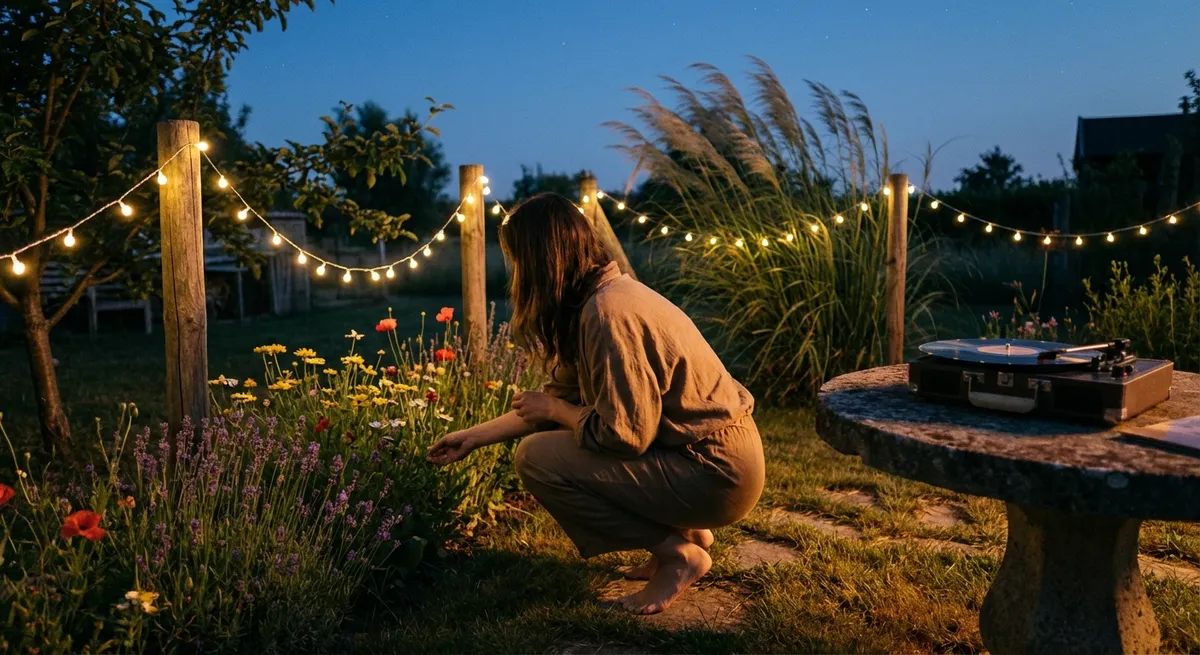
This isn’t about a perfect garden. It’s about shaping a place that matches your rhythm—where the world slows down, your shoulders drop, and you remember how good it feels to simply be. Here are five design ideas to help you compose an outdoor space that feels deeply, unmistakably yours.
1. The Soft-Edged Garden: Painting With Layers Instead of Lines
Straight lines are efficient. Soft edges are inviting.
Instead of a sharp border between lawn and beds, imagine a gentle drift: tall grasses bending at the back, medium-height shrubs in front of them, then low, flowering perennials near the path. Like a fading echo, each layer softens into the next. This kind of planting feels more like a painted landscape than a diagram.
Play with shape and height the way you’d arrange harmonies in a song. Use sweeping curves rather than harsh angles so your eye never gets “stuck”—it simply flows. A curved gravel path that disappears behind a shrub, a planting bed that bulges and tapers like a riverbank, a border that changes width as it runs along a fence: all of this makes your yard feel more alive and less like a grid.
To keep it from feeling wild in a stressful way, choose a limited palette of plants and repeat them. Maybe you lean into blue-green foliage and lavender blooms, or deep emerald leaves with pops of apricot and white. Repetition is your rhythm section; it keeps the scene coherent while the softer edges keep it soulful.
2. The Scent Trail: Let Fragrance Be Your Invisible Design
Some of the most powerful landscape experiences are the ones you can’t see first—you feel them.
Design your yard like a quiet, fragrant journey. Start at the place you step outside most often and work outward. By the door, anchor something calming and familiar: maybe pots of basil and thyme, or a cluster of lavender that brushes your legs as you pass. Move a little farther and shift the mood—roses climbing a trellis, jasmine near a corner where the air tends to linger, or mint by the path that releases its scent every time a foot scuffs the leaves.
Think in seasons, too. Spring can carry the sweetness of lilacs or flowering crabapples; summer, the resinous warmth of rosemary and pine; autumn, the earthy, leaf-mulch smell that says the year is exhaling. Even in winter, evergreen foliage and bark with a subtle aroma give the air character.
Fragrance works best when it greets you in small, surprising doses instead of overwhelming you in one spot. Plant in pockets and intervals, so the yard feels like a series of gentle scent “verses” instead of a single overpowering chorus. Your landscape becomes more than what you see—it becomes what you breathe in.
3. The Living Canvas: Color That Changes Without Feeling Chaotic
A beautiful landscape doesn’t freeze one perfect moment. It rolls gracefully from chapter to chapter.
Design your plant palette like a story that evolves. Choose a “base mood” for your space—cool and tranquil, or warm and energizing—and then let each season remix that feeling. For a calmer yard, lean on deep greens and blues with silver foliage; for a more animated space, use golds, corals, and bright, clean greens.
Set anchor plants that look good almost all year: evergreens, ornamental grasses, or shrubs with sculptural silhouettes. Around them, weave in perennials and bulbs that pass the baton of color through the seasons: early tulips and daffodils, late-spring salvia, summer coneflowers and black-eyed Susans, autumn asters and sedums. This way, your landscape never feels “over” when one bloom fades; it just turns the page.
Use color to frame what matters. A cluster of white flowers near your seating area can glow into the evening. Deep burgundy foliage by the front walk can make even a small entry feel dramatic and intentional. And remember: green is your foundation, not your afterthought. Varying shades of green—lime, forest, blue-green, olive—create depth even before the first flower opens.
4. The Quiet Stage: Crafting a Small Space That Holds Big Moments
You don’t need acres to have a landscape that changes how you feel. Sometimes all you need is one well-composed “stage.”
Pick a single spot—maybe a corner under a tree, a strip beside the garage, or the far end of a small yard—and treat it like the heart of your outdoor life. Start with a grounding surface: crushed gravel, pavers, or even a simple, level patch of ground with a mat or outdoor rug. Add one or two pieces of seating that feel like invitation rather than obligation—something you’d gladly sink into with a book or a friend.
Now frame this stage the way a theater uses curtains. Taller plants at the back, medium in the middle, low at the front. A narrow trellis with a climbing vine, a leafy shrub that softens a fence, or a single small tree can all act as a “backdrop.” Container plants at the sides can pull the edges closer, creating a sense of intimacy without fully closing you in.
Don’t forget small rituals: a side table that always holds a candle or lantern, a basket for blankets, a hook where your favorite hat waits for sun hours. Landscaping isn’t only about what grows—it’s about how you choreograph your time out there, how you make it easier to say, “I’ll sit for five minutes,” and then happily stay for thirty.
5. The Gentle Wild: Inviting Pollinators Without Losing Calm
A landscape that hums with life feels different. It changes the way silence sounds.
You can invite bees, butterflies, and birds into your space without turning your yard into an unruly meadow. The secret is to mix structure with generosity. Use clean-edged paths, defined seating areas, and a few strong shapes (like a clipped shrub or bold container) to set the scene. Then, within those boundaries, plant pockets of abundance: clusters of nectar-rich flowers, seedheads that birds can feast on, and shrubs that offer berries or shelter.
Choose plants that native pollinators already recognize—local extension services and botanical gardens often share region-specific lists. Aim for blooms from early spring through late fall, so something is always on the menu. Even a small raised bed or a row of large pots can become a tiny sanctuary: think zinnias and cosmos buzzing in summer, sedum and asters feeding late-season visitors.
Leave a little imperfection on purpose. A patch of bare ground for ground-nesting bees, a shallow dish of water with stones for butterflies, a corner where fallen leaves and stems can quietly decompose and shelter insects. These “gentle wild” gestures turn your yard from a static display into an ecosystem—and watching that daily, living choreography can be more soothing than any perfectly manicured lawn.
Conclusion
Landscaping isn’t just about curb appeal or resale value. It’s about composing a place that teaches you to slow down, look closely, and feel grounded in the tiny patch of earth you call yours.
When you soften edges, follow your nose, layer color across seasons, stage small sacred spaces, and welcome the hum of life, your yard stops being a backdrop. It becomes part of your story—a living, changing song that plays every time you open the door.
You don’t have to do it all at once. Start with one corner, one curve, one scent by the door. Over time, you’ll look around and realize you didn’t just landscape a yard; you built a feeling you can step into whenever you need it.
Sources
- United States Environmental Protection Agency – Green Landscaping – Overview of environmentally friendly landscaping practices and design considerations
- Lady Bird Johnson Wildflower Center (University of Texas) – Native Plants Database – Searchable guide to regionally appropriate native plants for pollinators and resilient landscapes
- Royal Horticultural Society – Plants for Pollinators – Evidence-based plant lists and guidance for creating pollinator-friendly gardens
- Cornell University Cooperative Extension – Designing a Home Landscape – Practical principles for layering, structure, and seasonal interest in residential yards
- Missouri Botanical Garden – Sustainable Gardening – Advice on plant selection, habitat support, and low-impact landscape design