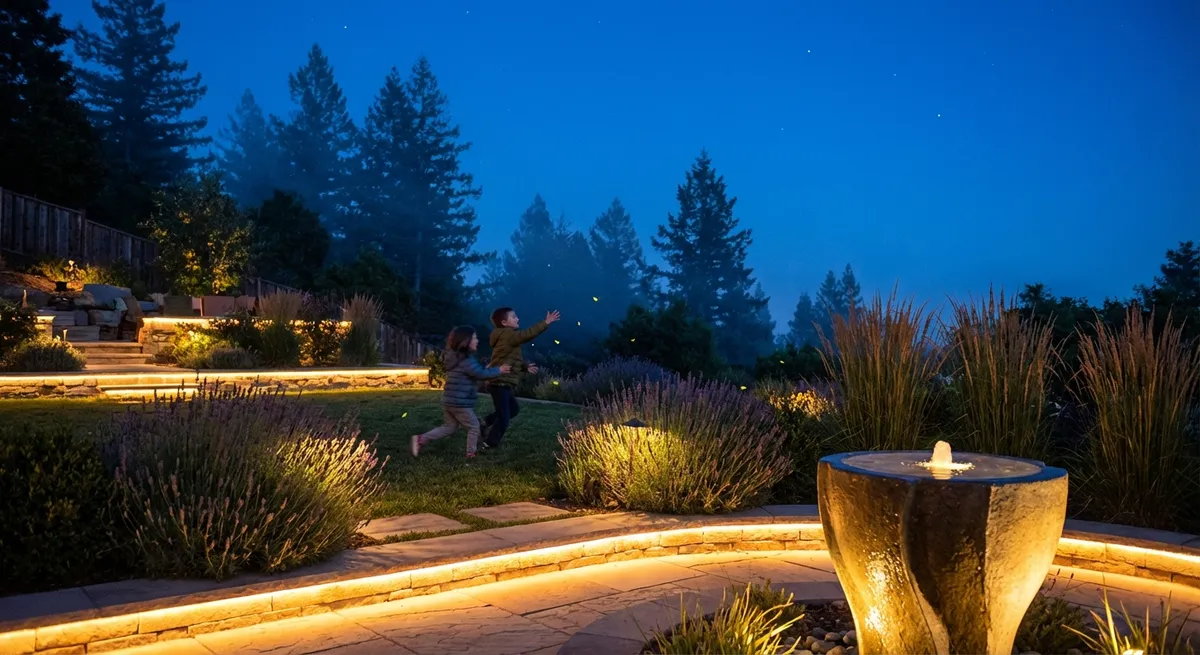
This is an invitation to shape a landscape that glows—gently, warmly, and in a way that makes you want to stay outside just a little longer. Below are five design ideas outdoor living enthusiasts will love, each one designed to help your yard feel less like “property” and more like a place you truly inhabit.
Idea 1: The Moonlit Pathway Garden
There’s a particular kind of magic in walking a softly lit path at night—one that feels both safe and a little bit cinematic. A moonlit pathway garden turns every evening stroll into a slow, deliberate ritual.
Start with a simple path—gravel, flagstone, or pavers—that curves slightly rather than running straight. Curves invite curiosity; they encourage you to see what’s just beyond. Line the edges with low-growing, pale or silvery plants: think lamb’s ear, dusty miller, white alyssum, or variegated hostas. These lighter tones catch any available light, from streetlamps to the moon itself, making your path seem to glow even before you add fixtures.
To deepen the effect, tuck in warm, low-voltage path lights that cast a soft, downward glow instead of a harsh spotlight. Avoid stadium-bright fixtures; you want a gentle shimmer, not daylight at midnight. Between the plants and the lights, you’re crafting an experience: that feeling of stepping into a secret route that belongs to your home and nowhere else.
The best part? A moonlit pathway garden doesn’t require a huge yard—just a willingness to guide people (and yourself) from one beautiful moment to the next. From front walk to side yard, even a short path can become an evening highlight.
Idea 2: The Fire & Shadow Corner
Firelight does something to us that electric light never quite can—it slows thoughts, loosens shoulders, and draws people into a quiet circle of conversation. A dedicated fire-and-shadow corner transforms an overlooked corner of your yard into an intimate retreat.
Choose a spot that feels slightly tucked away—maybe near a fence line, beneath a tree canopy, or between two shrubs. Install a simple fire feature: a built-in fire pit, a metal fire bowl, or a gas-powered tabletop flame if you have space constraints. Surround it with seating that invites lingering: deep chairs with cushions, a low bench with throw pillows, or even a curved stone seat built into the landscape.
The key here is to think not just about the fire, but about the shadows it casts. Plant ornamental grasses, airy shrubs, or open-branched trees nearby so that the flames throw gentle, moving silhouettes on leaves and trunks. The dance of light and shadow turns your corner into a living painting that changes with every breeze.
Add a few subtle lanterns or string lights at the periphery—not to overpower the fire, but to gently frame the space. This is where late-night talks, solo reflections, and quiet, phone-free moments begin. In the fire-and-shadow corner, time doesn’t exactly stop, but it stops insisting.
Idea 3: The Scented Night Border
In the daytime, your eyes lead the way in the garden. At night, your nose takes over. A scented night border transforms your landscape into an aromatic sanctuary, where the air itself feels like part of the design.
Choose a bed or border that’s close to where you actually spend your evenings: along a patio edge, near your porch steps, beside a favorite chair. Fill it with plants that release their fragrance even more strongly as the temperature drops. Night-blooming jasmine, moonflower, nicotiana (flowering tobacco), and certain varieties of phlox can turn twilight into an invisible bouquet. Herbs like lavender, thyme, and mint release scent when brushed as you walk by.
Think in layers: taller scented shrubs or vines in the back, mid-height perennials in the center, and low herbs or groundcovers at the front. This vertical variety creates a textured wall of fragrance that catches and holds cooler evening air. If you have a fence or pergola, consider training a scented climber up and over, so the aroma surrounds you from above and around.
The beauty of a scented night border is that you don’t have to see it clearly to enjoy it. On evenings when your lights are low and your eyes are tired from screens, your landscape still reaches out to welcome you—quietly, gently, through every breath you take outside.
Idea 4: The Water-Whisper Nook
Sound is one of the most underrated tools in outdoor design. A small water feature—nothing grand, just a steady trickle or quiet spill—can completely change how your yard feels, especially in the evening. A water-whisper nook is less about spectacle and more about creating a soothing soundtrack for the moments when the world feels loud.
Find a spot where you naturally want to pause: near the back door, in a side yard, or in a corner with partial shade. Install a compact fountain, a ceramic urn with a recirculating pump, or a small disappearing water feature where water flows over stones and vanishes into a hidden reservoir. Aim for a gentle sound—like distant rain or a shallow creek—rather than a roaring cascade.
Surround the feature with plants that love moisture: ferns, hostas, astilbe, or native wet-tolerant species in your region. They’ll soften the edges of the fountain and make it feel like it has always belonged there. Add a chair, a small bench, or even just a flat boulder where you can sit. This becomes your ear’s favorite spot in the garden.
In the evening, a subtle underwater or nearby accent light makes the water sparkle without overwhelming it. Paired with crickets, rustling leaves, and the murmur of water, your nook becomes a tiny refuge from the rest of the day—a place to exhale, unclench, and listen to something quieter than your thoughts.
Idea 5: The Living Light Canopy
Overhead space is often overlooked in landscaping, but it’s a powerful canvas. A living light canopy turns the space above you into a gently glowing ceiling woven from leaves, branches, and soft illumination.
Start with structure: a pergola, an arbor, a strong tree branch, or a series of posts connected by cables. Train vines like wisteria, clematis, trumpet vine, or native climbers to weave their way upward, creating dappled shade by day and a leafy halo by night. If you have mature trees, you already own part of this design—your branches are the frame.
Then, let there be light. String café lights or fairy lights loosely through the canopy, aiming for a natural, draped effect rather than rigid, straight lines. Warm-white bulbs (not cool blue) create a softer, more inviting glow. The leaves diffuse the light, casting a patterned shimmer on the surfaces below—your table, your deck, your favorite reading chair.
Underneath this living ceiling, place what matters to you: a dining table for long, candlelit meals, a swing for daydreaming, a low daybed with outdoor cushions for afternoon naps and late-night star-watching. The canopy transforms this spot into a room without walls, where the ceiling moves with the wind and the lighting changes with the seasons.
A living light canopy blurs the line between “indoors” and “outdoors.” It reminds you that comfort doesn’t have to be confined to four walls—and that some of the most memorable evenings of your life can happen under a tangle of leaves and tiny lights.
Conclusion
Landscaping is more than arranging plants; it’s arranging experiences. When you design with evening in mind—with moonlight, fire, scent, sound, and soft illumination as your tools—you stretch the usable life of your outdoor space far beyond daylight hours. A moonlit path invites wandering. A fire corner gathers your people. A scented border turns the air into a welcome. A water nook calms the mind. A living light canopy gives the night a gentle ceiling.
You don’t need to build everything at once. Start with a single idea that speaks to you, and let your landscape grow at the speed of your own life. Over time, you’ll find that your yard is no longer just something you look at from inside—it’s a place that calls you out, gently, again and again, long after the sun has gone down.
Sources
- U.S. Department of Energy – Outdoor Lighting Tips - Guidance on choosing efficient, low-glare outdoor lighting that supports ambiance and safety
- Royal Horticultural Society – Evening Gardens - Ideas for plants and designs that shine at dusk and after dark
- Missouri Botanical Garden – Fragrant Plants - Extensive list and details on fragrant species ideal for scented borders
- Colorado State University Extension – Water Features in the Landscape - Practical considerations for incorporating water elements into gardens
- University of Minnesota Extension – Vines and Climbers - Information on selecting and growing vines suitable for living canopies