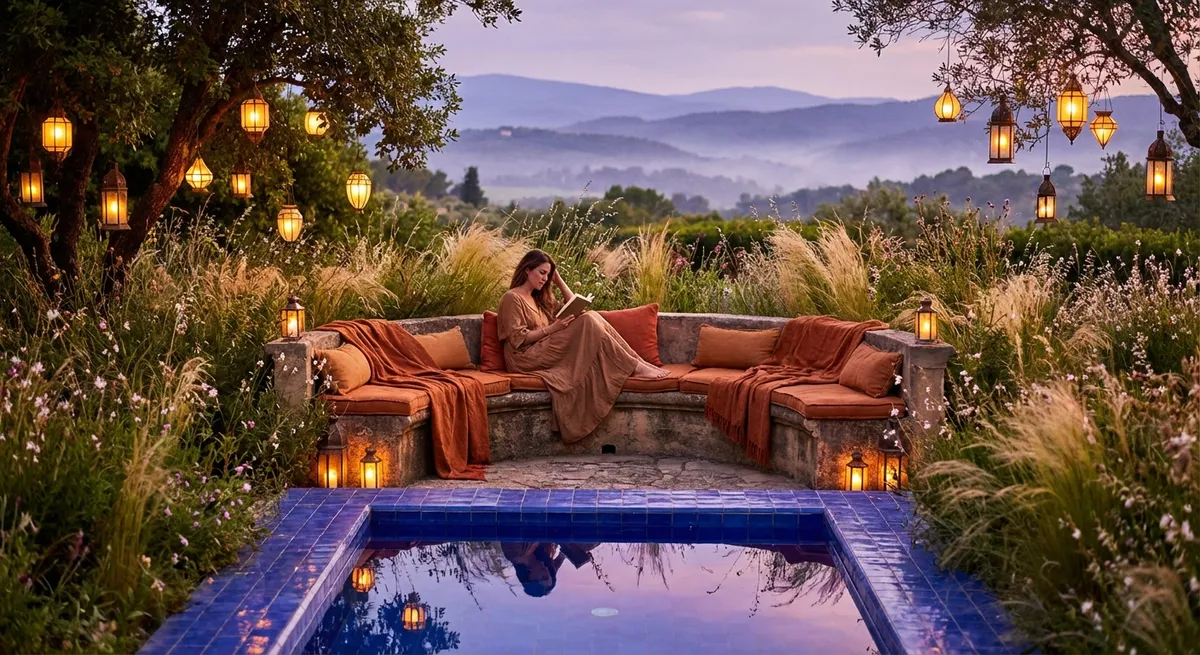
Below are five design ideas to help you create a landscape that doesn’t just look beautiful in photos, but feels like home in your bones.
1. The Soft-Edge Sanctuary: Blurring the Line Between House and Horizon
Think of your landscape as a slow, gentle exhale from your home to the rest of the world. Instead of an abrupt stop—porch, then lawn, then fence—imagine layers that soften every edge.
Start at the threshold: wide containers with grasses that sway, herbs that release scent when brushed, or small shrubs that visually “anchor” your steps. From there, let plant heights rise gradually: low groundcovers near pathways, medium perennials in the middle, and taller shrubs or small trees at the perimeter. This tiered approach wraps you in a sense of enclosure without closing you off.
Use repeated colors and textures to guide the eye: silver-leafed plants echoing one another along a bed, or the same terracotta tone appearing in both planters and pavers. The goal is flow—so that when you step outside, it feels like the house is still gently holding you, even as you wander further away from the door.
Lighting is the final brushstroke of this sanctuary. Add warm, low-level illumination along steps, under benches, or tucked into plantings so that as twilight comes, your landscape doesn’t disappear—it simply grows softer, like a room with the lights dimmed just right.
2. The Quiet Trail: Creating a Micro-Pathway for Daily Wandering
Every landscape, no matter how small, deserves a journey. A micro-pathway—just a few turns of stepping stones or a short gravel ribbon—gives your outdoor space a sense of story.
Design a path that invites a slow pace. Use natural stone, crushed gravel, or even reclaimed brick to create a narrow “trail” that curves just enough to spark curiosity. Let it disappear behind a cluster of grasses or dip slightly out of sight behind a shrub. Where does it go? Maybe to a single chair under a tree, a birdbath, or a tiny reading nook edged in potted plants.
Border your path with plants that ask to be noticed: lavender that brushes your legs, thyme that releases fragrance underfoot, or feather-light ornamental grasses that catch the wind. If space is limited, a looping path that begins and ends at the same spot can still feel like a journey, especially if the plantings shift as you move along.
This is where your daily rituals can live. A morning mug of coffee walk, a slow twilight stroll, or a barefoot wander after a long day. The quiet trail isn’t only about moving through your yard—it’s about giving your mind somewhere gentle to go.
3. The Living Canvas: Planting for Color, Mood, and Motion
Imagine your landscape as a painting that never quite finishes itself. Every bloom, leaf, and branch is a brushstroke, and the seasons are constantly editing your work.
Start with color as emotion. Soft pastels—pale pinks, blues, and creams—create a calming, dreamy feel perfect for spaces meant for reflection. Vibrant oranges, deep purples, and sunny yellows bring energy and playfulness, ideal near dining areas or gathering spots. Repeat key colors throughout the yard so your eye feels led, not scattered.
Then think in layers of time. Choose plants that unfurl through the year: bulbs in early spring, flowering perennials for summer, ornamental grasses that glow in autumn, evergreens or interesting bark for winter. This way, there’s always a reason to step outside, even on days when the air is sharp and cold.
Don’t forget motion. Plants that sway, rustle, or tremble in the breeze bring your landscape to life. Grasses, tall salvias, and plants with delicate seedheads make the air itself feel like a collaborator in your design. At dusk, these subtle movements can be almost hypnotic, transforming your yard into a living, breathing companion.
4. The Gather-Round Garden: Designing Spaces That Pull People Closer
Landscaping isn’t only about how you feel alone outside—it’s also about how easily your space says, “Come sit for a while.” A gather-round garden is less about size and more about intention: how you shape the land to bring people shoulder-to-shoulder and heart-to-heart.
Define a focal point where people naturally cluster: a low fire bowl, a circular bench under a tree, a simple café table draped in morning light. Then, use your landscape to “lean in” toward this center. Curve flower beds inward. Place taller plants behind seating to create a sense of backdrop and privacy. Add low containers near chairs to soften hard edges and keep the space feeling intimate.
Pay attention to the ground plane. A change in material—stone for the gathering area, mulch or grass around it—signals that guests have stepped into a different kind of room. This subtle cue encourages people to linger, talk longer, laugh louder.
Finally, add small delights meant to be shared: herbs that guests can pinch and smell, edible flowers in nearby pots, or a cluster of berry shrubs along the edge. When your landscape offers little discoveries to point out, it naturally fuels conversation and connection.
5. The Everyday Retreat: Layering Comfort Into the Landscape
The most powerful landscapes aren’t flawless—they’re lived in. They make it incredibly easy to step outside without a second thought. The Everyday Retreat is where design meets daily life: comfortable, forgiving, and irresistibly inviting.
Start with comfort zones. Place seating where you already find yourself looking: that corner that always gets the last light of the day, the spot with the best glimpse of the sky, the place where you can hear water or birdsong. Then build mini-landscapes around these zones: low plantings at your feet, taller greenery at your back, and a framed view in front.
Incorporate texture you want to reach out and touch: velvety lamb’s ear, soft moss between pavers, sun-warmed wood, smooth stone. Mix shade and sun so your landscape feels welcoming in different seasons and moods. A pergola draped with vines, a small shade tree, or even a tall shrub in a pot can transform harsh rays into dappled comfort.
Most importantly, design for ease. Choose plants suited to your climate and light so maintenance feels like care, not a chore. Add simple irrigation or self-watering containers. Use durable materials underfoot that can handle bare feet, pets, and bad weather without fuss.
When your landscape is easy to love on an ordinary Tuesday—when you can step outside with unwashed hair, a chipped mug, and ten spare minutes—that’s when it truly becomes a refuge.
Conclusion
Landscaping is much more than curb appeal or “finishing” your yard. It’s the slow, thoughtful act of deciding how you want your life to feel when you’re outside your walls. Whether you create a soft-edge sanctuary, a quiet trail, a living canvas, a gather-round garden, or an everyday retreat, you’re not just arranging plants and paths—you’re arranging moments.
Let your landscape evolve with you. Add a new corner of comfort this season, adjust a pathway next year, experiment with a color you’ve never tried before. Over time, your outdoor space will begin to feel less like a project and more like a companion—one that holds you, surprises you, and invites you back, again and again.
Sources
- [EPA – Green Landscaping: Greenacres](https://www.epa.gov/greenacres) - Guidance on sustainable landscaping practices, native plants, and eco-friendly design ideas
- [U.S. Department of Energy – Landscaping for Energy-Efficient Homes](https://www.energy.gov/energysaver/landscaping-energy-efficient-homes) - Explains how thoughtful planting and layout can improve comfort and microclimate around your home
- [Cornell University – Garden-Based Learning Resources](https://gardening.cals.cornell.edu) - Research-backed information on plant selection, garden design, and seasonal interest
- [Royal Horticultural Society – Garden Design](https://www.rhs.org.uk/garden-design) - Practical and inspirational guidance on layout, color, planting structure, and creating atmosphere outdoors
- [Lady Bird Johnson Wildflower Center – Native Plant Information Network](https://www.wildflower.org/plants) - Extensive database for selecting climate-appropriate plants that support biodiversity and low-maintenance landscapes