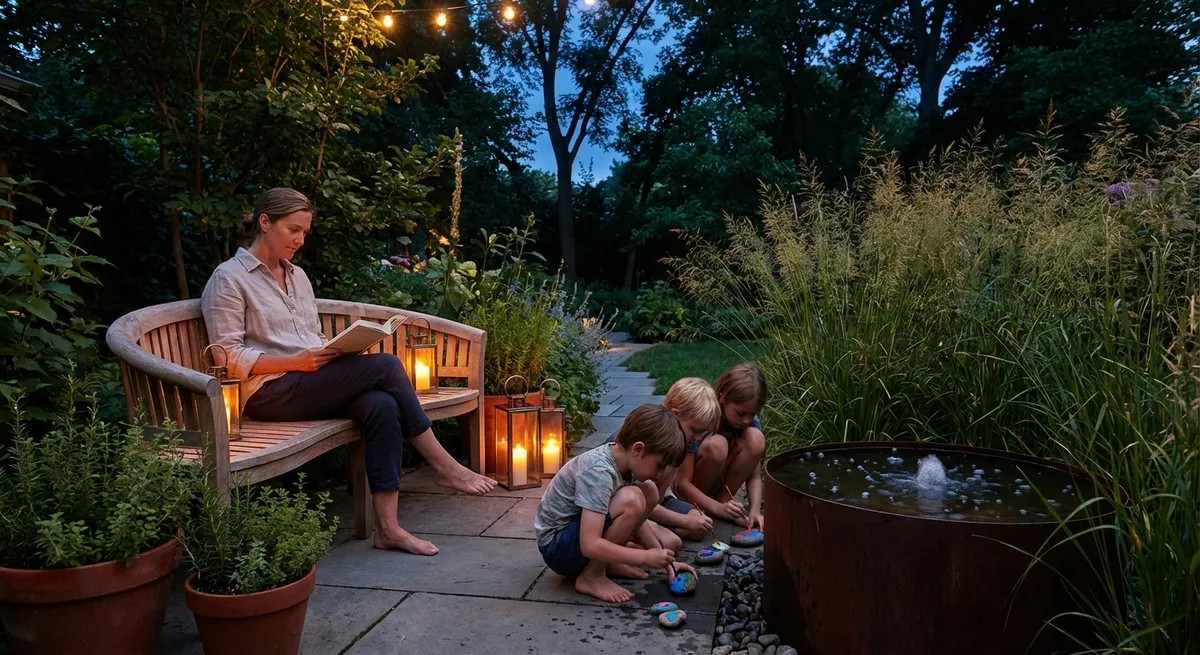
Below are five landscape design ideas that outdoor living lovers can use as raw material for their own personal oasis—less a checklist, more a sketchbook for your imagination.
1. The Wanderer’s Path: Designing a Yard You Don’t Walk Through, But Walk With
A yard with no path often becomes a place you only glance at through a window. Add a path, and suddenly you’ve given your landscape a storyline. The magic isn’t in expensive materials; it’s in the way the path invites you to slow down, detour, and notice.
Imagine a narrow gravel walk that begins at your back steps and refuses to go straight. It curves around a stand of ornamental grasses, dips between two raised beds of herbs, then widens into a tiny pause-point: a flat stone just big enough for two chairs and a lantern. The journey is short, but the feeling is of having “gone somewhere.”
Use simple materials—crushed stone, stepping stones set in clover, brick reclaimed from an old patio—but let the path shift in width and texture as it moves. Plant low, fragrant groundcovers or herbs like thyme, chamomile, or creeping oregano along the edges so that each footstep releases a whisper of scent. Tuck in solar path lights like small, thoughtful punctuation marks, guiding you safely in the dark without flattening the night.
A good path doesn’t just connect point A to point B; it creates reasons to stop between them. A birdbath, a single sculptural shrub, a bench facing the sunset—these become the supporting characters in your yard’s unfolding story.
2. The Green Room: Layered Planting That Feels Like Stepping Into a Scene
Outdoor living feels most magical when the yard doesn’t just surround you but holds you. That sensation comes from planting in layers—like building a stage set with a backdrop, mid-ground actors, and low, textured details underfoot.
Start with your “walls” and “ceiling”: trees, tall shrubs, and climbers. A small ornamental tree near a seating area can act like a living chandelier, dappling light over chairs and cushions. Along fences or property lines, mix evergreen structure (like boxwood, holly, or arborvitae) with flowering shrubs that shift the scene as the year turns—hydrangeas, lilacs, mock orange, or native flowering species for pollinators.
In front of that backdrop, your mid-layer is where the eye lingers. Think billowing perennials and grasses: coneflower, black-eyed Susan, salvia, switchgrass, and little bluestem that glows copper in late fall light. Vary heights and bloom times so that the view never goes completely quiet. Let a few plants lean casually over edges—nothing too stiff, everything a little bit like a friendly crowd.
Finally, sprinkle in groundcovers and low textures to soften hard edges and open soil. Creeping thyme along edges, sedums tumbling between rocks, woodland phlox beneath a tree. When you sit outdoors, you’ll feel tucked in, framed by life on all sides rather than left on an exposed island of patio stone.
Layered planting doesn’t just make a yard look lush; it shifts the emotional tone. The world feels closer, gentler, and more alive—like you’ve stepped into a scene that was waiting for you to arrive.
3. The Quiet Fire: Building a Glow-Centered Gathering Nook
Every outdoor-loving person knows there’s a particular magic to sitting outside after dark, when the day lets go and conversation loosens. Landscaping can turn a simple fire feature—whether full fire pit, smokeless unit, or tabletop flame—into a destination you seek out even on weeknights.
Instead of placing a fire pit randomly in the open, imagine carving out a small “bowl” in the landscape. Low walls of stone or raised planters define the edges, shrubs or tall grasses catch and reflect the light, and overhead string lights softly mark the boundary between your circle and the night sky. Underfoot, use decomposed granite, pea gravel, or pavers to signal that this is a designated gathering zone.
Arrange seating in a semi-circle or loose oval so everyone sees both the flames and each other. Mix materials: a built-in bench softened with cushions, a couple of weathered Adirondack chairs, maybe a low stump repurposed as a side table. Plant heat-tolerant, textural companions just outside the splash zone of sparks—ornamental grasses, rosemary, lavender, or yarrow that will glow at the edges when the fire is lit.
The surrounding landscape should feel like a soft amphitheater. You might plant a ring of night-scented flowers—nicotiana, evening primrose, or moonflower—so that fragrance rises as the temperature drops. Add one dramatic focal plant, like a Japanese maple or a multi-stemmed birch, up-lit from below. It becomes your living sculpture, watching quietly as gatherings stretch long past bedtime.
This is landscaping in service to presence: designing not just a beautiful space, but a ritual of lighting the fire and letting the day’s noise burn off into the dark.
4. Edible Edges: Weaving Food Into the Landscape, Not Just the Garden Bed
For outdoor living enthusiasts, the most joyful yards are often the ones you can snack your way through. But edible plants don’t have to live in rigid vegetable rows tucked out of sight. When you blur the line between ornamental and edible, the whole yard becomes part kitchen, part art.
Begin by slipping edibles into your foundation and border plantings. Blueberries make stunning, compact shrubs with fiery fall color. Rosemary and lavender pull double duty as aromatic edging and culinary heroes. Kale and Swiss chard come in jewel-toned varieties that look as decorative as anything in the perennial aisle.
Instead of a solid hedge, consider a mixed “edible fence” with espaliered apples or pears along the back, currants and gooseberries in the mid-layer, and strawberries or thyme at ground level. On a sunny fence, train grapes or kiwifruit on trellises—green curtains that happen to grow snacks.
Near your main outdoor seating area, plant a “gathering garden” of herbs and easy-to-grab greens in large containers: basil, mint (contained!), thyme, lemon balm, cherry tomatoes. When friends come over, you can step away from the table and return with a handful of garnishes right from the landscape, folding your surroundings directly into the meal.
Edible landscaping makes your yard feel more interactive. You don’t just look at it—you taste it, touch it, wander through it with a colander or a basket. The land stops being decorative scenery and becomes a quiet collaborator in how you eat and live.
5. Soundscapes and Secret Corners: Designing for the Senses You Forgot to Plan For
Beautiful yards are often built for the eye alone, but the most transportive outdoor spaces speak to all your senses, including the subtle ones: the way air moves, how sound travels, where your body instinctively relaxes. Landscaping is your chance to script that sensory experience.
Start by listening. Where does traffic noise encroach? Where is it already quiet? Planting dense, layered greenery—hedges of native shrubs, clusters of evergreens, tall ornamental grasses—can soften unwanted sound and create a sense of acoustic privacy. Add a small water feature, even a simple recirculating fountain, to introduce gentle, consistent white noise that helps your mind let go.
Then curate your micro-havens. A “secret corner” doesn’t need a lot of space; it needs just enough definition to feel like a place apart. Maybe it’s a single chair tucked behind a tall hydrangea, or a mini-deck nestled between the house wall and a screen of bamboo. Underfoot, a small rug or wood platform changes the feel of the ground. Overhead, a pergola beam, a branch, or even a string of lights implies a ceiling.
Textural variety matters here: smooth stone under hand, rough bark at your back, cool moss near your feet. Choose plants that invite touch—lamb’s ear, ferns, soft grasses—and ones that reward close inspection: hellebores, columbine, sedges with intricate seedheads. When the wind moves through them, the space comes alive with rustles and whispers instead of silence.
In these corners, you’re not performing for anyone. You’re reading, stretching, staring at the sky, or doing nothing at all. The landscaping around you becomes an unspoken permission slip: this is a place where slowing down isn’t indulgent; it’s exactly what the space was built to hold.
Conclusion
Landscaping, at its best, is less about impressing the neighborhood and more about deepening your relationship with the patch of earth that holds your home. Paths that invite you to wander, layers of plants that embrace rather than merely decorate, glowing firelit nooks, edible edges you can harvest from, and sensory-rich hideaways—each is a different way of saying to your outdoor space, “I’m listening. Let’s build something together.”
When you treat your yard as a living extension of how you want to feel—curious, grounded, connected—design decisions stop being overwhelming. They become intuitive, almost conversational. Over time, you’ll look outside and realize that your landscape is no longer just a backdrop.
It has become a co-author in the story of your life at home.
Sources
- University of Minnesota Extension – Landscaping with Native Plants – Guidance on using layered plantings and natives for structure, habitat, and beauty
- U.S. Department of Energy – Landscape Design for Energy-Efficient Homes – Insights on using trees, shrubs, and placement to improve comfort and microclimate outdoors
- Royal Horticultural Society – Edible Landscaping – Practical ideas for weaving fruits, vegetables, and herbs into ornamental plantings
- National Wildlife Federation – Creating a Wildlife Habitat Garden – Information on designing sensory-rich, habitat-friendly landscapes with water, shelter, and layered plants
- Cornell University – Garden Design Essentials – Fundamentals of garden layout, paths, focal points, and planting design that support many of the concepts above