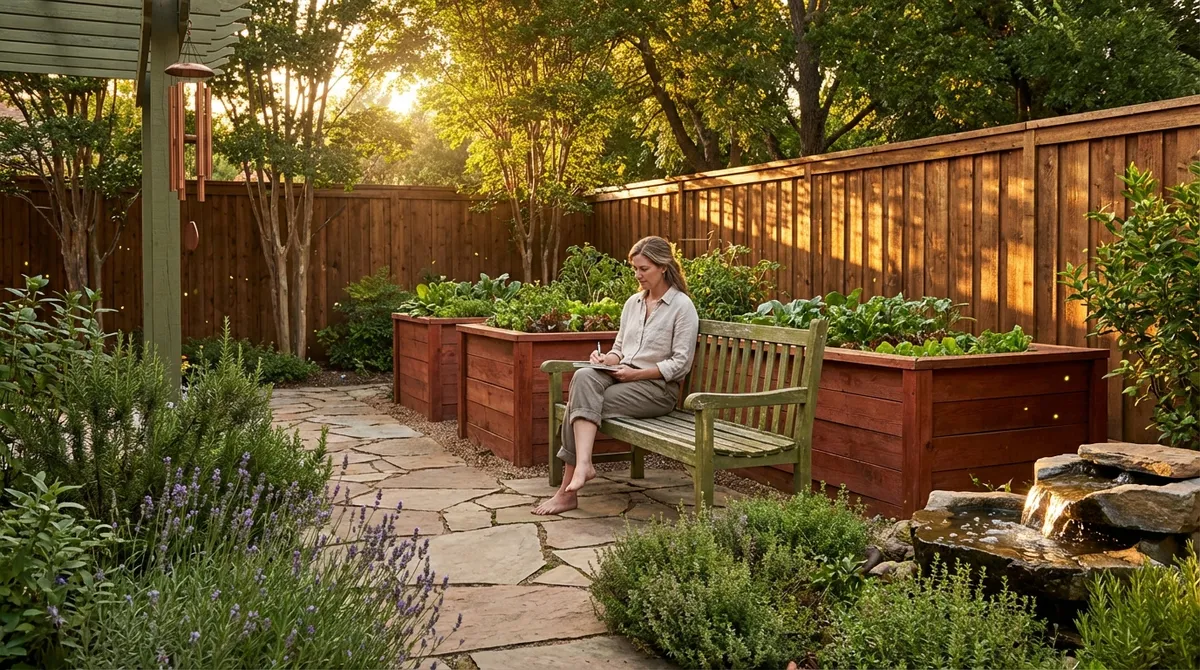
This is landscaping as conversation, not decoration. It’s where every path, plant, and pool of light responds to the life you’re trying to build—slow mornings, curious kids, late‑night talks, solo thinking time, and everything in between.
Below are five design ideas outdoor living lovers can use to turn any yard—big or small—into a landscape that feels like it’s listening, and gently answering, “Stay a little longer.”
1. The Meandering Spine: A Path That Gathers Moments As It Goes
Straight paths rush you. Meandering paths invite you to notice.
Design your yard around a single “spine” path that wanders, pauses, and curves, as if it’s learning your pace. Instead of one direct walkway to a back door or patio, imagine a soft, looping route that collects little experiences along the way—an herb pocket here, a shaded bench there, a cluster of blooms where the light is most generous.
Use materials that slow the eye and the foot: decomposed granite that crunches underfoot, irregular flagstone set in green groundcovers, or wood slices softened by moss. Let plants spill over the edges a bit—lavender brushing against your legs, thyme releasing its scent when stepped on, low ornamental grasses bowing into the path.
The path doesn’t just move you from A to B; it becomes a gentle story line. A turn reveals a small water basin. Another curve frames your favorite tree like a picture. The final bend opens to your primary sitting area, so that by the time you arrive, you’re already more present, more awake to the details of your own life.
2. The Layered Horizon: Planting for Depth, Drama, and Daily Change
A flat planting bed feels like a painting. A layered one feels like a world you can walk into.
Imagine your yard as a series of horizons, each one stepping back a bit further: tall anchoring trees or shrubs at the rear, mid‑height flowering shrubs and grasses in front of them, and low groundcovers near the edges. This creates a sense of depth that makes even a small yard feel expansive, almost cinematic.
Mix shapes and textures so your eye never gets bored. Pair upright columnar trees with loose, billowing grasses. Tuck spiky yucca beside soft lamb’s ear. Let glossy evergreen leaves be the backdrop for delicate fern fronds or airy flower heads swaying on slender stems. Think in layers of time as well as height: early spring bulbs, high summer blooms, autumn foliage, winter seed heads left for birds.
Choose a restrained palette—three to five core colors—and let texture and form do the rest. Your landscape becomes a changing horizon line: misty with morning dew, alive with backlit seed heads at sunset, rich with shadow and silhouette in the evenings. It doesn’t just look good in one season or one photo; it reveals something new every day you actually live there.
3. The Quiet Anchor: One Focal Point That Holds the Whole Space
Every landscape needs something that silently says, “This is the center of your world out here.”
Instead of scattering lots of features—a birdbath here, a sculpture there—choose one powerful anchor. It might be a sculptural tree with a twisted trunk, a simple boulder half‑buried as if it’s always been there, a large urn overflowing with greenery, or a minimalist reflecting basin that mirrors the sky.
Place this anchor where your eye naturally rests from key vantage points: framed in the dining room window, centered at the end of a path, or aligned with the main seating area. Then build the rest of your design around it like a quiet orbit—plants pointing toward it, paths curving gently in its direction, lighting drawing it out after dark.
An anchor isn’t about drama; it’s about calm. On hectic days, it’s the one constant shape you can look at and exhale. On gathering nights, it gives your outdoor space a sense of cohesion—a visual “north star” that makes the yard feel intentional, even if everything else is wild and lush.
4. The Conversation Nest: Planting Enclosures Around Where You Sit
Outdoor living is less about furniture and more about how it feels to be held by the space.
Start by deciding where you actually want to linger: the warmest winter corner, the breeziest summer spot, the place with the best view of the sky. Then plant around that area like you’re building a soft nest—not fencing you in, but gently implying, “Right here is for staying.”
Use tall grasses or multi‑stem shrubs at the back of your seating to create a sense of protection without blocking air and light. Layer in mid‑height perennials or flowering shrubs to the side, so that when you sit, you’re shoulder‑to‑shoulder with plants instead of staring at a blank fence. Add low groundcovers, creeping thyme between pavers, or low mounds of flowers at your feet to pull the living world right into your personal space.
If you love long conversations, consider acoustics too. Plants can absorb and soften sound, making a small yard feel more private. Dense hedging near property lines or a trellis with climbing vines can muffle street noise. Even a modest fountain or bubbler can create a gentle sound curtain, turning your conversation nest into a place where words feel safely held.
Over time, that planted enclosure becomes part of your social life’s memory: the rustle of leaves behind laughter, the scent of night‑blooming flowers pouring into stories you’ll tell for years.
5. The Seasonal Ritual Corners: Small Spaces for Big Feelings
Not every meaningful moment needs a big stage. Often, it’s the tiny outdoor rituals that stitch your days together: a place to drink tea at sunrise, to read in the afternoon, to watch the first star at night.
Design for these rituals with small, specific landscape gestures—micro‑spaces that feel like they were created for one clear purpose.
Create a dawn corner facing east with pale‑colored flowers and silvery foliage that glows in low light—think dusty miller, white roses, soft grasses, and a single comfortable chair. For a midday pause, carve out a dappled‑shade reading nook with a tree, pergola, or shade sail overhead, and plant cool greens and deep blues around it for a sense of calm.
For evenings, frame a view of the western sky or a favorite tree with simple, low lighting and plants that come alive in low light—white blooms, reflective foliage, or plants with strong silhouettes. Let a vine climb a nearby structure so that over the years, your evening ritual is marked by its slow, steady growth.
Each ritual corner doesn’t need to be grand. A single chair, a small side table, a few thoughtfully chosen plants, and intentional orientation to light can be enough. The power is in repetition: when you keep coming back to the same planted spot as the seasons turn, your landscape feels less like a project and more like a companion.
Conclusion
A meaningful landscape isn’t just “well‑designed.” It’s responsive. It learns you.
Paths that remember you like to wander. Horizons that shift with your moods and the weather. An anchor that steadies you, a nest that holds your people, corners that honor the little rituals that make your days feel like yours.
When you shape outdoor spaces this way, you’re not merely decorating dirt. You’re building a living, breathing stage where your life can unfold more slowly, more beautifully, more intentionally. And one morning, without quite realizing when it happened, you’ll step outside, look around, and feel it:
Your yard isn’t just outside your home anymore. It has become a part of who you are becoming.
Sources
- [University of Minnesota Extension – Landscape Design Basics](https://extension.umn.edu/landscape-design/landscape-design) – Covers core principles of layering plants, focal points, and creating depth in residential landscapes
- [Royal Horticultural Society – Designing with Plants](https://www.rhs.org.uk/garden-design/designing-with-plants) – Practical guidance on texture, form, and seasonal interest in planting design
- [American Society of Landscape Architects (ASLA) – Residential Design](https://www.asla.org/residentialinfo.aspx) – Insights into creating functional, people‑centered outdoor spaces, paths, and gathering areas
- [Environmental Protection Agency – Green Landscaping](https://www.epa.gov/greeningepa/green-landscaping) – Information on sustainable plant choices and environmentally responsible yard design
- [Cornell University – Creating Outdoor Rooms](https://ecommons.cornell.edu/items/5a4cc7c4-9a70-4d5d-8564-afa8cd8787f9) – Explores the concept of “rooms” and enclosure in outdoor living areas