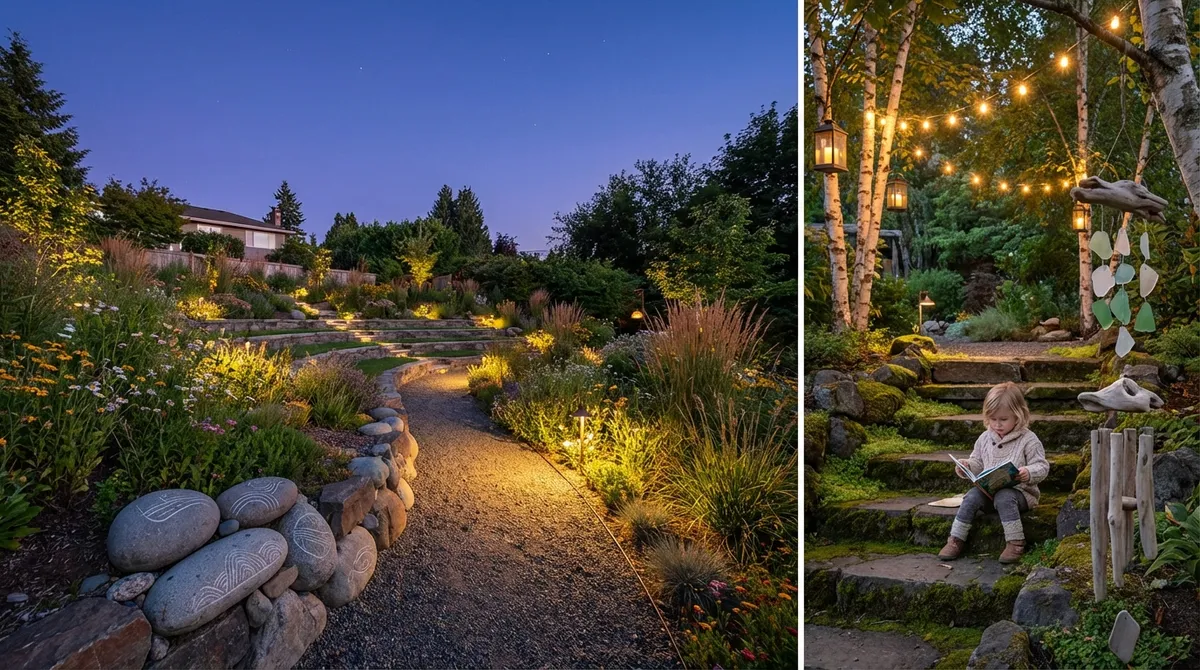
This is your invitation to shape a landscape that doesn’t just sit there—it speaks, hums, glows, and grows right alongside you.
Begin With a Mood, Not a Map
Before you sketch a single line or buy a single plant, pause and ask: What do I want to feel out here? Rested? Playful? Adventurous? Cocooned? Energized?
When you start with emotion instead of measurements, your decisions become more intuitive and personal. A “quiet morning retreat” might call for soft groundcovers, filtered light, and a single, perfectly placed bench. A “social heartbeat” yard might lean toward open lawn pockets, layered seating, and plants that invite movement and conversation.
Walk your space at different times of day. Notice where the light lingers, where shadows pool, where the wind tends to move. Let these observations guide your layout more than grid paper. Think in scenes: a reading corner here, a barefoot-friendly stretch there, a dramatic view framed by a tree or trellis in the distance. You’re not just planning a yard; you’re choreographing moments you’d like to live in, over and over again.
Idea 1: The Layered Sanctuary Garden
Imagine stepping outside and feeling the world soften, layer by layer. A sanctuary garden is all about creating a gentle sense of enclosure without losing the sky. Think of it as a series of whispers instead of a single bold statement.
Start with tall, structural elements that sketch the outline of your sanctuary: ornamental trees, trellises, or tall grasses that sway in the wind. Beneath them, add mid-height shrubs and perennials that blur edges and soften boundaries. Near your main seating or walking areas, tuck in low groundcovers and delicate plants—thyme between stepping stones, moss around rocks, creeping Jenny spilling over the edges of planters.
Choose plants with staggered bloom times and varied foliage so the sanctuary evolves through the seasons: spring blossoms, summer fullness, autumn amber, winter silhouettes. Add a single focal point—a birdbath, a sculptural pot, a lantern on a pedestal—that quietly centers the space. The result is a garden that doesn’t shout for attention but makes you breathe differently the moment you step into it.
Idea 2: The Wandering Water Thread
Water has a way of pulling your thoughts into the present. Even the softest trickle can turn a backyard into a place you tune in to, not just pass through. Instead of a large pond or dramatic fountain, consider a “water thread”—a slim, wandering feature that guides both the eye and the feet.
This might be a narrow rill (a shallow, lined channel) that slips alongside a path, a small recirculating stream that curves between boulders, or a tiered collection of bowls where water overflows gently from one to the next. Keep it scaled to your space; the goal is intimacy, not spectacle.
Plant along this water thread with intention: ferns that lean in, irises or rushes that echo its line, low plants that invite you to pause and touch. Place a bench or flat stone at a natural “pause point” where the sound is clearest. At night, a few warm, low lights grazing the water’s surface create a quiet drama you can enjoy from indoors. The water becomes a living line that ties your landscape together, giving your yard its own soft, steady heartbeat.
Idea 3: The Firelight Conversation Ring
Some landscapes are designed for looking at. Others are built for staying in. A firelight conversation ring turns your yard into the place people linger long after the last story is told.
Instead of centering just on a grill or a practical table, imagine a circular or semi-circular arrangement of seats around a fire feature—this could be a built-in fire pit, a sleek gas bowl, or a rustic chiminea. The shape matters: a ring suggests equality and connection, making every spot feel like the best seat.
Surround this space with plants that glow in firelight: silvery foliage like lamb’s ear, pale ornamental grasses, white-blooming flowers that catch the embers’ flicker. Use low, textural groundcovers or decomposed granite so the area feels casual yet intentional. Place taller shrubs or small trees further back, framing the circle like a natural amphitheater.
Think about the journey to the fire: a gently lit path, maybe with stepping stones that feel solid underfoot. When the flames are out, this ring still functions as a gathering place—a sun-warmed reading nook by day, a stargazing circle on crisp evenings. The landscape isn’t just beautiful here; it’s tuned to conversation, laughter, and the kind of quiet shared moments you remember years later.
Idea 4: The Edible Edges and Hidden Harvests
There’s something quietly thrilling about stepping into your yard and realizing half the beauty around you is delicious. Edible landscaping blurs the line between garden and pantry, turning everyday pathways and borders into hidden harvests.
Instead of isolating vegetables into a separate square, weave edibles into your ornamental beds. Blueberries become shrubs with spring flowers, summer fruit, and fiery fall color. Rosemary and lavender form fragrant low hedges. Kale and chard provide sculptural leaves that look as striking as any ornamental. Strawberries spill from pots or creep along the front of sunny borders like tiny treasures.
Tuck dwarf fruit trees into corners where they can frame views—espaliered apples along a fence, a fig tree near a patio, citrus in containers you can move to shelter when needed. Add herbs where you naturally walk: along the path from door to grill, near the outdoor dining table, beside your favorite chair. The act of wandering your yard becomes a sensory adventure—snipping basil on the way to the kitchen, plucking a cherry tomato as you water, catching the scent of thyme underfoot.
The magic lies in the overlap: your landscape looks lush and deliberate, and only you (and those you share it with) know just how many meals it’s quietly growing behind the scenes.
Idea 5: The Seasonal Drama Pathway
Every yard deserves one moment of theater—a place where the seasons put on a show and you get a front-row seat. A seasonal drama pathway is less about getting you from point A to B and more about transforming the simple act of walking into a tiny ritual.
Start by choosing a route that naturally wants to exist: from back door to shed, from gate to seating area, from driveway to front steps. Instead of a straight shot, allow for a few graceful curves or subtle shifts in width. Line this path with plants intentionally chosen for their seasonal drama—spring bulbs that erupt in waves, summer blossoms that hum with pollinators, autumn foliage that flames into gold or crimson, winter stems and seed heads that hold structure against snow or frost.
Use repeated elements to create rhythm: the same grass every few feet, the same flower echoing down the line. Add a couple of “moments” along the way: a change in paving texture, a small arch or arbor, a cluster of lanterns, a low stone wall that invites you to sit. The pathway becomes less of a commute and more of a ceremony—your daily way of checking in with the year, noticing small shifts, letting the landscape remind you that everything is in motion, including you.
Conclusion
Your landscape doesn’t need to be grand to be transformative. It just needs to be intentional—shaped by the feelings you crave and the stories you want to live in. A layered sanctuary for your thoughts. A quiet line of water to follow. A ring of firelight where friendships deepen. Harvests disguised as beauty. A path that turns every crossing into a seasonal revelation.
When you design a yard that listens—to light, to wind, to the people who move through it—you end up with more than curb appeal. You create a living backdrop that steadies you, surprises you, and keeps inviting you back outside, again and again.
Your outdoor space is already trying to say something. With a little vision and a few bold choices, you can help it find its voice—and maybe, in the process, hear a bit more clearly what your own is saying too.
Sources
- University of Minnesota Extension – Landscaping with Native Plants - Guidance on plant selection, layering, and ecological benefits for home landscapes
- Royal Horticultural Society – Water in the Garden - Design ideas and practical tips for incorporating water features into garden spaces
- U.S. Forest Service – Firewise Landscaping - Safety considerations for designing around fire pits and outdoor fire features
- Cornell University – Edible Landscaping - Strategies for integrating fruits, herbs, and vegetables into ornamental gardens
- Royal Horticultural Society – Designing with Seasonal Interest - Insight on planning planting schemes for year-round drama and changing garden scenes