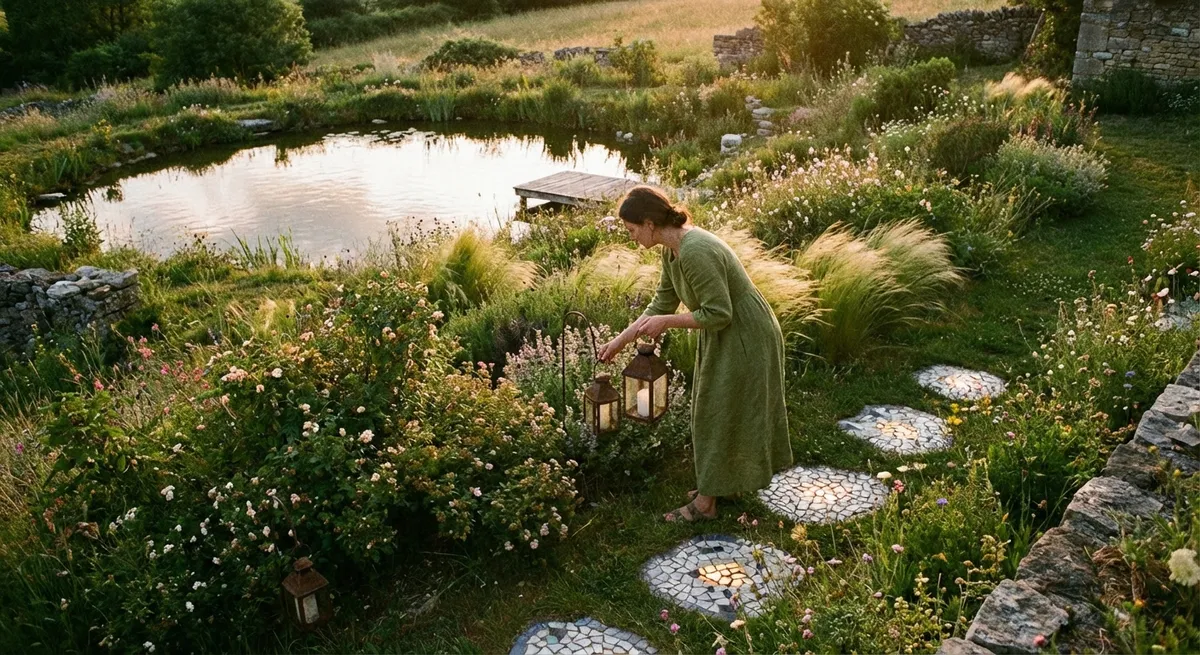
Below are five design ideas that invite movement, season, and rhythm into your landscape, turning your outdoor space into a living artwork you get to walk through.
Idea 1: The Sun-Chasing Garden
Imagine a landscape that feels slightly different every hour—not because you moved the furniture, but because the light did. A sun-chasing garden is designed with the path of the sun in mind, so different corners wake up and wind down throughout the day.
Start by watching how light travels across your yard for a few days: where does morning first touch the ground? Which area glows just before sunset? Plant low, silvery foliage like lamb’s ear or artemisia where sunrise hits—they’ll catch the early light and shimmer. Reserve bold, saturated blooms like coneflowers, black-eyed Susans, or salvias for late-afternoon zones, where backlighting turns petals into stained glass.
Layer height intentionally: taller ornamental grasses can cast changing shadow patterns over a seating area, while small trees like serviceberry or Japanese maple can filter harsh midday sun into a soft, dappled canopy. Position a favorite chair where you know golden hour will arrive—so the day naturally guides you there.
The magic of a sun-chasing garden lies in anticipation. You don’t control the show; you simply set the stage, and every day the light rewrites the script.
Idea 2: The Drift Path—Landscaping That Gently Guides You
Instead of a straight, utilitarian path from door to gate, imagine a route that feels like a gentle suggestion—a drift rather than a line. The drift path is designed to nudge you into slowing down, noticing small details, and taking the slightly longer way just because it feels right.
Use soft curves rather than sharp angles, letting the path swell wider near special features: a favorite shrub, a birdbath, a sculptural rock. Ground surfaces can mix materials—flagstone stepping stones set in gravel, crushed shell paired with brick edging, or decomposed granite bordered by low thyme. Each texture change is a quiet invitation to pay attention to your feet, your pace, your surroundings.
Flank the path with plants that brush the edge but don’t overwhelm it. Think low mounds of lavender, catmint, or dwarf mondo grass; they create a subtle sense of enclosure while leaving sightlines open. Tuck in scent along “pause points”—a rosemary bush near a bench, sweet alyssum by a gate, a climbing rose at a corner—so your nose gets to discover as much as your eyes.
The drift path transforms simple movement from point A to point B into a ritual: you step outside and, almost without thinking, wander just a bit further than you planned.
Idea 3: Layered Seasons That Never Really End
A truly captivating landscape doesn’t peak for three weeks in June and then fade—it keeps whispering new things at every turn of the calendar. Layered seasonal design is about orchestrating a rotating cast of plants so there’s always something beginning, something flourishing, and something gracefully fading.
Start with structure: evergreens, ornamental grasses, and woody shrubs that hold their form in winter and anchor the garden in every season. Then choreograph your floral “waves.” Early in the year, hellebores, crocuses, and daffodils announce the thaw. In late spring and summer, perennials like bee balm, daylilies, and yarrow take over. Autumn can be a crescendo of asters, sedums, and grasses turning bronze and copper, followed by winter interest from seed heads, red-twig dogwood, and berries for birds.
Think in overlapping layers instead of isolated moments. Pair spring bulbs under summer-blooming shrubs so the same spot feels different in April and July. Plant fall-color trees (like sweetgum or sugar maple) near winter-interest evergreens to create a handoff from fire-toned foliage to calm, dark green silhouettes.
With layered seasons, your yard becomes a quiet calendar. Instead of lamenting what’s gone, you’re always watching for what’s secretly getting ready to appear.
Idea 4: The Ground-Level Retreat—Lushness at Your Feet
Many landscapes focus on eye-level plants and tall trees, but some of the most intimate, calming experiences live close to the ground. A ground-level retreat turns the floor of your outdoor space into a soft, textural tapestry that makes every step feel intentional.
Consider trading sections of traditional turf for a mosaic of low-growing groundcovers. Creeping thyme, Irish moss, sedums, and clover can weave between stepping stones or form living carpets beneath small trees. Their varied textures—cushiony, feathery, glossy—invite you to walk barefoot, sit on the edge of a stone, or even lie down and watch clouds drift by.
Create small sunken or low-sitting zones: a recessed gravel “conversation pit” surrounded by mounded plantings, or a hammock slung just above a sea of green. Use boulders, log rounds, or low walls as informal perches at the boundaries between paths and planting beds, so there’s always a spot to tuck in and feel enveloped by foliage.
By giving attention to what’s beneath your knees, you create a sense of refuge that’s especially powerful after a day spent staring at screens. You’re invited to slow down so much that even the smallest leaf seems like a discovery.
Idea 5: Soundscapes and Stillness—Designing What You Hear
Landscaping isn’t just a visual art; it’s also about composing the sounds (and silences) of your outdoor space. When you shape what you hear, you change how relaxed you feel—and how long you want to stay outside.
Start with plants that move. Tall, fine grasses like feather reed grass or switchgrass catch the wind and turn breezes into a gentle rustle. Trees with loose, fluttering leaves—aspens, birches, some oaks—add a delicate shiver of sound overhead. Shrubs that attract birds bring layers of chatter, trills, and wingbeats; a single berry-laden bush can become a lively gathering place.
If you’re near traffic or urban noise, consider a softly bubbling fountain, rill, or small pond. Water doesn’t need to be grand to make a difference; even a modest, recirculating basin can blur harsh sounds into a more soothing backdrop. Position it near seating so your conversations take place in a cocoon of gentle water notes.
Equally important is the design of quiet. Use hedges, fences with climbing vines, or dense planting strips to absorb or deflect noise, creating a small pocket where you can hear the subtler sounds: insects humming, wind in the branches, your own breath. When sound is thoughtfully shaped, your landscape becomes a place where your nervous system can finally exhale.
Conclusion
Landscaping, at its best, is less about perfection and more about participation. You’re not just “finishing” your yard—you’re starting a long, changing conversation with light, weather, seasons, and life itself. When you design for movement, layers, textures, and sound, your outdoor space becomes something you don’t just look at, but live inside.
Whether you begin with a single curved path, a cluster of seasonal bloomers, or a tiny fountain by your favorite chair, each choice is a brushstroke in a living painting. Step outside, notice what your space is already trying to become, and let your next design move be an answer to that quiet invitation.
Sources
- [American Society of Landscape Architects (ASLA) – Residential Design Trends](https://www.asla.org/ResidentialInfo.aspx) - Insights into current residential landscape priorities and outdoor living patterns
- [University of Minnesota Extension – Sustainable Home Landscaping](https://extension.umn.edu/sustainable-home-landscapes) - Practical guidance on plant selection, seasonal interest, and site planning
- [Royal Horticultural Society – Creating a Garden for Year-Round Interest](https://www.rhs.org.uk/garden-inspiration/garden-design/year-round-interest) - Strategies for layering plants to keep a garden engaging in every season
- [Environmental Protection Agency (EPA) – Soak Up the Rain: Landscaping](https://www.epa.gov/soakuptherain/soak-rain-landscaping) - Information on permeable surfaces, water features, and environmentally mindful design
- [Cornell University – Gardening Resources](https://gardening.cornell.edu/) - Research-based advice on plant selection, groundcovers, and garden planning techniques