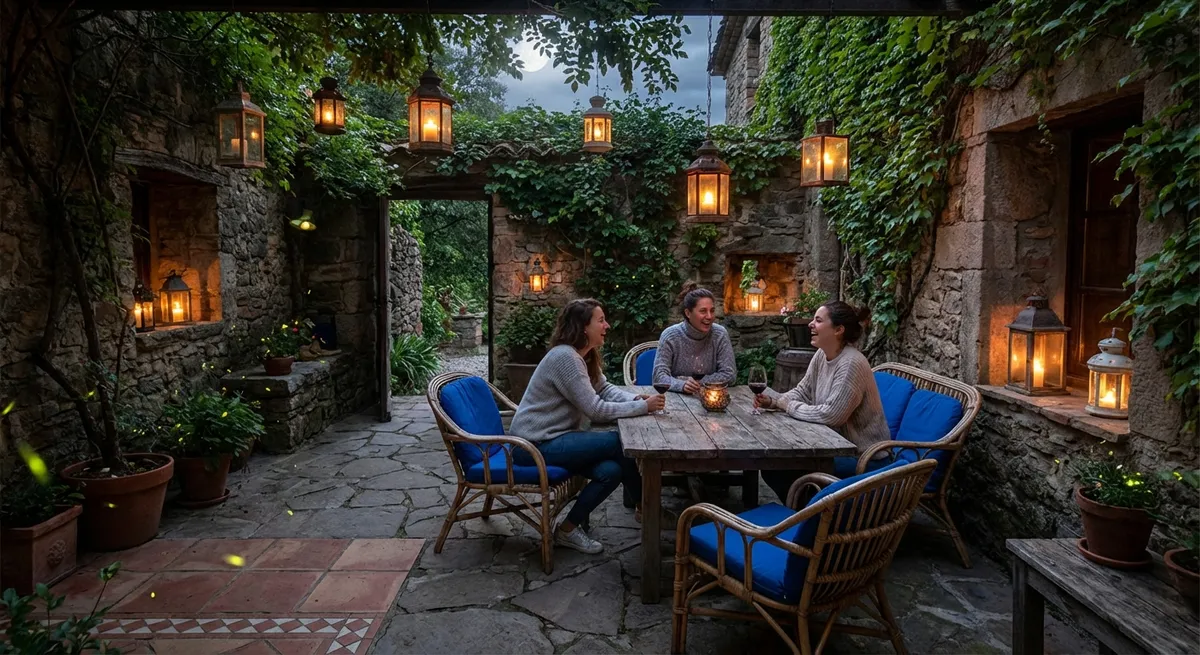
Imagine stepping outside and feeling your shoulders drop before the door even clicks shut behind you. That’s the power of a well‑designed outdoor space: it rewrites the mood of your entire day. These patio ideas aren’t about perfection or big budgets—they’re about crafting a little magic under the open sky.
The Storyteller’s Patio: Layered Textures and Quiet Corners
Build your patio like a story that unfolds as you move through it. Start with texture: a woven rug underfoot, a slatted wood bench, smooth stone planters, and a soft throw draped over the chair that always catches the evening light. When different textures meet—linen against metal, terracotta against greenery—your eye lingers, and lingering is the first step toward feeling at home. Think in “chapters” instead of one big open space: a reading nook by the railing, a small café table near the kitchen door, a hammock or lounge where the shadows gather in late afternoon. Each mini‑zone becomes a plot point in your day: morning coffee here, afternoon emails there, stargazing further out. Add a low, warm lamp or lantern to each corner, so the patio shifts effortlessly from bright daytime hangout to soft, whispered after‑dark retreat. The goal isn’t perfection; it’s a space that feels like it’s been lived in and loved for years, even if you styled it last weekend.
The Garden Drift Lounge: Seating That Flows With Greenery
Instead of placing a sofa against the wall and calling it done, let your seating drift through the greenery like little islands in a sea of leaves. Pull chairs slightly into your plant beds, tuck a bench under an overhanging branch, or slide a pouf next to tall grasses that sway in the breeze. Mix seating heights and shapes: a low lounge chair that makes the sky feel bigger, a higher bistro chair where you can sip and overlook the scene, a built‑in bench that hugs the curve of a planter or retaining wall. Choose cushions in natural tones—moss, clay, soft sand—so they visually melt into the landscape. Then introduce one bold, unexpected color in a single throw pillow or side table; suddenly, the entire space feels curated, not cluttered. As plants fill in and grow, your patio becomes a place where you’re not just beside the garden—you’re wrapped in it. The feeling is less “backyard furniture set” and more “secret lounge discovered in the middle of a wild, friendly jungle.”
The Twilight Canvas: Painting With Subtle Light
Think of your patio at night as a blank canvas for light. Instead of flooding everything with one bright fixture, “paint” the space with gentle strokes: a glow at your feet from solar stake lights, a halo above from string lights, a soft wash of light across a textured wall or fence. Place lanterns where your eye naturally travels: at the edge of a stair, on the corner of a coffee table, beside a trailing vine that catches the light on its leaves. Swap harsh white bulbs for warmer tones that echo candlelight; your patio will instantly feel more like a lounge and less like a parking lot. If you can, layer three kinds of glow: overhead sparkle (strings or small pendants), mid‑level accents (sconces or lanterns), and low, intimate lighting (candles, LED tea lights, or tiny uplights under plants). The result is a space that doesn’t simply “turn on” at night—it awakens. Every shadow becomes part of the design, every flicker of flame or filament an invitation to stay out just one more hour.
The Sound & Scent Retreat: Designing With Invisible Details
Some of the most powerful patio upgrades can’t be seen at all. Begin with sound: the hush of a tabletop fountain, the rustle of tall grasses, wind chimes tuned to deeper, gentler notes that soothe rather than jangle. Place these elements where you’ll pass them often, so your body begins to associate that subtle music with rest. Then think in scents instead of colors. Plant lavender or rosemary along the path you take from the house to your favorite chair, so the smell rises every time you brush past. Add pots of scented geranium, jasmine, or mint near your seating areas—herbs you can pinch and crush between your fingers when your mind needs something to focus on besides a screen. Even a simple bowl of citrus slices or a bundle of eucalyptus can turn a basic patio table into a tiny sensory escape. When sound and scent are woven into the space with intention, your patio stops being just a place to sit and becomes somewhere you can actually exhale, reset, and return to yourself.
The Transforming Table: From Solo Sanctuary to Social Stage
Let one element on your patio be the shape‑shifter that carries you from quiet mornings to lively nights: the table. Choose a piece that can expand, fold, tuck, or stack, then design the rest of the patio to support its many lives. In its smallest form, it’s your personal altar—holding your notebook, coffee mug, and a single stem in a bud vase. With a few quick moves, it becomes a tapas bar, game station, or project surface for painting and potting. Store a “party kit” nearby: a basket with string lights, a soft throw, a few extra candles, cloth napkins, and a small speaker. When friends drop by, you’re never more than five minutes from a complete transformation. Surround the table with movable stools and lightweight chairs that can be rearranged on a whim, forming circles for storytelling or rows for an outdoor movie night. Over time, your table collects memories—coffee stains, candle wax drips, faint rings from summer drinks—and those imperfect marks will quietly remind you how fully you’ve lived in this space.
Conclusion
A beautiful patio doesn’t demand perfection, expensive furniture, or a magazine‑ready view. It asks for intention: the willingness to treat a simple patch of floor as a canvas for how you want to feel. By layering texture, welcoming greenery into your seating, painting with light, engaging the quieter senses, and honoring the moments that unfold around a single transforming table, you build more than an outdoor room—you craft a daily ritual under the sky.
Step outside today and look at your patio not for what it is, but for what it’s almost ready to become. A few thoughtful changes, and it may start to feel less like the edge of your home and more like the heart of it.