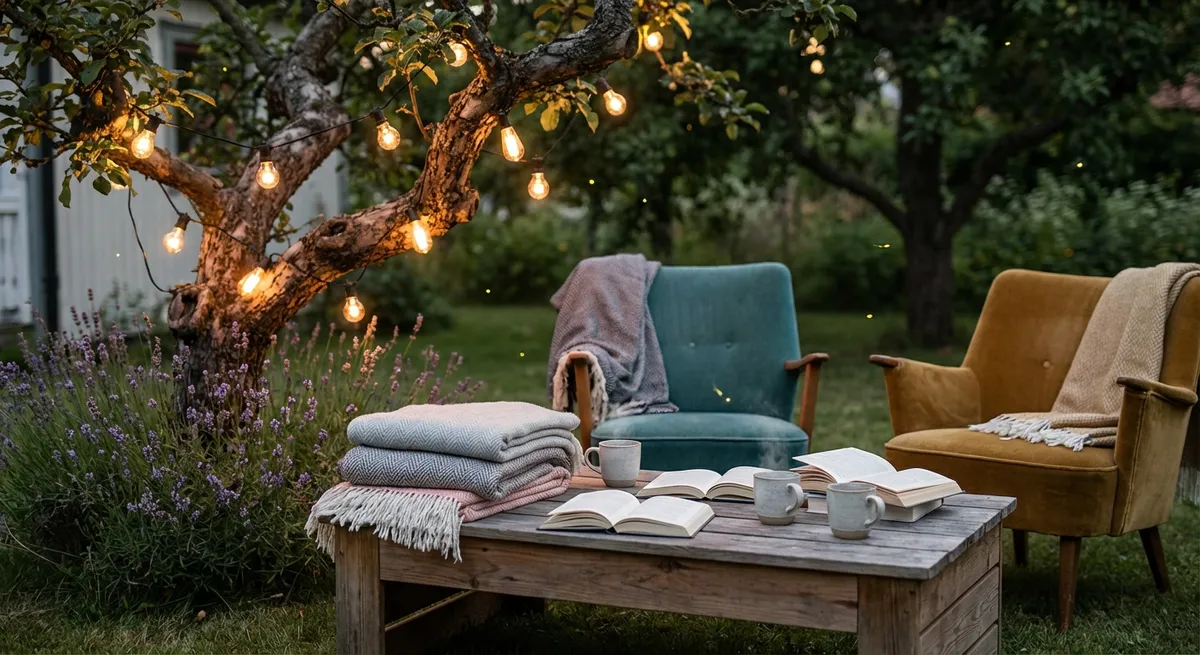
When you choose pieces with intention, your backyard stops being “outside” and starts feeling like the room where your favorite memories happen.
Idea 1: The Conversation Circle That Never Really Ends
Imagine stepping outside and finding a low, generous circle of seating that seems to say, “Stay a little longer.” A round outdoor sofa, curved sectional, or a ring of deep lounge chairs encourages people to face each other, not the screen in their pocket.
Layer the circle with textured cushions: stone-washed linens, sun-faded blues, warm terracotta, and soft creams. Add a low, sturdy coffee table in the center—wood for warmth, metal for modern edge, or a smooth concrete piece that feels like sculpture. This becomes the place where drinks are set down and stories are picked up.
Anchor the grouping with an outdoor rug so everything feels intentional rather than “stuck around the yard.” Throw in blankets that live outside in a storage bench or deck box, ready for cool evenings. With a simple circle of furniture, you’ve created a magnet for conversation—somewhere that makes it impossible to just “pop out for a minute” and not linger.
Idea 2: The Quiet-Reader’s Corner That Feels Like a Secret
Every outdoor space deserves at least one small corner that feels just a bit hidden, as if you’ve stumbled into your own tiny refuge. Start with a single, generous lounge chair or chaise—something you can curl into, not just sit on. Look for a high back, a bit of recline, and arms wide enough to balance a book and a cup.
Tuck this chair near a wall of greenery, a climbing vine, or a tall planter collection. Even if your “yard” is a balcony, you can fake tranquility with slender trees in containers or a row of lush plants that frame your view.
Add a compact side table for your tea and a lantern or solar-powered floor lamp that throws a soft, reading-friendly glow once the sun dips. A small outdoor pillow at the lower back, a light throw thrown over the arm, and suddenly this isn’t just a chair—it’s your personal intermission from the day.
Over time, that corner gathers its own rituals: morning pages, late-night journaling, sketching, or a few quiet minutes of doing nothing at all.
Idea 3: The Long-Table Moment That Turns Meals Into Events
When you bring a long, welcoming dining table outdoors, you’re not just adding furniture—you’re declaring that meals matter. Choose a table that feels slightly bigger than you think you need; a bit of breathing room at dinner makes guests feel unhurried.
Look for sturdy materials built for the elements: teak that silvers beautifully with time, powder-coated aluminum that feels light but lasts, or responsibly sourced hardwoods with weather-resistant finishes. Mix in a variety of seating: benches on one side for closeness, chairs at the ends for structure, maybe even a few seat cushions for cross-legged lounging that blurs the boundary between dining and relaxing.
Above the table, consider a simple shade solution: a pergola, sail shade, or generous umbrella that makes midday meals comfortable. On the tabletop, lean into materials that can live outside—a simple stone or wood tray holding candles, a pitcher of water, a bowl of citrus or herbs cut from your own pots.
This table becomes a stage for everyday celebrations: Sunday pancakes, birthday pizza, takeout sushi under the stars. The furniture stays; the stories keep changing.
Idea 4: The Flexible Lounge That Changes With Your Day
Some days you want to stretch out alone. Other days you want to host half the neighborhood. That’s where modular outdoor furniture shines—it moves with your mood. Choose a modular sectional with individual pieces you can detach and rearrange: a corner here, a chaise there, a stand-alone chair when a guest needs their own little island.
Think of the layout like puzzle pieces you’re free to rearrange as the day unfolds. In the morning, maybe two chaise pieces form a daybed for a quiet nap. In the afternoon, the same pieces pull apart for a more social layout. At night, everything pivots toward a fire bowl or a low table for games and snacks.
Keep the palette simple but layered: a base of neutral upholstery with pillows that can swap out seasonally—muted greens and clay tones in spring, sun-yellow and ocean blue in summer, deeper rust and charcoal in fall. Store extra cushions in a weatherproof chest so your space can expand at a moment’s notice.
With this kind of flexible lounge, you’re never locked into one way of using your space. The furniture listens to how you live and rearranges itself around you.
Idea 5: The Daybed Nook That Feels Like A Vacation You Don’t Have To Book
If you want one single piece of outdoor furniture that instantly changes how your space feels, consider an outdoor daybed. It can be as elaborate as a canopied, four-post structure or as simple as a deep, oversized bench with thick cushions and pillows spilling over the sides. Either way, it sends a powerful message: you’re allowed to rest here.
Position your daybed where it catches gentle breezes or where it frames your favorite view—a sliver of sky between buildings, the tops of trees, your garden in bloom. Add sheer outdoor curtains or a built-in canopy if you need shade or just want the cocooned feeling of your own little outdoor cabana.
Pillows in different sizes create that “fall-into-me” look: long bolsters for afternoon naps, square pillows for reading, and one or two in a pattern that makes the whole thing feel curated, not random. A low stool or nesting tables nearby hold your book, your drink, or your laptop on the days your office moves outdoors.
That daybed will quietly rewrite your schedule: emails answered horizontally, weekend afternoons disappearing into naps, stargazing sessions that stretch later than planned—each moment reminding you that your outdoor space can hold both productivity and peace.
Conclusion
Outdoor furniture isn’t just about chairs, tables, and cushions—it’s about giving shape to the way you want to live. A circle of seats becomes a tradition of long talks. A single armchair becomes a daily ritual of quiet. A big table rewrites dinner as an event, not a task. A flexible lounge follows your changing rhythms, and a daybed turns “backyard” into “getaway.”
When you choose each piece as if you’re designing a chapter of your own story, your outdoor space stops being an afterthought and becomes the backdrop for the life you’re making—slowly, intentionally, one beautiful seat at a time.
Sources
- U.S. Environmental Protection Agency – Environmentally Preferable Purchasing: Furniture – Guidance on sustainable, durable materials to consider for outdoor furniture
- American Society of Landscape Architects (ASLA) – Outdoor Rooms – Insights on designing outdoor spaces that feel like extensions of indoor living
- Harvard Graduate School of Design – Designing Outdoor Spaces for Wellbeing – Research-backed discussion of how outdoor environments support mental health and restoration
- Consumer Reports – Best Patio Furniture Materials for Your Climate – Practical guidance on choosing materials that last in different weather conditions
- University of Florida IFAS Extension – Outdoor Living Areas: Creating Comfortable Spaces – Educational overview of planning comfortable and functional outdoor living areas