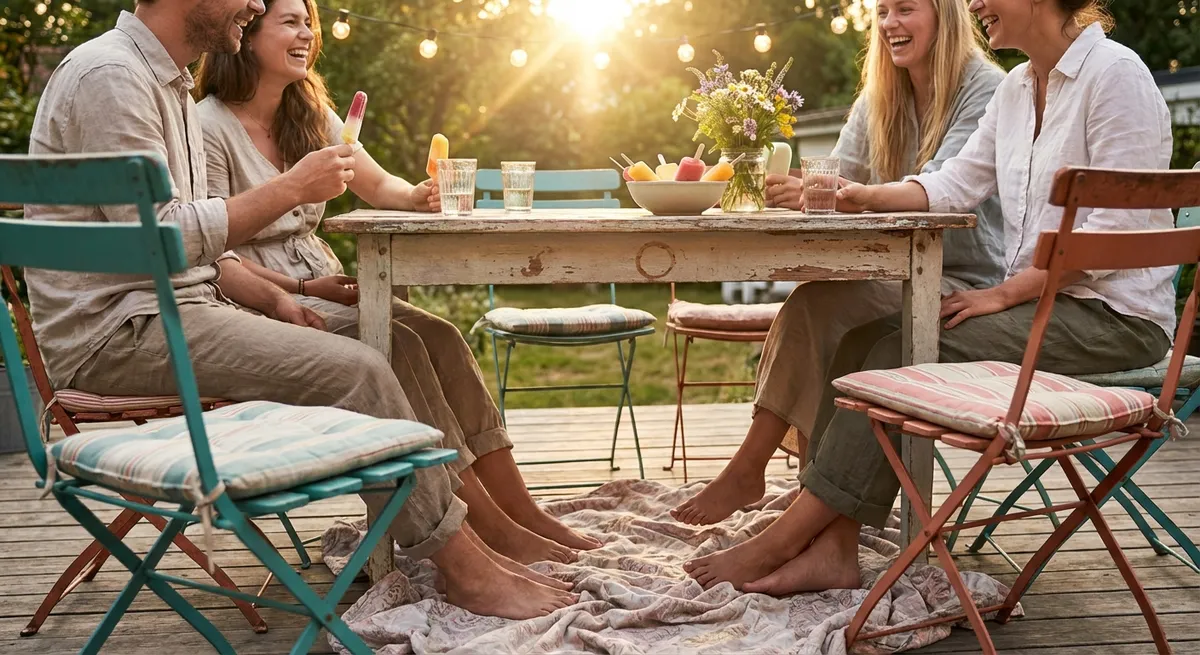
Furniture as the Architecture of Your Outdoor Life
Before you think about colors or cushions, imagine scenes. Who is out here with you? What do you want to be doing—lingering over brunch, reading alone, hosting loud dinners, or simply listening to the rain? Outdoor furniture is the architecture of those moments: it shapes where people pause, which way they face, how long they stay.
Start by noticing your light. Morning people might anchor a small café table where the sun first touches your space, while lovers of twilight might prioritize deep seating that faces sunsets or city lights. Consider how air moves—breezy corners are perfect for hammocks and swings, sheltered spots for dining and working. When you let your habits and hopes design the space first, the chairs, tables, and loungers you bring in become less like objects and more like invitations.
Idea 1: The Conversation Constellation
Think of your seating not as a line of chairs, but as a constellation—points of comfort connected by eye contact, shared stories, and the easy rhythm of people who feel at home. Instead of a traditional linear layout, arrange outdoor furniture in gentle arcs or broken circles that naturally draw people toward the center.
Anchor the space with a low outdoor coffee table or fire bowl, then float lounge chairs, loveseats, or modular sofas around it at slightly varied angles. Leave pathways instead of rigid edges; allow someone to slip in late to the gathering without disrupting the whole scene. Mix chair types—one deep lounge, one upright armchair, a bench along the perimeter—so every guest finds their own favorite “spot.”
Finish with side tables that are just big enough for a glass and a book, so no one has to lean far to reach comfort. At night, the constellation glows with lanterns or string lights; by day, it’s a universe of shadows and sun, ready for whoever wanders in.
Idea 2: The Solitude Corner That Resets Your Whole Week
Outdoor furniture can be extravagant in the simplest way: by holding one person perfectly. Create a tiny sanctuary dedicated to solitude—a place where your body knows, the moment you sit, that it’s allowed to rest.
Start with a single, generous piece of seating: a deep chaise lounge, a cocoon chair, a hanging nest, or an Adirondack chair with a view. Add one ottoman or pouf so your feet have somewhere soft to land. Keep a narrow table close enough to place a mug without breaking your reverie. Think layers: a weather-resistant cushion, a throw you can grab when the air cools, an outdoor rug that turns cold stone or wood into something that feels almost like a room.
You can frame this corner with tall planters, a trellis, or even a simple outdoor screen to create the sense of a gentle boundary without shutting out the sky. This is your quiet checkpoint between the rush of the day and the softness of the evening—a single chair that teaches your nervous system the shape of “enough.”
Idea 3: The Moveable Feast: Pieces That Transform for Every Gathering
Some of the best outdoor spaces live many lives. On Tuesday, they’re yoga studios. On Friday, they’re wine bars. On Sunday, they’re craft tables for kids. The secret is furniture that doesn’t insist on staying in one role.
Look for nesting side tables that expand into a larger surface when guests arrive, then tuck away neatly when you want open space. Choose lightweight dining chairs or stools that can easily migrate from table to fire pit. Consider a bench with hidden storage that doubles as extra seating and a home for cushions and blankets. Modular outdoor sofas can be reconfigured: one day they’re a long lounge for naps, the next a pair of facing loveseats for heart-to-hearts.
Keep the core palette cohesive—perhaps warm wood and charcoal metal, or creamy cushions and woven textures—so the whole space feels intentional even as you move things around. Your yard becomes a stage that can reset at a moment’s notice, ready for impromptu dinners, solo sunsets, or a living-room-sized game night under the stars.
Idea 4: Textures That Let You Feel the Day With Your Hands
Outdoors, design isn’t only what you see—it’s what your fingertips remember. The rough grain of teak warmed by the sun, the cool curve of powder-coated steel, the gentle give of woven rope under your palm—these are the quiet luxuries that make a space unforgettable.
When choosing outdoor furniture, think in layers of texture: a solid, durable base (metal, wood, or high-quality resin), wrapped or softened with natural-feeling materials like wicker, rope, or weather-resistant fabric. Let one hero material lead the story—perhaps a solid acacia wood table—then echo it subtly in smaller pieces like stool legs or serving trays. Contrast is your friend: a slatted bench with a plush cushion, a stone-top side table beside a soft, cushioned lounge.
Invest in performance fabrics that can handle sun and rain without sacrificing softness. Good textiles invite people to linger: cushions you don’t mind sitting cross-legged on, pillows sturdy enough for kids and pets. These textures remind everyone that being outside doesn’t mean sacrificing comfort—it means discovering new kinds of it.
Idea 5: The Dawn-to-Midnight Lounge That Changes With the Light
Some spaces are meant to hold entire days. Imagine one outdoor lounge that feels just as right for a quiet morning coffee as it does for a midnight wind-down. To create this, arrange your furniture with time in mind.
Choose a primary seating zone with a sectional or a pair of generous loungers facing your best view—trees, skyline, or simply the open sky. Add a low, generous table so the space shifts easily between “coffee spot,” “laptop perch,” and “board-game arena.” Include at least one reclining piece—a chaise or adjustable backrest—so you can stretch out fully when the afternoon slowness hits.
Layer the space with elements that respond to changing light: umbrellas or pergolas for harsh midday sun, throw blankets for cool evenings, lanterns or rechargeable table lamps for a soft, adjustable glow. As the day unfolds, the furniture doesn’t change, but your relationship to it does—sitting upright with a journal at 7 a.m., sprawling with a book at 3 p.m., leaning in close to a friend at 10 p.m. You’ve built not just a lounge, but a gentle rhythm for your entire day.
Conclusion
Outdoor furniture is where the weather meets your life. It’s not about matching sets or perfect photos; it’s about creating places where time can slow down enough for you to notice it. A single, well-placed chair can change how you end your workday. A thoughtful cluster of seats can turn your home into the destination everyone remembers. A table under the open sky can gather people who might otherwise stay strangers to each other—and even to themselves.
When you choose pieces that honor both beauty and daily life, you’re not just decorating a yard or balcony. You’re giving your days new shapes, your evenings new endings, and your memories a place to land. Let your outdoor furniture be the gentle reminder that life is allowed to spill past your walls and into the open air—where every breeze, every shadow, every fading ray of sunlight is part of your home’s story.
Sources
- [Consumer Reports – Best Patio Furniture Materials](https://www.consumerreports.org/patio-furniture/best-patio-furniture-materials-a7813983794/) - Overview of durable outdoor furniture materials and how they perform outside
- [University of Florida IFAS Extension – Outdoor Living Spaces](https://edis.ifas.ufl.edu/publication/EP480) - Guidance on designing outdoor living areas that support how you actually use your space
- [Environmental Protection Agency (EPA) – Sun Safety](https://www.epa.gov/sunsafety) - Information on managing sun exposure, useful when planning shading and furniture placement
- [NC State Extension – Selecting Outdoor Fabrics](https://content.ces.ncsu.edu/outdoor-fabrics) - Details on choosing weather-resistant textiles for cushions and upholstery
- [American Society of Landscape Architects (ASLA) – Residential Design Trends](https://www.asla.org/residentialinfo.aspx) - Insights into current trends in outdoor living and how furniture supports them