Designing for the Way You Want to Feel Outside
Before you scroll through endless chairs and sectionals, ask yourself a different question: How do I want my outdoor space to feel? Energizing and social? Calm and contemplative? Cozy and cocooned? Your answer becomes the compass for every design choice.
Furniture can signal rhythm and intention. A long dining table says: “Stay. Talk. Pass the salad again.” A pair of deep lounge chairs angled toward a view says: “Slow down. Look out there.” A low daybed under a tree says: “You’re allowed to do nothing today.”
Think of your outdoor space as a story with a beginning, middle, and end. Where do mornings begin—perhaps at a bistro table that catches first light? Where does the day drift into afternoon—a chaise tucked near the garden? Where do evenings land—a cushioned bench near twinkling lights? Let furniture mark these chapters, so you’re gently guided into using the space instead of just admiring it from inside.
Idea 1: The Conversation Circle That Makes Time Disappear
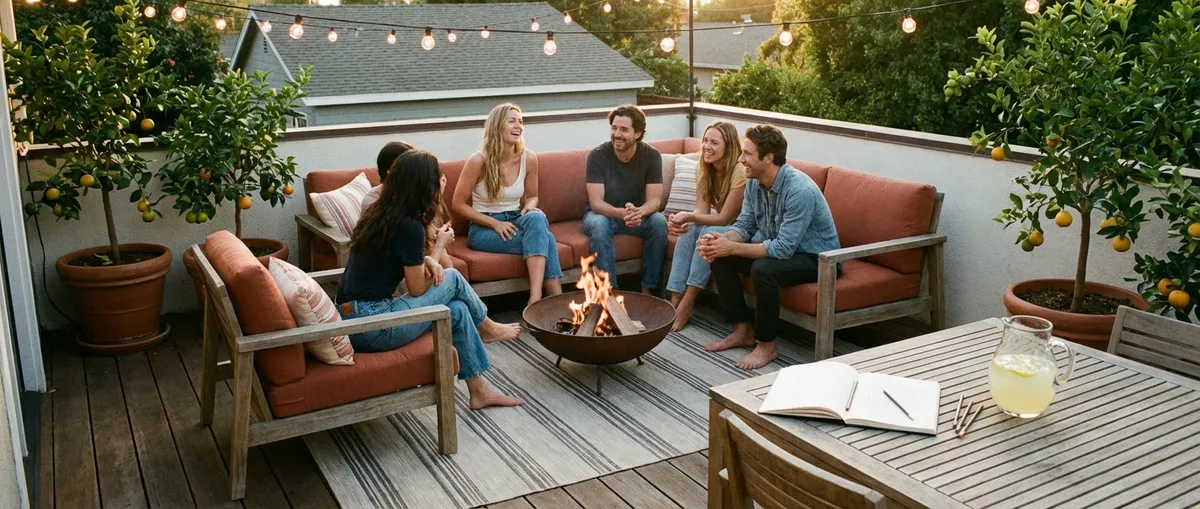
Imagine stepping outside and finding a soft circle waiting for you—chairs curved toward one another, a low table at the center, cushions that invite you to stay past sunset. This isn’t just “seating.” It’s a built-in excuse to linger, to ask one more question, to tell the long version of the story.
A conversation circle can be created with four deep lounge chairs, a modular sectional arranged in a partial ring, or even a mix of bench seating and individual chairs. The secret is in the inward focus: everyone can see everyone else without twisting or leaning. Add a sturdy, weather-resistant coffee table or drum-style side tables for drinks, books, or board games, and suddenly your outdoor area becomes your favorite “living room,” only with wind and birdsong.
Layer in texture—woven rattan frames, slubby outdoor linens, a patterned rug underfoot—to keep the space feeling warm rather than formal. A few lanterns or candles on the table introduce that soft, flickering glow that makes ordinary evenings feel like occasions. Over time, the furniture becomes a kind of memory map: “That’s where we sat when we planned our road trip. That chair is where we solved that big problem.” The more you gather there, the more the circle feels like a trusted friend.
Idea 2: The Morning Nook for Rituals and Quiet Starts
Some spaces aren’t meant for crowds; they’re designed for one person and one cup of something warm. Picture a slim, round café table, just large enough for a mug, a notebook, and a small vase of something green. Add a single beautiful chair or a pair of light bistro chairs positioned where the light touches first—along a balcony railing, tucked into a corner of a tiny deck, or nestled under a window.
This kind of nook doesn’t demand a lot of square footage; it thrives in the overlooked slivers of space—a strip of porch, a landing at the top of the stairs, that weird corner beside the back door. Choosing a chair with a gentle curve or even a small cushion signals softness over speed. If mornings are sacred to you, invest in comfort: a supportive back, a seat you don’t mind lingering in, a throw blanket for those colder days.
The power of this nook is its predictability. The chair waiting in the same spot each day becomes a cue: “Pause here.” Over time, the routine of sitting outside—checking in with the sky instead of your phone first—soaks into your sense of well-being. You might jot three lines in a journal, read a single page of a book, or simply sip and stare. Your outdoor furniture, humble as it is, has quietly turned daily life into a gentle ritual.
Idea 3: The Flexible Dining Zone That Adapts to Every Gathering
Outdoor dining doesn’t have to look like a static, formal setup. Think instead of a stage that rearranges itself depending on the scene. A slender, extendable table, for instance, can live small on weeknights and stretch out long when friends arrive. Stackable or folding chairs can hide neatly when not in use, then appear like magic when there are more plates than expected.
Choose a table surface that feels good to the touch—smooth wood, durable powder-coated metal, or a composite material that doesn’t scorch in the sun. Comfortable chairs are crucial: slightly reclined backs, supportive seats, and optional cushions that can handle a breeze. Keep color in mind: neutral frames with cushions in earthy tones, soft blues, or muted terracotta can echo the landscape around you rather than compete with it.
To make the space feel intentional instead of temporary, anchor it with an outdoor rug beneath the table or a long bench on one side. A bench is a quiet transformation tool: it fits more people in a pinch, doubles as a perch for plants or blankets when not in use, and visually softens the “line” of chairs. String lights or a pendant over the table add a sense of “room” without walls, telling guests that this is where the night will unfold.
In this kind of setting, dinner can stretch without anyone noticing the time. The furniture isn’t shouting for attention; it’s holding the gathering gracefully, allowing conversation, clinking glasses, and gentle laughter to be the main décor.
Idea 4: The Lounge-By-Nature Corner With Layers of Comfort
There’s something almost luxurious about having a place outdoors where you’re meant to recline. Not sit primly, not perch on the edge, but really sink in. A lounge corner is your permission slip to do just that—whether it’s a low-profile sectional, a pair of chaise lounges, or a deep outdoor daybed piled with cushions.
Set this zone near something living: a line of potted herbs, a stretch of lawn, a small tree, or even a vertical garden on a fence. When your back is cushioned and your feet are up, your senses have room to notice details—shadows moving across leaves, bees working over blossoms, faint scents of rosemary or mint. Choose fabric in shades that nod to nature: olive, sand, cloud, stone. The effect is less “backyard showroom” and more “soft extension of the outdoors.”
Layering is what makes this idea irresistible. Add outdoor throw pillows with varying textures, a breathable throw blanket, a side table for a book and iced tea, maybe a small basket with sunscreen and a favorite hat. Low lanterns or solar stake lights can mark the edges of the zone so it feels defined even after the sun slips away. This becomes your place for half-finished novels, mid-afternoon naps, or simply staring at the sky long enough to remember the shape of the clouds.
Over time, you might find that this is where you drift when you don’t know what you need: a reset, a moment alone, a breath between tasks. Your furniture quietly offers all of it.
Idea 5: The Creative Corner Where Work and Play Feel Lighter
Outdoor furniture can also carve out a spot where your imagination comes to life—a hybrid space where sketchbooks, laptops, kids’ crafts, or passion projects can unfold under open air. Think of a compact table with a clean, uncluttered surface and a supportive chair—sturdy enough for typing or drawing, relaxed enough that it doesn’t feel like your indoor desk followed you outside.
Position this corner where light is kind: bright but not blinding, perhaps under a pergola, shade sail, or leafy branch. Consider a bar-height table and stools if your view is better a little higher up, or a standard-height set if you prefer both feet firmly planted. Storage-friendly pieces—like a bench with hidden compartments or a narrow console along a wall—can hold sketchpads, cards, paints, or even an outdoor “office” kit, ready to go.
The goal isn’t to recreate your indoor workspace; it’s to soften it. A small planter of trailing vines on the table edge, a portable speaker for soft background music, a comfortable outdoor cushion on your chair—all these remind you you’re allowed to feel good while being productive. On days when work feels heavy, simply moving your laptop to this space can shift your mood. When the work is done, the same furniture seamlessly transforms into a game table, a puzzle station, or a place for kids to build forts from cushions and imagination.
Outdoor furniture, in this sense, becomes an ally to your creative life—a tangible reminder that good ideas often arrive when you give them sky.
Conclusion
Outdoor furniture is often sold as objects: chairs, tables, benches. But what you’re really collecting are possibilities—slow mornings, long conversations, quiet afternoons, unexpected bursts of creativity. The curve of a chair can invite someone to stay a little longer. The placement of a table can turn an ordinary deck into a daily ritual. The softness of a cushion can convince you that you’re allowed to rest.
When you design your outdoor space around the feelings you want to foster—connection, calm, curiosity—your furniture becomes more than décor. It becomes the frame that holds your best days outside. Step over the threshold, take a seat, and let the life you want to live out there begin.
Sources
- Environmental Protection Agency – Green Landscaping: Greenacres – Guidance on sustainable outdoor environments and plantings that can complement outdoor furniture zones
- Harvard Health Publishing – The Health Benefits of the Great Outdoors – Explores why spending time outside supports mental and physical well‑being
- American Society of Landscape Architects (ASLA) – Outdoor Rooms – Professional insights on creating functional, livable outdoor “rooms” with furniture and layout
- University of California ANR – Outdoor Living Spaces – Educational overview of designing outdoor living areas, including furnishings and uses
- Consumer Product Safety Commission – Outdoor Furniture Safety – Practical information on choosing and maintaining safe outdoor furniture