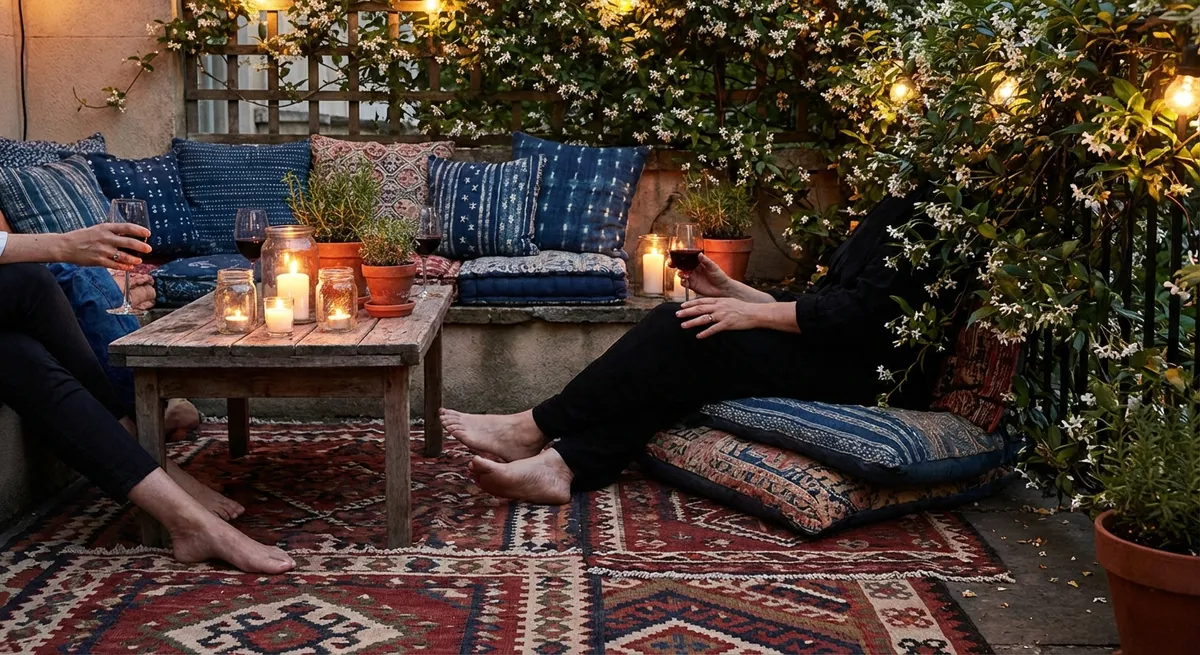
Below are five patio design ideas crafted for outdoor living enthusiasts who want more than just a place to sit. These ideas are about atmosphere, ritual, and the subtle art of making the outdoors feel like an extension of your inner life.
Idea 1: The Dawn Corner – A Patio That Wakes Up With You
Imagine a small corner of your patio designed entirely for the earliest light. This is your “dawn corner,” where the day feels gentle instead of rushed. Start by observing where the first sunbeam lands each morning, then build your ritual right there.
Choose a low, comfortable chair or chaise that faces the sunrise, and layer it with soft, washable textiles in pale, sunrise-inspired colors—soft corals, misty blues, and warm creams. A small side table becomes your grounding station: a ceramic mug waiting for coffee or tea, a slim vase for a single stem clipped from your yard, a notebook or journal that quietly invites reflection.
Add a thin outdoor rug underfoot for warmth and texture so that the first step outside doesn’t feel like a shock, but like being welcomed. A lantern with a battery-powered candle or soft solar lights helps bridge the darkness before sunrise and the glow that follows. Surround the area with plants in varying heights—tall grasses that whisper in the early breeze, a pot of lavender or rosemary whose scent wakes as the sun warms them.
This corner is not for multitasking. It’s a space that trains your body and mind to associate the patio with slowness, breath, and the stunningly simple act of watching the light change.
Idea 2: The Conversation Arcade – Circles, Layers, and Shared Stories
Some patios are built for storytelling. To design a “conversation arcade,” think less about matching furniture sets and more about creating a shape—a circle or semi-circle that naturally draws people toward each other.
Start with a focal point in the center: a fire pit, a coffee table with candles and stacked books, or a large planter overflowing with greenery. Arrange seating around that center in varied styles—an outdoor sofa, a couple of lounge chairs, maybe a woven stool or floor cushion or two. The slightly mismatched textures give the space a collected, lived-in warmth, like your favorite café patio.
Use layered lighting to set the emotional tone. Overhead string lights cast a gentle canopy-of-stars effect, while table lanterns and small path lights define the edges of the gathering space. Consider adding a single “statement” light—like a sculptural lantern or pendant—so the space feels curated rather than generic.
Scatter throw pillows in earthy, saturated tones—terracotta, deep teal, mustard, charcoal—to anchor the space and invite people to linger. Add a low shelving unit or console against a wall for games, a small speaker, blankets, and candles, turning your patio into an outdoor living room that feels ready at a moment’s notice.
The magic of this design is in the circle: no single “best seat,” no clear front or back. Just a quiet invitation for everyone to face each other and let time stretch longer than the clock suggests.
Idea 3: The Green Sanctuary – A Patio Wrapped in Living Walls
For nature lovers, the dream patio doesn’t just sit beside the garden—it dissolves into it. A “green sanctuary” patio is one where plants aren’t an accessory; they’re the architecture.
Begin by thinking vertically. Install trellises, wall-mounted planters, or even a freestanding screen to create a living backdrop. Climbing vines like jasmine, clematis, or honeysuckle can soften fences and walls, adding scent and shelter. If space is small, lean into it—a patio wrapped on three sides by plants can feel more like a secret garden than a limitation.
In the foreground, layer container plants in tiers: tall planters toward the back, medium at the center, and small herb pots close to seating. Mix textures—glossy leaves, feathery grasses, structured succulents—so your eyes have something new to discover each time you sit. Add at least one plant that moves with the wind, like ornamental grass or bamboo, to bring motion into the stillness.
Consider a small water element: a compact fountain or bowl with a recirculating pump. The sound of trickling water doesn’t just soothe; it softens the edges of neighborhood noise and makes your patio feel more like a cocoon than a platform.
Choose furniture that doesn’t fight the greenery: natural wood, bamboo, or metal in understated tones. A single swing chair or gently rocking bench can become the heartbeat of the space. Over time, as plants mature and fill in, your patio will feel less like it sits in the yard and more like it’s grown out of it.
Idea 4: The Creative Table – A Patio for Making, Sipping, and Dreaming
Some patios are for resting; others are for doing. The “creative table” patio is your outdoor studio—part café, part workshop, part idea factory.
Anchor the space with a sturdy, weather-resistant table that feels substantial enough for projects but welcoming enough for dinner or drinks. Look for a finish that can handle watercolors, clay dust, potting soil, or a spilled espresso without feeling fussy. Surround it with chairs that are comfortable but not precious; this is a place where it’s okay to get messy.
Keep tools of inspiration close at hand. A crate or weatherproof cabinet can hold notebooks, colored pencils, a sketchbook, a deck of conversation cards, or gardening gloves and seed packets. A chalkboard or pinboard on an adjacent wall can serve as your out-loud thinking space: sketches, garden plans, quotes, or seasonal goals.
Overhead, add a shade structure—a pergola, sail shade, or even a simple umbrella—to protect you and your projects from harsh midday sun. Soft, directional lighting, like clamp lights or adjustable wall sconces, can turn the same space into an evening hub for game nights, late-night brainstorming, or stargazing with a thermos of tea.
This patio doesn’t have to be perfectly styled; in fact, a little creative chaos gives it soul. Clay pots half-filled, a paint jar left from yesterday, a stack of books with weather-softened covers—these are signs that this is not just a backdrop, but a living, working part of your life.
Idea 5: The Seasonal Stage – A Patio That Changes With the Calendar
Why should your patio look the same in June as it does in November? The “seasonal stage” concept treats your outdoor space like a rotating set, updated with intention as the year unfolds.
Start with a simple, neutral base: a foundational rug, core furniture pieces, and timeless planters. Then build a collection of seasonal layers you can swap in and out—textiles, lanterns, table decor, and even plant choices. Lightweight storage bins or a dedicated closet make this easier than it sounds.
In spring, lean into fresh greens, soft blues, and floral patterns. Bring in pots of bulbs, blossoming branches in tall vases, and lighter blankets. In summer, shift to vibrant colors, breezier fabrics, extra seating, and outdoor games or poolside accessories that suggest spontaneity.
Autumn can bring in deeper oranges, rusts, and umbers—think plaid throws, lanterns with amber-tinted glass, and pots of mums or ornamental kale. In winter (if your climate allows patio use), you might emphasize texture and glow: faux fur or wool blankets, heavier cushions, more candles, and evergreen planters that keep life in the landscape.
Lighting is your secret weapon here. Use dimmable or swappable bulbs—cooler white in summer, warmer amber in fall and winter—to subtly shift the emotional temperature of the space. Over time, your patio becomes a living calendar that keeps you connected to the rhythm of the year, reminding you that every season has its own way of inviting you outside.
Conclusion
A patio is more than a slab of stone or a deck of wood—it’s an open-air room where your life can breathe a little wider. Whether you’re drawn to slow sunrise rituals, late-night conversations, immersive greenery, creative projects, or the changing moods of the seasons, your outdoor space can be shaped to reflect the inner life you want to nurture.
You don’t need a sweeping view or a sprawling yard to create something meaningful. You just need intention, a few well-chosen pieces, and the courage to treat your patio as more than an afterthought. Step outside, notice how the light falls, listen for what the space wants to become—and then begin designing a patio that feels less like an add-on, and more like a second soul.
Sources
- Environmental Protection Agency – Green Landscaping - Guidance on using plants and landscaping to create sustainable, soothing outdoor environments
- Royal Horticultural Society – Container Gardening - Practical ideas for using containers to build lush patio and balcony spaces
- Harvard Health Publishing – The Health Benefits of Being Outdoors - Research-backed insights on why spending time outside supports well-being
- University of Minnesota Extension – Outdoor Room Design - Concepts for treating patios and yards as intentional “outdoor rooms”
- U.S. Department of Energy – Outdoor Lighting Basics - Useful information on choosing and layering outdoor lighting effectively