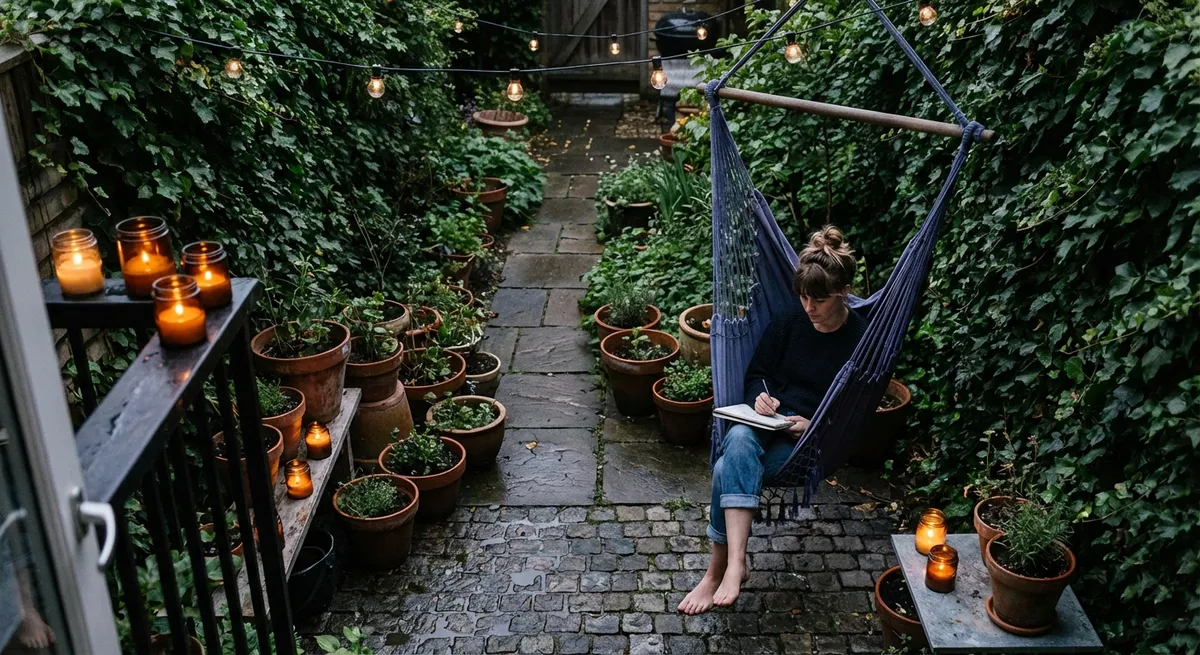
Think of your patio not as “finished square footage,” but as a living story you step into. Below are five design ideas that invite you to linger, listen, and live a little slower—without sacrificing style, function, or fun.
1. The Dawn Corner: A Patio That Starts Your Day Before You Do
Design a small slice of your patio that exists purely for first light. It doesn’t need to be big—just intentional. Place a comfortable chair or small bench where the morning sun naturally lands, and add a petite side table for your coffee, journal, or favorite book. Choose cushions in colors that echo sunrise tones: blush, soft gold, misty blue.
Layer textures that feel good against sleepy skin: a knit throw tossed over the chair, a woven jute rug under bare feet, a smooth ceramic mug that warms your hands. A single potted evergreen or small ornamental tree nearby creates a sense of enclosure, like you’ve stepped into a tiny open-air room.
Add one gentle sound: a small tabletop fountain or a wind chime with a soft, low tone. The goal isn’t a fully styled “outdoor living room”—it’s a ritual-ready nook that reminds you the day can start with presence, not just notifications. Over time, this little dawn corner becomes less of a design feature and more of a habit you look forward to.
2. The Firelit Circle: Conversation Built Into the Floor Plan
Instead of centering your patio around the house, center it around each other. Create a circular or semi-circular seating layout focused on a fire source: a built-in fire pit, a gas fire table, or even a grouping of oversized lanterns with candles if open flame pits aren’t allowed where you live.
Choose seating that naturally turns faces inward: curved sectionals, Adirondack chairs angled in a crescent, or a mix of lounge chairs and poufs arranged around the flame. Layer in low, moveable tables so people can set down drinks or plates without breaking the spell of the circle. Use warm-toned lighting—string lights draped overhead, stake lights along the perimeter—to keep the focus soft and intimate.
Surround this circle with planters of fragrant herbs or night-opening flowers so scent joins the conversation after dark: think lavender, thyme, or evening primrose. Your patio stops being just “outdoor space” and becomes a modern campfire—where stories are told, phones are forgotten, and time stretches the way it used to when you were a kid staring into embers.
3. The Green Room: Blurring the Edge Between Garden and Home
Instead of treating your patio and garden as separate zones, let them overlap until the line disappears. Use container gardens, raised planters, or vertical green walls to bring foliage right up to the edge of your seating and dining areas. Climbers like jasmine or clematis can frame doorways and pergolas, softening hard architecture with living edges.
Mix heights: low groundcovers that spill over pavers, mid-height grasses that sway at chair level, and taller shrubs or small trees that cast dappled shade. This layered planting creates a “green room” effect—a sense that you’re inside a living structure, with walls made of leaves and sky for a ceiling.
Incorporate functional plants too: pots of basil, mint, cherry tomatoes, or strawberries within arm’s reach of your table. Meals can be sprinkled, torn, or snipped right from the surrounding greenery. When your patio feels cultivated but not stiff—like a semi-wild room you happen to dine in—you start to experience it as part of your home’s heartbeat, not an accessory.
4. The Transforming Patio: One Space, Many Lives
A truly soulful patio doesn’t have just one role; it shifts with your day the way a good soundtrack does. Design your space with flexible, lightweight pieces that make transformation simple. Stackable chairs, nesting tables, and storage benches let you move from yoga studio at sunrise to workspace at midday to dinner party by dusk.
Consider a foldable bistro table that can expand when guests arrive, or modular seating that can be rearranged into a lounging daybed, a reading chair, or a group conversation area. A roll-up outdoor rug or easy-to-move floor cushions allow you to clear the deck for an evening of dancing, a kid’s art project, or a projected movie on a blank wall or sheet.
Think of your patio as a stage set with smart props: lanterns that double as Bluetooth speakers; stools that function as both side tables and extra seats; planters that act as subtle space dividers. When you can re-script your patio in five minutes, you’re more likely to use it not just for “occasions,” but for the real, unscripted life happening between them.
5. The Quiet Threshold: Designing a Soft Welcome Home
Your patio can also be a gentle on-ramp from the world outside to the sanctuary inside. Focus on the transition zone—the few steps between your yard, your door, and your main seating area—and design it as a calming sequence rather than just a walkway.
Use a repeating material underfoot—stone, brick, or decomposed granite—that guides the eye and the body forward. Add one simple, grounding element at the threshold: a substantial planter with a small tree, a sculptural light, or a low bench where shoes, thoughts, or burdens can be briefly set down.
Keep the color palette here minimal and soothing: soft neutrals, deep greens, maybe a single accent hue repeated in cushions or pots. The idea is not to impress but to exhale. As you cross this quiet threshold each day, the patio becomes an emotional buffer zone—a place where work, errands, and noise loosen their grip before you step fully into home.
Conclusion
A patio doesn’t have to be sprawling or perfect to be powerful. It just needs intention: a corner for dawn, a circle for fire-lit talks, a green room that grows, a space that shifts with your rhythms, and a soft landing at day’s end.
When you design your patio as a living story instead of a static “outdoor area,” you give yourself more than a pretty backdrop. You create a place that listens, holds, and gently asks you to stay a little longer—right where you are.
Sources
- [U.S. Environmental Protection Agency – Green Landscaping](https://www.epa.gov/soakuptherain/soak-rain-rain-gardens) – Guidance on eco-friendly landscaping practices and water-wise planting ideas
- [University of Minnesota Extension – Container and Raised Bed Gardening](https://extension.umn.edu/planting-and-growing-guides/container-and-raised-bed-gardening) – Practical tips for designing and maintaining container gardens on patios
- [Better Homes & Gardens – Outdoor Room Ideas](https://www.bhg.com/home-improvement/porch/outdoor-rooms/) – Inspiration and examples for creating outdoor “rooms” and flexible patio layouts
- [Harvard Health Publishing – The Health Benefits of Time Outdoors](https://www.health.harvard.edu/mind-and-mood/spending-time-nature-is-good-for-you) – Research-backed overview of how outdoor spaces support mental well-being
- [National Fire Protection Association – Fire Pit Safety](https://www.nfpa.org/Public-Education/Fire-causes-and-risks/Top-fire-causes/Outdoor-entertaining) – Important safety information for incorporating fire features into outdoor living areas