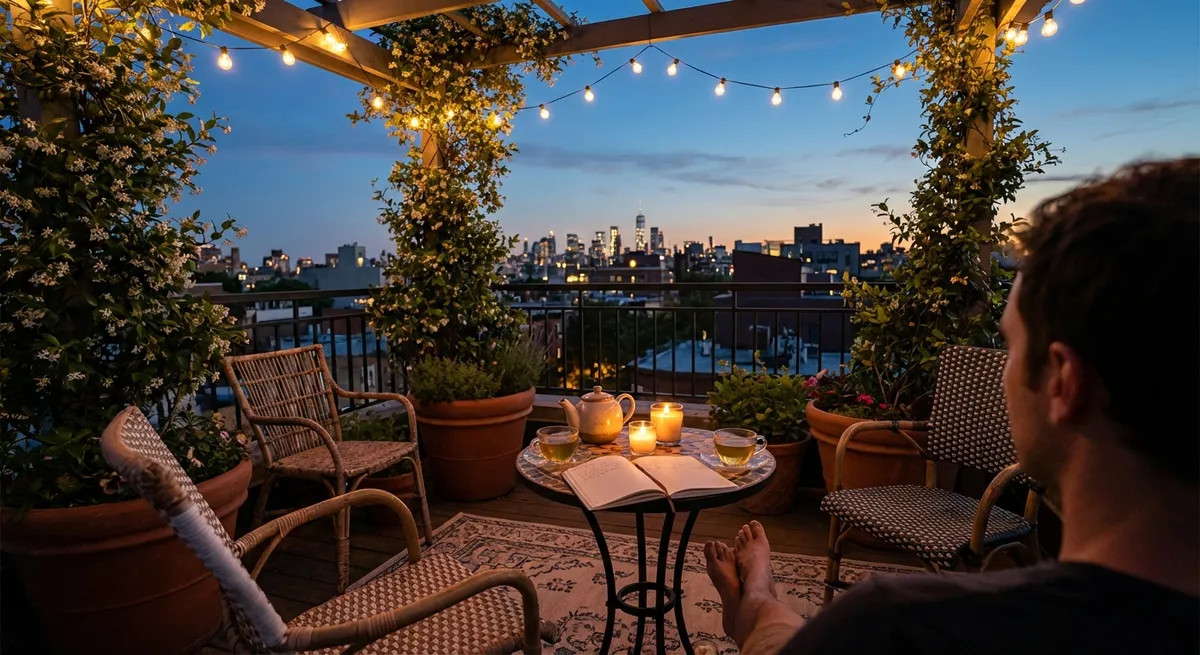
Below are five design ideas that don’t just decorate your patio—they transform how it feels to live there.
Idea 1: The Dawn & Dusk Nook
Design a corner of your patio that belongs to the quiet edges of the day—the few minutes before the world wakes and the soft exhale before night fully arrives. Start with seating that invites lingering: a deep, cushioned chair, a small outdoor loveseat, or even a chaise that lets you put your feet up and tilt your gaze to the sky. Add a petite side table just big enough for a mug of coffee or a glass of wine, and choose textures that feel like a gentle “good morning” or “welcome back”—linen-look outdoor cushions, a woven throw, a low-pile outdoor rug.
Orient this nook toward the sunrise or sunset if you can, or frame a favorite view: a neighbor’s maple tree, a skyline, your own garden. Layer in soft lighting that doesn’t fight the sky—solar lanterns, dimmable string lights, or a candle in a hurricane glass. A small planter with fragrant herbs like mint, thyme, or lavender quietly deepens the experience; brushing your hand through them turns every sit into a tiny ritual. Over time, this nook becomes the place where you go to ask the day what it has in store—or to tell it, simply, “that was enough.”
Idea 2: The Open-Air Dining Studio
Instead of thinking “outdoor dining set,” imagine an open-air studio for meals—where cooking, eating, and conversation feel like a collaborative art project. Start with a table that fits the way you host: long and communal for big gatherings, round and intimate for slow, late-night dinners. Choose comfortable chairs that don’t rush people away after dessert; outdoor cushions, supportive backs, and armrests invite one more story, one more refill.
Give this area a sense of structure with overhead elements: a pergola, a retractable canopy, or a simple row of string lights that traces the “ceiling” of your dining room. If possible, position it near your kitchen door or grill station so food flows easily, reducing back-and-forth trips that break the magic. A portable bar cart or console table becomes a landing pad for drinks, extra glasses, and that stack of plates that always appears right before guests arrive.
Treat the table itself like a rotating gallery. Use simple, durable basics—neutral outdoor dinnerware, clear glassware, plain linens—then swap in seasonal accents: citrus and clipped greenery in summer, small gourds and branches in fall, pine and candles in winter. A single, low centerpiece (so no one is peeking around it) keeps the view open. The result is a patio dining space that doesn’t just host meals; it holds memories, layer after layer.
Idea 3: The Firelight Conversation Circle
There’s something deeply human about pulling chairs closer around a shared glow. A fire pit or smokeless fire bowl instantly transforms your patio into a fireside lounge where stories come out more easily and time keeps slipping past bedtime. Arrange seating in a loose circle or semi-circle around your fire feature: Adirondack chairs for a classic campfire feel, sectional seating for a more lounge-like vibe, or a mix of chairs and floor cushions for an eclectic, inviting look.
Keep the arrangement close enough that everyone feels part of a single conversation, but with enough space to stretch out and lean back. Low side tables or sturdy garden stools give people a place to rest drinks and plates, and a basket of blankets layered nearby invites guests to stay long after the temperature dips. Choose lighting that lets the fire remain the star: soft pathway lights for safety, maybe one or two lanterns for a gentle glow at the perimeter.
If open flames aren’t an option, embrace the spirit of firelight instead: clusters of oversized candles in glass cylinders, LED pillar candles, or a sculptural outdoor lantern as the visual heartbeat of the circle. The goal is the same—a central, mesmerizing glow that makes people lean in, speak softer, and remember what unhurried conversation feels like.
Idea 4: The Greenroom Retreat
Turn your patio into a “greenroom” between house and garden—a living space wrapped in leaves and texture. Start by defining the edges: tall planters with ornamental grasses, potted shrubs, or small trees can outline your patio like living walls, creating a sense of privacy and enclosure. Mix heights and shapes—upright evergreens, spilling vines, broad-leaf plants—to give your eye a reason to wander and your shoulders a reason to drop.
If your patio is small, think vertical. Use wall-mounted planters, trellises with climbing flowers, or a slim plant shelf to layer greenery without stealing valuable floor space. Choose a mix of hardy, low-maintenance plants and a few “joy plants” that you just love, whether that’s a brilliantly colored bloom or a pot of basil you snip for dinner. Add one sensory element—fragrance, movement, or sound—like a jasmine vine, wind-ruffled grasses, or a small tabletop fountain.
Furnish this retreat with pieces that echo the natural textures around you: wicker, teak, stone, or metal softened with cushions in earthy or botanical hues. This is the place for quiet recharging—a book, a journal, or simply five minutes with your phone on silent, counting the shades of green. Over time, your patio begins to blur the line between indoors and out, and you find yourself stepping outside not just to “get some air,” but to let your whole nervous system breathe.
Idea 5: The Play & Creativity Corner
Patios don’t have to be serene and serious; they can also be where your playful side lives. Carve out a portion of your space—no matter how small—that’s dedicated to movement, making, or simple fun. For families, this might mean a weatherproof storage bench filled with sidewalk chalk, bubbles, yard games, or outdoor-safe blocks. For adults, it might evolve into a compact “studio” corner: an easel for painting, a small potting bench for gardening, or a mat and storage basket for yoga and stretching.
Use outdoor rugs or different flooring textures to visually mark this as a distinct “zone,” so it feels intentional rather than like overflow clutter. A foldable table can appear when it’s time to paint, craft, or puzzle, then disappear when you need a clean slate. If space allows, hang a chalkboard or bulletin board on an outdoor wall for sketches, ideas, or rotating family notes—tiny exhibits of the life you’re building.
Lighting matters here too. Brighter, more functional fixtures make it easier to draw, build, or stretch after sunset, while still keeping the overall mood warm. The goal isn’t to create a perfect studio; it’s to make creativity feel at arm’s reach instead of hidden in a closet. When your patio quietly whispers “come play” every time you glance outside, you’re more likely to say yes.
Conclusion
A patio is more than a slab of stone or a patch of pavers; it’s a stage where your everyday life can feel a little more cinematic. When you give that space a purpose—dawn nook, open-air dining studio, firelight circle, greenroom retreat, play corner—it stops being an afterthought and becomes a living, breathing part of your home’s story.
You don’t have to build everything at once. Start with one idea that tugs at you: a single chair facing the sunrise, a few potted plants, a string of lights above a simple table. Let your patio evolve as the seasons and your life do. With each small addition, you’re not just decorating outdoors—you’re creating a place where you can step outside and remember that home is also where you get to exhale.
Sources
- U.S. Department of Energy – Guide to Outdoor Lighting - Practical guidance on choosing efficient, comfortable outdoor lighting for patios and yards
- Environmental Protection Agency (EPA) – Green Landscaping Tips - Ideas for eco-friendly planting and landscaping that can inform patio greenery and layout
- University of Minnesota Extension – Selecting and Caring for Outdoor Container Plants - Detailed advice for choosing and maintaining potted plants for patios and small spaces
- Harvard Health Publishing – The Health Benefits of Time Outdoors - Explores how outdoor environments support mental well-being, reinforcing the value of creating inviting patio spaces
- American Society of Landscape Architects (ASLA) – Outdoor Living Trends - Insight into current outdoor living design trends and features homeowners are embracing