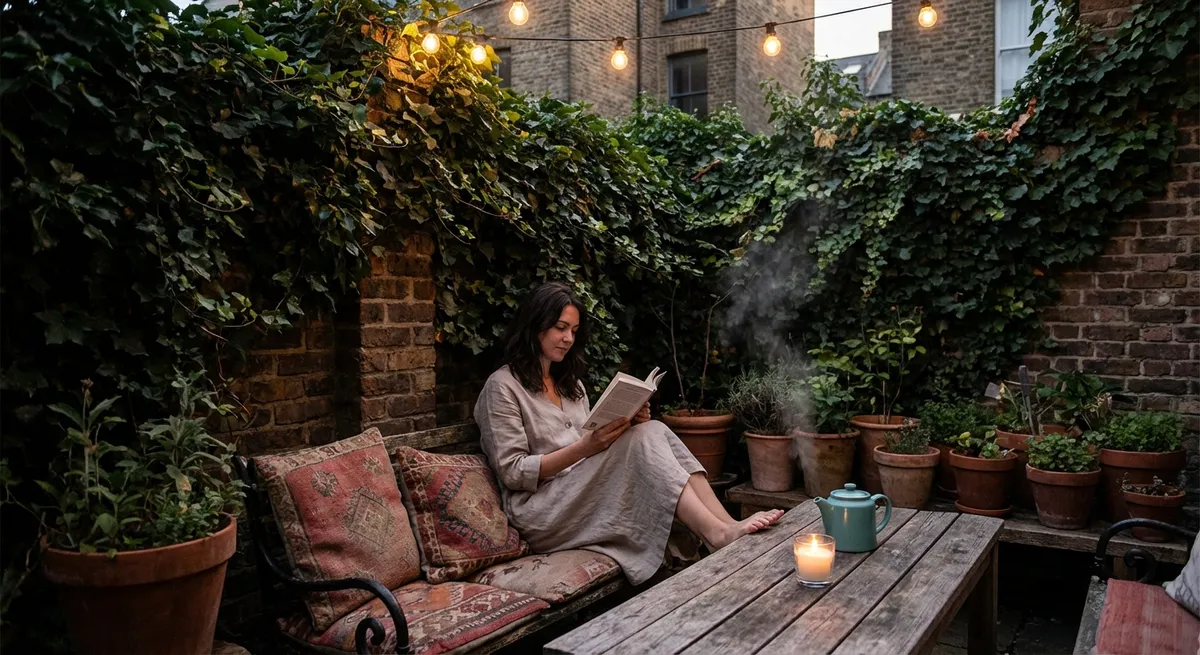
Below are five design ideas that invite you to slow down, stretch out, and let your patio feel less like “the area behind the house” and more like the destination your week is quietly asking for.
Idea 1: The Conversation Cove
Imagine stepping outside and feeling like the patio is pulling you gently toward connection. A Conversation Cove is less about square footage and more about how close your chairs sit to each other, how easily your eyes meet, and how comfortable it feels to linger for “just one more story.”
Start by choosing seating that wraps, not lines up: a curved sectional, a semicircle of lounge chairs, or two chairs angled slightly in, as if they’re already mid‑whisper. Add a low, sturdy coffee table in the center—somewhere for shared appetizers, board games, or a notebook of half‑written dreams. Layer in cushions with soft, touchable fabrics and a mix of patterns that feel collected, not matched.
For atmosphere, think about sound and glow. A small tabletop fountain or a nearby bird bath turns background noise into something soothing. Solar lanterns, outdoor string lights, or chunky candles in hurricane vases keep it intimate but not dim. Enclose the space just enough: tall planters, a trellis with climbing vines, or an outdoor screen that hints at privacy without blocking the sky. The result is a patio corner that gently insists: stay, talk, be here a little longer.
Idea 2: The Morning Ritual Nook
For people who feel most like themselves with a mug in their hands and soft light on their skin, a Morning Ritual Nook is a gift you design for your future self. This corner of your patio doesn’t have to be big; it just has to feel like the first kind words of your day.
Start with a single amazing chair—one that invites you to curl one leg under, rest your head back, and forget the time. A small bistro table or narrow side table is enough for your coffee, your journal, and maybe a vase with one stubbornly cheerful flower. If your patio faces the sunrise, honor that: aim the chair so you can watch the light change without moving.
Add texture that comforts you first thing in the morning: a thick outdoor throw for chilly dawns, a woven rug underfoot to soften concrete, and a cushion that actually supports your back. Consider scent as part of the design: a pot of lavender, rosemary, or mint right beside you turns the everyday act of breathing into something almost ceremonial.
If you use your patio before the world is fully awake, pay attention to the details that matter in those quiet minutes: a small Bluetooth speaker for gentle playlists, a reading light for days the sky takes its time, and maybe a basket nearby for your current book stack. Over time, that little nook becomes less “just a seat” and more a promise you keep to yourself each morning.
Idea 3: The Open‑Air Dining Studio
Meals taste different outside. Even the simplest plate of grilled vegetables or take‑out pizza feels like an occasion when it’s served under sky instead of ceiling. Turning your patio into an Open‑Air Dining Studio means treating shared meals as experiences, not errands.
Start with a table that fits the way you actually gather. If you host often, a long, farmhouse‑style table or extendable set can hold big platters and bigger conversations. For smaller spaces, a round table encourages face‑to‑face connection and works beautifully tucked into a corner. Choose chairs that you’d be happy to sit in for hours—add cushions or seat pads if necessary; comfort is non‑negotiable.
Above the table, think “ceiling of light.” Overhead string lights, a weather‑safe pendant lamp, or a cluster of lanterns can transform an average patio into a place that feels intentionally set. Consider a simple outdoor rug to visually define the dining zone, especially if your patio opens into a larger yard.
Style the table in ways that are easy to repeat: neutral dinnerware, a linen or cotton runner, and a rotating cast of centerpieces—fresh herbs in clay pots, a line of small glass bottles with wildflowers, or a bowl of citrus that looks as bright as it tastes. If you love to cook outside, position a grill or portable pizza oven nearby, so you can keep stirring, flipping, and seasoning without leaving the conversations.
In time, your patio becomes known as “where we gather” rather than “where the extra chairs live.”
Idea 4: The Green Sanctuary Patio
Some patios are meant to blur the line between indoors and a hidden garden, turning hard surfaces into a living, breathing sanctuary. If you’ve ever craved a place to exhale where the dominant color is green and the soundtrack is leaves, this one is for you.
Begin by layering plants at different heights. Use tall planters or small trees (like potted olives, Japanese maples, or dwarf citrus) to create a vertical frame. Medium containers filled with ferns, grasses, or flowering perennials fill the middle space. Trailing plants in hanging baskets or on shelves soften edges and railings. The goal: wherever you look, something living is meeting your gaze.
Mix textures as much as plant types: glossy leaves against feathery ones, rigid succulents beside spilling vines, thick trunks next to delicate stems. Work with your climate and light—sun‑loving plants for bright patios, shade‑tolerant varieties for protected corners. Incorporate native species when possible; they’re usually easier to care for and better for the local ecosystem.
Add surfaces that invite pause: a bench tucked between planters, a small meditation stool, or a chaise lounge aimed at your favorite view of foliage. Consider a small water element—a tabletop fountain or recirculating bowl—to bring in motion and calming sound. Soft outdoor lighting nestled among the plants can make evening visits feel like stepping into your own quiet greenhouse after dark.
Over time, as your plants grow and change, your patio will, too. It becomes less of a finished project and more of a living collaboration between your hands and the weather.
Idea 5: The Creative Backyard Studio
Patios can hold more than meals and conversations—they can cradle your ideas. The Creative Backyard Studio is a space designed for making things: sketches, playlists, journaling, laptop work, or simply sprawling out with your thoughts until they begin to form something new.
Start with a table or surface that can handle mess and motion: a sturdy outdoor dining table, a wide console against a wall, or even a large coffee table for floor‑style creativity. Pair it with a comfortable chair that supports good posture but doesn’t feel rigid. If possible, position the workspace near an outlet for laptops, speakers, and task lighting.
Think storage: outdoor bins or weather‑resistant cabinets can hold paints, notebooks, yoga props, or whatever tools your creativity tends to scatter. A rolling cart is especially helpful—stock it with supplies so you can wheel your craft or writing station into place when inspiration appears.
Use the natural world as part of your “studio equipment.” Mount a simple corkboard or magnetic board on an exterior wall for mood boards, sketches, or pinned photos. Arrange a row of pots with herbs or flowers to serve as living “break reminders”—when your brain stalls, step away and water them, smell them, touch the leaves. Let breezes and birdsong do some of the background work that indoor white noise machines try to mimic.
Lighting is essential here. During the day, embrace what the sun offers, but for evenings, add an adjustable task lamp or warm‑white string lights overhead to keep your focus without harsh glare. The more your patio feels like a place where ideas are welcomed and expected, the easier it becomes to say, “I’m going outside to work on something,” and actually mean it.
Conclusion
Your patio is more than a slab of stone, a stretch of pavers, or a rectangle of composite decking. It’s the thin, magical edge between “out there” and “in here”—a threshold where you can craft how you want to feel, not just how you want things to look.
Whether you shape it into a Conversation Cove, a Morning Ritual Nook, an Open‑Air Dining Studio, a Green Sanctuary, or a Creative Backyard Studio, what you’re really building is permission: to rest, to connect, to make, to taste, to simply be. Start with one corner, one chair, one plant, one light. Let your patio evolve with you.
You don’t have to travel far to arrive somewhere new. Sometimes, the getaway you’ve been craving is waiting just outside the back door.
Sources
- Environmental Protection Agency – Outdoor Living and Green Spaces – Overview of the benefits of green outdoor spaces and sustainable landscaping practices
- Harvard Health – Why time outdoors is so good for you – Explores mental and physical health benefits of spending time outside
- University of Minnesota Extension – Creating Outdoor Rooms – Practical guidance on planning and furnishing functional outdoor living areas
- Royal Horticultural Society – Container gardening – Expert advice on selecting and caring for plants in pots for patios and small spaces
- Better Homes & Gardens – Outdoor Dining Ideas – Inspiration and design tips for creating comfortable, stylish patio dining areas