This is your permission slip to think bigger, softer, and braver about the space just outside your door. Let’s turn it into a setting your future memories deserve.
Idea 1: The Conversation Circle That Never Quite Ends
Imagine stepping outside and immediately being drawn to the center of your patio—not because of a TV or a screen, but because of a circle of chairs that seem to be waiting for a story. A conversation circle turns your patio into an invitation: to linger, to listen, to admit that you needed this time together more than you realized.
Choose chairs or loungers that all face inward, with no “best seat” and no one pushed to the edges. A low, sturdy table or fire bowl in the middle becomes an anchor: a place for tea mugs, candle clusters, charcuterie boards, or just a bowl of lemons that catch the evening light. Blend materials like woven rope, powder-coated metal, and wood to keep the space feeling textured and alive instead of matchy and stiff.
Layer the circle with cushions that feel like they were chosen for people, not for photos—washable, soft, and ready for real life. String lights overhead soften the edges of the night, and a portable speaker with a gentle playlist can sit quietly in the background, never competing with the conversations, only cradling them. Over time, this circle will gather its own stories: the night someone shared a big decision, the first toast to a new job, the quiet afternoon you needed to say nothing at all.
Idea 2: The Morning Ritual Nook at the Edge of the Day
Not every part of your patio needs to be social. One corner can be a sanctuary, built unapologetically for one or two people who take their mornings—or their evenings—seriously. Think of it as a small stage where your daily rituals get the lighting they deserve.
Start by choosing a spot that catches the first or last light of the day. A bench with a high back or a deep, cocoon-like chair tells your body: you’re allowed to stay here. Add a small side table devoted to ritual—a single surface that always holds the essentials: your favorite mug, a notebook, a book that’s slowly getting dog-eared, a small plant that thrives in your chosen light.
Surround this nook with living edges: a tall planter with grasses that whisper when the breeze comes through, a flowering shrub, or a trellis with a climbing vine that slowly frames your quiet moments over the seasons. A small outdoor rug underfoot announces this corner as a room of its own. If your climate allows, keep a soft throw in a weatherproof storage box nearby so that crisp mornings and cool evenings feel like an invitation, not an obstacle.
Over time, this nook becomes associated with your best thoughts and most honest check-ins with yourself. It’s where you show up for your life before you show up for your inbox.
Idea 3: The Open-Air Studio for Whatever You Create
Your patio can be more than a place to relax—it can be where you finally give your creativity some elbow room. Whether you paint, write, knit, design, or dream up business ideas, an “open-air studio” patio transforms fresh air into fuel.
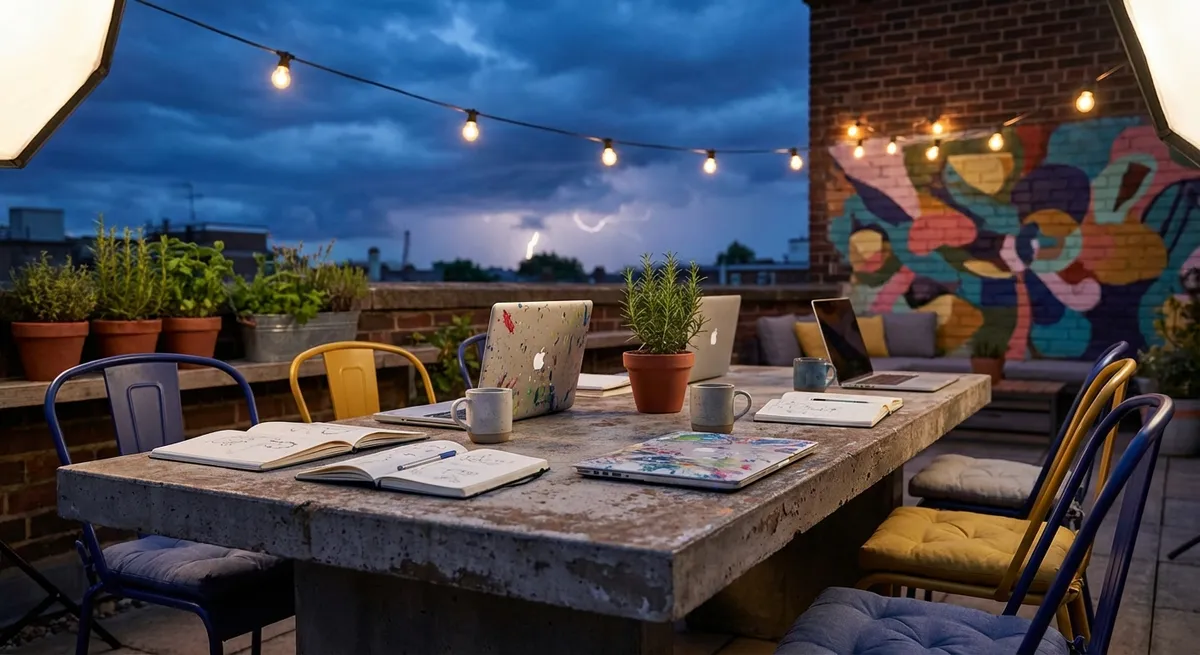
Begin with a work surface that doesn’t feel too precious: a bistro table, a vintage desk sealed for outdoors, or a wide console table along a wall. You want a place where you’re not afraid to spill a little paint, scatter paper scraps, or spread out materials. Include a comfortable but upright chair so your posture says “I’m here to make something,” not “I might fall asleep.”
Add storage that blends with your style: a weather-resistant cabinet, a big lidded basket for supplies, or wall-mounted shelves for pots filled with brushes, pens, or tools. If you work with laptops or tablets, choose a shaded area or add a canopy, pergola, or umbrella to keep glare and overheating at bay. A portable fan can keep summer air moving; a small, safe outdoor heater can stretch your creative season into cooler months.
Layer in inspiring touches: a vertical garden that changes slowly around you, a wind chime tuned to gentle notes, or a pinboard framed in weather-treated wood where you clip sketches, color swatches, or goals. This is not about perfection—it’s about building a place where “someday I’ll start” turns into “today, I did.”
Idea 4: The Seasonal Table That Tells Time in Meals
Some patios are defined not by their furniture, but by their feasts. A seasonal table turns your outdoor space into a living calendar: you know what time of year it is by what’s on the plates and what’s blooming nearby.
Start with a table that can handle real use—water rings, candle wax, the occasional spilled drink—and only looks better with time. Wood, metal, or a stone-topped table all gain character as the seasons pass. Surround it with a mix of seating: a bench on one side for closeness and flexibility, sturdy chairs on the others for long, comfortable meals that drift into star-watching.
Frame the dining area with scent and softness. A planter of herbs—basil, mint, rosemary, thyme—lets you reach down mid-meal to pluck something fresh. Potted citrus, lavender, or jasmine (depending on your climate) can mark warm evenings with fragrance. Use layered lighting to shift the mood: a pendant lantern or string lights overhead, candlelight on the table, and perhaps a solar lantern or two at the edges of the space.
Dress the table in ways that are easy but intentional: a linen runner that looks better slightly wrinkled, a collection of mismatched plates that somehow belong together, cloth napkins that carry traces of past celebrations. Let the menu shift with the year—grilled stone fruit and bright salads in summer, soups and bread in autumn, hot drinks and charcuterie in colder months. Your patio becomes the place where your days gather to be honored before they move on.
Idea 5: The Layered Sanctuary of Light, Shade, and Sound
The most memorable patios feel like they were built with the senses in mind. A layered sanctuary doesn’t chase a single theme; it nurtures an atmosphere. It’s the subtle combination of shade and sun, texture and echo, motion and stillness that makes people exhale the moment they step outside.
Begin by thinking vertically. Add a pergola, shade sail, or tall plants to create pockets of dappled light. Use curtains rated for outdoor use to frame one edge of the patio; when they move in the breeze, the entire space feels alive and cinematic. Mix surfaces underfoot—stone or concrete softened by woven outdoor rugs—so each step tells you something different.
Incorporate water if you can: a small fountain, a wall-mounted spout, or even a tabletop water feature. Moving water softens street noise and gives restless minds something gentle to focus on. Plants become your most versatile design tool: tall grasses that sway, climbers that trace lines upward, trailing vines that spill over containers, and resilient groundcover in the cracks between pavers.
Finally, weave in light as if you’re painting with it. Path markers to define edges, lanterns tucked into corners, and glow from within planters or under bench seats. Choose warm color temperatures so your sanctuary feels like candlelight even when it’s powered by the sun. This layered approach transforms your patio from a flat “backyard space” into a small, ever-changing world you step into—one where everyday worries feel less sharp and ordinary evenings feel mysteriously significant.
Conclusion
Your patio doesn’t have to be perfect to be powerful. It just needs to be intentional—shaped around the way you actually want to live, not the way a catalog page looks for five seconds. A circle made for honest conversations. A nook claimed by your morning rituals. A table that tastes like the seasons. A studio that believes you’re creative. A sanctuary that remembers how to soothe you when you forget.
Somewhere just beyond your door is a piece of ground that can hold all of this. Treat it not as leftover space, but as the stage where some of your best moments have yet to happen. Step outside, look around, and start imagining the life this patio could quietly help you build.
Sources
- [Environmental Protection Agency – Green Landscaping](https://www.epa.gov/soakuptherain/soak-rain-rain-gardens) – Guidance on using plants, soils, and landscaping to improve outdoor environments and manage water.
- [University of Minnesota Extension – Outdoor Living Spaces](https://extension.umn.edu/consumer-horticulture/creating-outdoor-rooms) – Research-based tips for designing functional and comfortable outdoor “rooms.”
- [American Society of Landscape Architects (ASLA) – Residential Design Trends](https://www.asla.org/residentialinfo.aspx) – Insights into popular and effective features for patios and outdoor living areas.
- [Royal Horticultural Society – Container Gardening](https://www.rhs.org.uk/plants/types/container-gardening) – Practical advice on choosing and arranging plants in pots and planters for patios.
- [International Dark-Sky Association – Outdoor Lighting Basics](https://www.darksky.org/our-work/lighting/lighting-for-citizens/lighting-basics/) – Best practices for outdoor lighting that’s beautiful, efficient, and gentle on the night sky.