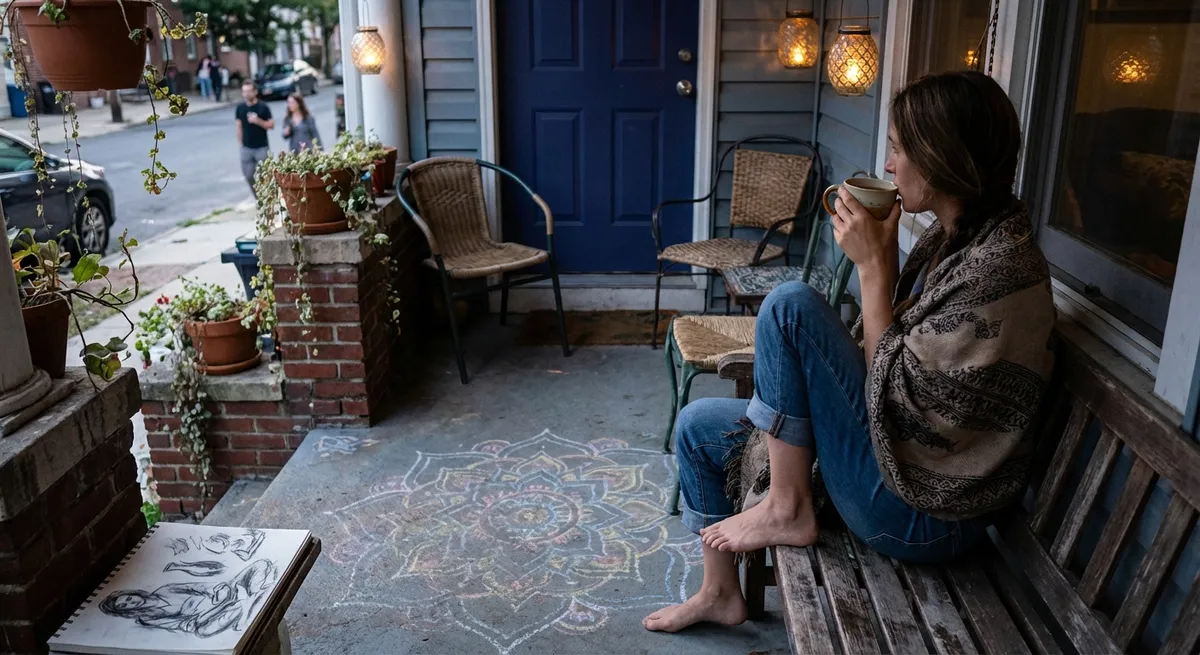
This is porch alchemy: the art of turning a simple entrance into a living, breathing extension of who you are.
A Porch That Glows: Layered Lighting for Atmosphere, Not Just Visibility
Think of your porch at night as a scene in a favorite film—everything shaped by light. Instead of a single harsh fixture by the door, imagine layers of glow that feel like a welcome rather than a spotlight.
Start with soft, warm overhead lighting to anchor the space—dimmable if possible, so you can shift from bright and practical to gentle and intimate. Add wall sconces or lanterns on either side of the door to create a sense of symmetry and ceremony, like a subtle frame around your arrivals. Then weave in smaller points of light: a string of café bulbs tracing the ceiling line, solar-powered lanterns on the steps, or LED candles tucked safely into hurricane glass on a side table.
The goal isn’t brightness; it’s mood. Warm color temperatures (around 2700–3000K) mimic firelight and sunset, flattering faces and calming the nervous system. When your porch glows instead of glares, it stops being a shortcut into the house and becomes a place worth lingering—an outdoor living room under a halo of your own making.
Textured Layers Underfoot: Rugs, Woods, and Stone That Invite Bare Feet
Porches often get treated like the “doormat zone,” but they can be as layered and tactile as an indoor living space. Start by thinking about what you want to feel underfoot—especially if you ever step outside barefoot, coffee in hand or book in tow.
An outdoor rug can instantly shift the energy from “entry point” to “gathering place.” Choose something durable but soft, with a pattern that anchors your seating area or frames the door. Natural textures—like jute-style weaves or flat-woven patterns—bring a sense of ease, while bold geometrics can wake up a plain façade.
If your porch is wood, consider staining or painting the floorboards to highlight their grain and rhythm; a painted checkerboard or border stripe can create a quiet, old-soul charm. For stone or concrete, add planters and low benches to break up the hardness and create flow. The more intentional the materials and textures, the more your porch stops feeling like a hallway and starts feeling like a destination—one that beckons your feet to slow down.
Living Green Edges: Plants That Turn Your Porch Into a Gentle Threshold
Plants are the poets of a porch—they soften lines, blur edges, and quietly rewrite the mood. Instead of a single potted plant by the door, imagine your porch wrapped in a living frame.
Use tall, architectural plants like small trees in containers (think dwarf olive, Japanese maple, or potted citrus in the right climate) to subtly “hold up” the roofline and guide sightlines toward your door. Layer in medium-height planters with herbs, ferns, or flowering perennials to add scent and movement; lavender brushing your leg as you pass in the evening is its own kind of welcome mat.
Hanging baskets can draw the eye upward, making a small porch feel taller and more embracing. Climbing vines on railings or columns—such as clematis, climbing roses, or jasmine—can turn structural elements into living sculptures over time. Choose plants that match your climate and sun exposure, and keep care simple: self-watering planters, mulch, and native species can help your porch garden thrive with less effort.
When the boundary between home and outdoors is softened by leaves and petals, stepping onto your porch feels less like crossing a line and more like being gently handed from one world to another.
Story Corners: Creating a Dedicated Nook for Your Favorite Ritual
Every porch has at least one corner that could be transformed into a personal ritual station—a place that quietly whispers, “This is where you come to be you.”
Choose one spot and claim it. Add a chair that you genuinely love to sit in, not just something that happened to be on sale. It might be a deep lounge chair with pillows that invite you to tuck in, a classic rocker with a soft cushion, or a built-in bench with layered throw pillows. Add a small side table just big enough for what matters: a book and tea, a sketchpad, a candle, or your laptop for a breezy work session.
Then, give that corner a story. Maybe it’s your “sunrise seat” pointed toward the first light, or your “letters corner” with a basket of stationery and stamps, or your “listening chair” beside a Bluetooth speaker where you play a favorite album at dusk. Add one or two personal objects—a framed photograph, a sculptural lantern, a basket for blankets—that tell your guests this nook means something.
When your porch holds an intentional corner for your rituals, it becomes less of a stage for traffic and more of a sanctuary—one that reminds you that your life is made up of these small, repeating moments, not just the big events.
Seasonal Shape-Shifting: Porches That Change With the Calendar
The most engaging porches are not static; they evolve with the light, the air, and the time of year. Instead of redesigning from scratch every season, think in “layers” you can add or subtract as the months move.
In spring, lean into awakening: fresh greenery in simple clay pots, lighter textiles in soft blues or greens, a vase of branches or early blooms by the door. Summer might mean rolling out breezy curtains or bamboo shades for shade and privacy, adding extra seating for gatherings, and keeping cold drinks within easy reach in a stylish cooler or beverage cart.
As autumn edges in, shift to richer colors and cozier textures—chunky knit throws on the chairs, lanterns with real or LED candles, and potted mums or ornamental grasses catching the low light. In winter (even if you live in a milder climate), think twinkle and warmth: string lights along railings, an outdoor-rated heater for lingering nights, evergreen planters that hold their shape when flowers fade.
This seasonal shape-shifting signals to you—and everyone who visits—that the porch is alive with the year, not frozen in time. It becomes a place that reflects the world outside and the life unfolding inside, one subtle change at a time.
Conclusion
Your porch doesn’t need to be grand to be transformative. With intentional lighting, textures underfoot, living green edges, a personal story corner, and gentle seasonal shifts, even the simplest stoop can become a place where your days begin and end with a little more ceremony.
In a world that pulls us to rush, a thoughtfully designed porch invites us to pause—between car and kitchen, inbox and evening—and notice the sky, the temperature of the air, the sound of the neighborhood breathing. It becomes a gateway not just to your home, but to a slower, more attentive version of your life.
Porch alchemy isn’t about perfection; it’s about presence. One chair, one light, one plant at a time, you can turn your entrance into a living artwork that meets you at the door and quietly says, “Welcome. You’re here now.”
Sources
- U.S. Department of Energy – Lighting Choices to Save You Money - Explains color temperature, efficiency, and types of lighting useful for planning layered porch illumination.
- University of Minnesota Extension – Container Gardening - Offers guidance on choosing and caring for plants in containers, ideal for porch greenery.
- Clemson Cooperative Extension – Outdoor Living Spaces - Covers design principles for comfortable, functional outdoor areas, including porches.
- NC State Extension – Selecting Outdoor Fabrics - Provides information on durable, weather-resistant textiles for outdoor rugs and cushions.
- Harvard Health Publishing – The Health Benefits of Time Outdoors - Explores how spending more time outside (including on porches and patios) supports mental and physical well-being.