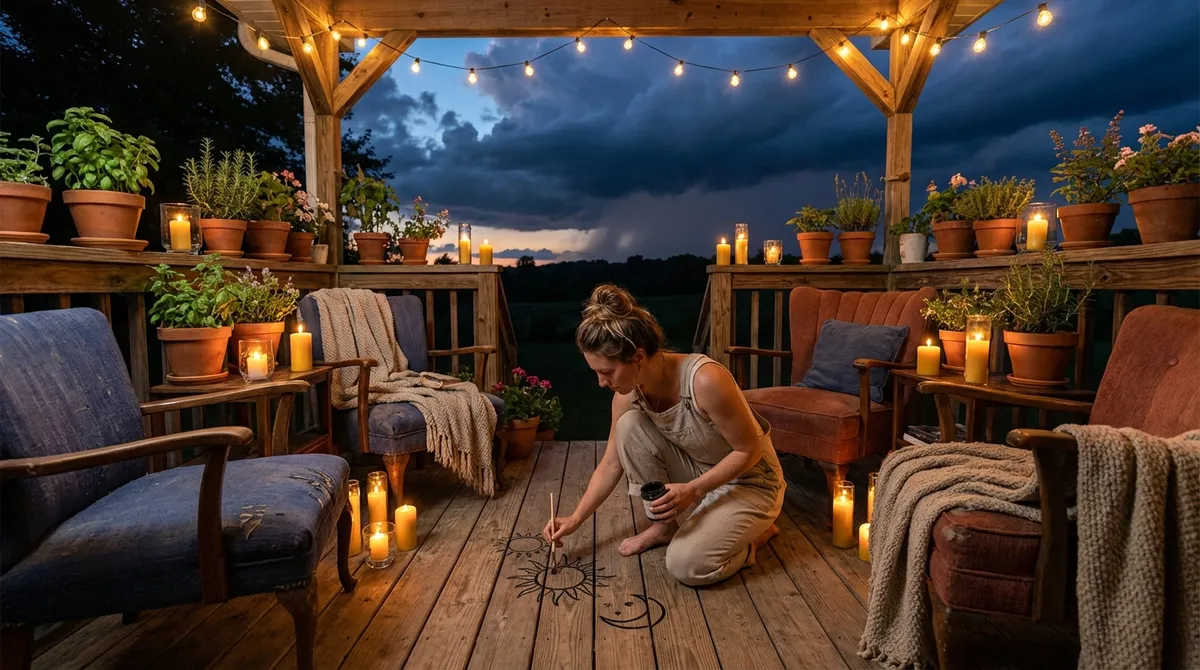
Below are five soulful design ideas to help you shape a porch that doesn’t just look beautiful in photos, but actually feels like a place your life can unfold.
1. The “Arrival Ritual” Porch
Think of your porch as the opening chapter of your home’s story—a place where stress falls away and a softer version of you steps forward.
Design this space around a simple ritual you can repeat every day. Maybe it’s a bench right by the door with a woven basket for shoes and a small table for keys and mail, turning arrival into a gentle, grounding routine. Add a single comfortable chair or rocker facing outward so you can pause for two slow breaths before you walk inside, or as you head out into the world.
Play with texture: a jute runner underfoot, a wood or metal coat hook rail, a ceramic or terracotta pot near the door holding herbs like lavender or rosemary. When you brush your hand across the leaves, they release scent—an instant signal that you’ve crossed from “rush” to “rest.”
Soft, warm lighting (think lantern-style sconces or a dimmable overhead fixture) helps the porch glow like an invitation instead of a spotlight. This isn’t just décor; it’s choreography. You’re designing how it feels to arrive home.
2. The Open‑Air Reading Nook
If you’ve ever wished books came with their own weather, this is the porch for you.
Create a reading corner that treats the sky as a ceiling and birdsong as background music. Start with one truly comfortable seat—something you can sink into for an entire chapter: a deep-cushioned chair, a cushioned porch swing, or a daybed piled with pillows. Choose outdoor fabrics in soft, sun-washed tones that echo the colors just beyond your railing—moss greens, cloud grays, pale blues, or sand.
Layer your nook like you’d layer a sentence: thoughtfully and with rhythm. A small side table for tea, iced coffee, or a stack of books. A throw blanket stored in a weather-resistant basket for cooler evenings. A floor lantern or wall sconce with a warm, not harsh, bulb—bright enough for late-night pages without stealing the magic of the dark.
If your porch catches a lot of sun, sheer outdoor curtains or bamboo shades can be your adjustable “page markers,” letting you move from bright daylight to soft shade in an instant. Add a subtle sound element—like a small fountain or wind chimes tuned to gentle notes—to smooth out the noise of nearby streets.
The goal is simple: when you see this corner, you feel a tug to sit down “just for a minute.” That minute becomes twenty. And that’s how a porch becomes part of your reading life.
3. The Shared-Table Story Porch
Some porches are meant for more than one heart at a time.
If you dream of dinners under the fading sky or card games that go late enough for a second pot of tea, design your porch around a shared table. Size matters here: choose one that allows for plates, glasses, and maybe a vase of cut branches or wildflowers without crowding elbows. A slim rectangular table works beautifully on narrow porches; a round bistro table feels intimate on smaller spaces.
Mix seating styles—two classic chairs, a bench along the wall, maybe a pair of stools that tuck away when not in use. This variety invites people to shuffle, shift, lean in. It makes the space feel less staged, more lived-in.
String lights overhead or along the railing draw a soft line of stars around your gathering. Combine them with one strong, central light source (like a pendant or semi-flush fixture) that you can dim as conversations deepen. Candlelight—real or LED—can anchor the center of the table without competing.
Keep a “porch caddy” nearby: a tray or basket holding folded cloth napkins, a deck of cards, citronella candles, coasters, and maybe a small notebook where guests can leave little notes or favorite quotes. Your table isn’t just for meals; it’s a surface where stories land and linger.
When you design a porch as a shared table, you’re not just decorating. You’re making a promise: there will be room here. For people, for plates, for laughter that spills over the railing.
4. The Nature-Weaving Threshold
Instead of thinking of your porch as separate from your yard or garden, imagine it as a woven edge where indoors and outdoors braid together.
Start at eye level. Hang a simple trellis or vertical planter along one wall and let climbing plants—like clematis, jasmine, or native vines—trace their way upward. This softens hard lines and pulls green into your periphery, even if your porch is in the heart of a city. If your climate allows, add a tall pot with a small tree or structural plant to create a sense of shelter and height.
At ground level, cluster pots of different heights and materials: terracotta, glazed ceramic, or even galvanized metal. Mix herbs with flowers and foliage plants so you get fragrance, color, and texture all at once. When you brush past thyme or basil on the way in, you’re writing scent into your daily routine.
Use natural materials as much as possible: a wood or composite floor, a stone or wood side table, seagrass or rattan baskets. Layer an outdoor rug that echoes the tones of nearby plants—the deep green of leaves, the rust of bark, the cream of petals. This visual echo blurs the boundary between porch and garden.
If your porch overlooks a busy street, plants can also act as a privacy veil. A row of tall grasses, potted shrubs, or planters lined up along the railing filters views while still allowing sunlight and breeze. You’re not closing off the world; you’re choosing how it reaches you.
This kind of design turns your porch into a living threshold. Season by season, it shifts and grows, inviting you to step into a slightly greener version of your own life.
5. The Day-to-Night Shape‑Shifting Porch
A truly magical porch doesn’t belong to just one time of day—it transforms with the light.
Begin by imagining the porch in three acts: morning, afternoon, and night. In the morning, you might want a sunlit coffee corner—a small table and chair where the first rays reach. A light-toned rug and reflective surfaces like glazed pots or a pale tabletop can amplify those early beams, making small spaces feel brighter.
By afternoon, shade becomes everything. Incorporate adjustable elements: roll-down shades, outdoor curtains, a tilting umbrella, or a pergola with a simple fabric canopy. Position your main seating where it can catch the best breeze, not just the best view. A ceiling fan or portable outdoor fan can turn hot air into a slow, steady drift.
At night, lighting is your paintbrush. Instead of a single bright source, layer different intensities: a gentle overhead light, string lights tracing the perimeter, and a few low-level accents like lanterns or step lights. Think of it as setting a stage: bright enough for board games, low enough that stars still feel visible.
Consider flexible, lightweight furniture that can be rearranged for different “modes”: a solo journaling corner, a gathering circle, or a yoga mat space. Nesting tables, stackable stools, and moveable plant stands make it easy to reset the scene. Store a small, weather-safe crate or cabinet on the porch with candles, blankets, and a portable speaker so the space can shift in under five minutes.
When your porch is designed to change with the day, you start using it more. Morning you has a place. Tired-after-work you has a place. Weekend-gathering you has a place. That’s when a porch stops being a backdrop and becomes a living part of your everyday rhythm.
Conclusion
Porch design isn’t really about chairs, rugs, or string lights—it’s about what those choices make possible. A place to pause before you cross a threshold. A corner where books and breeze meet. A table that gathers people in. A living edge where plants, light, and weather become part of your routines.
When you treat your porch as an emotional space instead of just an architectural one, even a tiny landing or narrow balcony can feel like a retreat. Start with one idea that tugs at you—an arrival ritual, a reading nook, a shared table—and build from there. Little by little, you’re not just decorating a porch; you’re designing the way your days begin, unfold, and quietly end.
Sources
- U.S. Department of Energy – Outdoor Lighting Tips - Guidance on selecting efficient, comfortable outdoor lighting for porches and patios
- Illinois Extension – Container Gardening - Practical information on choosing and arranging plants in containers for small outdoor spaces
- North Carolina State University Extension – Using Native Plants - Database to help select region-appropriate plants and vines for porch and threshold planting
- Harvard Health – The Health Benefits of Time Outdoors - Research-backed overview of how outdoor spaces like porches support mental well-being
- National Association of Home Builders – Outdoor Living Trends - Insights into how homeowners are using and valuing outdoor living areas