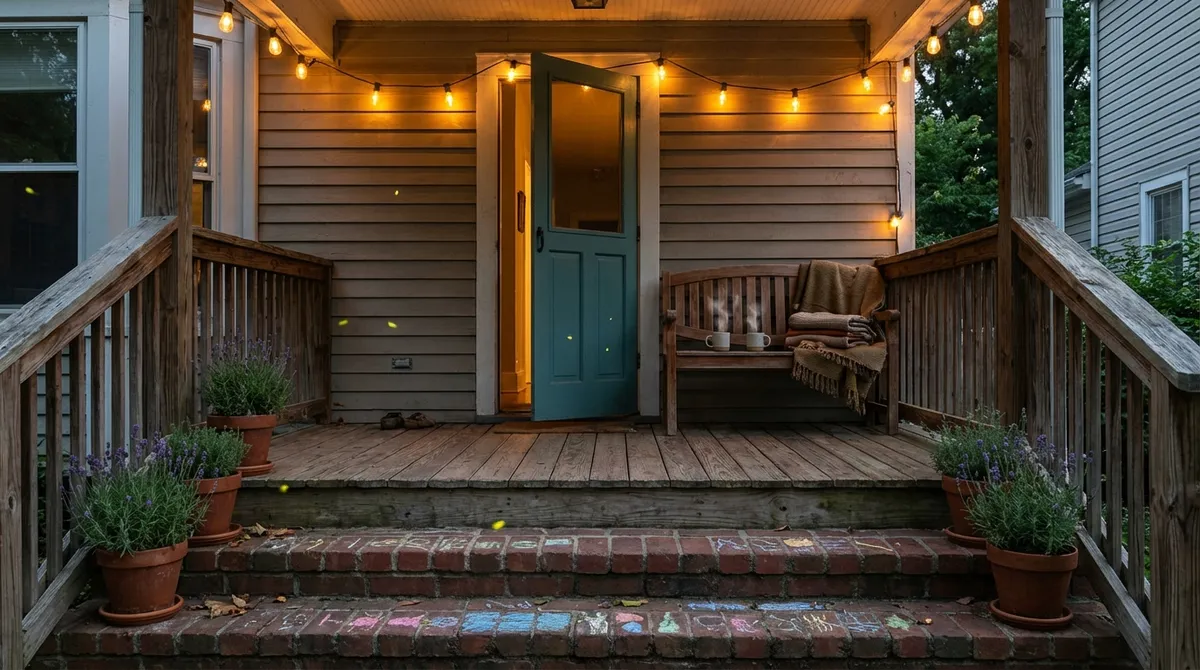
Below are five design ideas that outdoor living enthusiasts can shape into their own. Treat them as invitations, not instructions—your porch is a story that only you can tell.
1. The Conversation Arc: Seating That Pulls People Closer
Picture this: instead of a straight line of chairs pressed against the siding, your seating curves inward like open arms. Rockers angled toward each other, a bench at a diagonal, a small accent chair completing the circle—suddenly your porch isn’t a viewing platform, it’s a gathering place.
Design your seating so people naturally face one another, not the sidewalk. Use a mix of textures to keep it alive: a woven loveseat, a slatted wood bench, a pillowy armchair made for sinking in. Add cushions in earthy tones or sun-washed colors to soften every edge. A small round table in the center gives coffee mugs, iced tea, and late-night glasses of wine a home base. This “conversation arc” makes even a compact porch feel generous, like it’s leaning forward to hear your stories instead of hiding behind a railing.
2. Layers of Light: Painting the Evening With Glow
Light is where porches learn to whisper instead of shout. Instead of relying on a single overhead fixture, think in layers—like brushstrokes of glow that you can turn up or down depending on the mood.
Start with something warm and steady: a wall lantern or sconce flanking the door with amber-toned bulbs that won’t glare. Add a softer, lower layer—string lights tucked along the ceiling line, or wrapped around a column, dim enough to feel like a memory. Bring in one or two portable accents, such as lanterns with candles (real or LED) on the floor or table, to anchor the space with a campfire-like intimacy.
By mixing fixed, ambient, and accent lighting, your porch becomes more than an entry—it becomes a nightly ritual. You’re not just flipping on a switch; you’re lighting a scene that tells your body: you’re home now, you can exhale.
3. Green Thresholds: Turning the Porch Into a Soft Forest Edge
A porch doesn’t need acres of land to feel lush. With a few intentional plant choices, you can turn this in-between space into a kind of green threshold—a soft forest edge where leaves, petals, and scent blur the boundary between indoors and out.
Think in vertical layers. At ground and step level, use large containers with structural plants: small evergreens, ornamental grasses, or dwarf trees to give a sense of permanence. At railing height, mix trailing vines and flowering annuals that spill and soften hard lines. Up high, consider hanging baskets or wall-mounted planters that draw the eye upward and frame the sky.
Choose plants that respond to your climate and light, but also think about experience: herbs you can brush and smell on your way in (rosemary, lavender, mint), pollinator-friendly blooms that bring hummingbirds and bees, or fragrant evening flowers that release their scent just as you settle into your chair. Over time, your porch becomes less of a front and more of a living edge—where nature politely steps forward to meet you halfway.
4. Story Layers Underfoot: Rugs, Patterns, and Quiet Drama
Floors are the most overlooked storytellers on a porch. Beneath your feet is a canvas waiting to be dressed, and the right choices can turn a bare slab or simple decking into a stage set for daily rituals.
Start with an outdoor rug that feels like a chapter heading: bold stripes for a coastal, breezy vibe; intricate patterns for a collected, travel-worn feel; soft neutrals for a calm, spa-like retreat. Size matters—go large enough so that most of your furniture legs rest on it, pulling every piece into one visual “room.”
Layer if you can: a solid base rug and a smaller patterned one on top beneath your coffee table or main seating area. This depth underfoot instantly warms the space, both visually and emotionally. Add small details—a woven basket for blankets, a low wooden stool as a side table, a footrest that invites bare toes. Without moving a wall or adding a window, you’ve said something powerful: this porch is not leftover space. It’s a room with its own story, written in threads and edges.
5. Personalized Ritual Corners: Designing for How You Actually Live
Instead of asking, “What should a porch look like?” ask, “What do I want to do here—again and again?” Then carve out a corner that fiercely protects that ritual.
If you’re a morning person, create a sunrise nook: one deep chair pulled toward the best light, a small side table for a mug, and a throw blanket draped over the back like a promise. Add a single piece of wall art or a weatherproof shelf with your favorite books or a small plant, so the space feels distinctly yours.
If evenings are your time, lean into that: a low, cushioned bench with pillows in dusk tones, wind chimes that catch the slightest breeze, maybe a portable speaker tucked discreetly away for background music. For creatives, consider a narrow writing ledge, a sketching stool, or a small potting station where hands and mind both find something to shape.
By designing for a specific ritual rather than a generic “nice porch,” you anchor the space in daily life. The porch stops being a backdrop and becomes a partner—quietly, steadily helping you keep the promises you make to yourself.
Conclusion
A porch is more than an architectural feature; it’s the emotional punctuation at the beginning and end of every day. With conversation-shaped seating, layered lighting, living greenery, grounded textiles, and corners tailored to your personal rituals, you’re not just decorating—you’re choreographing how life flows in and out of your front door.
When you give your porch intention, it gives you something back: an open-air room where time stretches, neighbors slow down, and your own heartbeat feels easier to hear. You don’t need a grand veranda or perfect weather to begin—just the courage to say, “This small space matters,” and to design it as if every arrival and every goodbye deserved a beautiful place to stand.
Sources
- U.S. Environmental Protection Agency – Green Landscaping – Guidance on plant choices, native species, and sustainable outdoor design ideas
- University of Minnesota Extension – Selecting Landscape Plants – Practical information on choosing plants that fit your climate and light conditions
- Energy.gov – Lighting Choices to Save You Money – Overview of bulb types, color temperatures, and efficient lighting that can inform layered porch lighting
- This Old House – Front Porch Ideas – Inspiration and practical tips for transforming front porches into functional outdoor rooms
- American Society of Landscape Architects (ASLA) – Residential Design Trends – Insights into current outdoor living and residential design trends, including porches and entry spaces