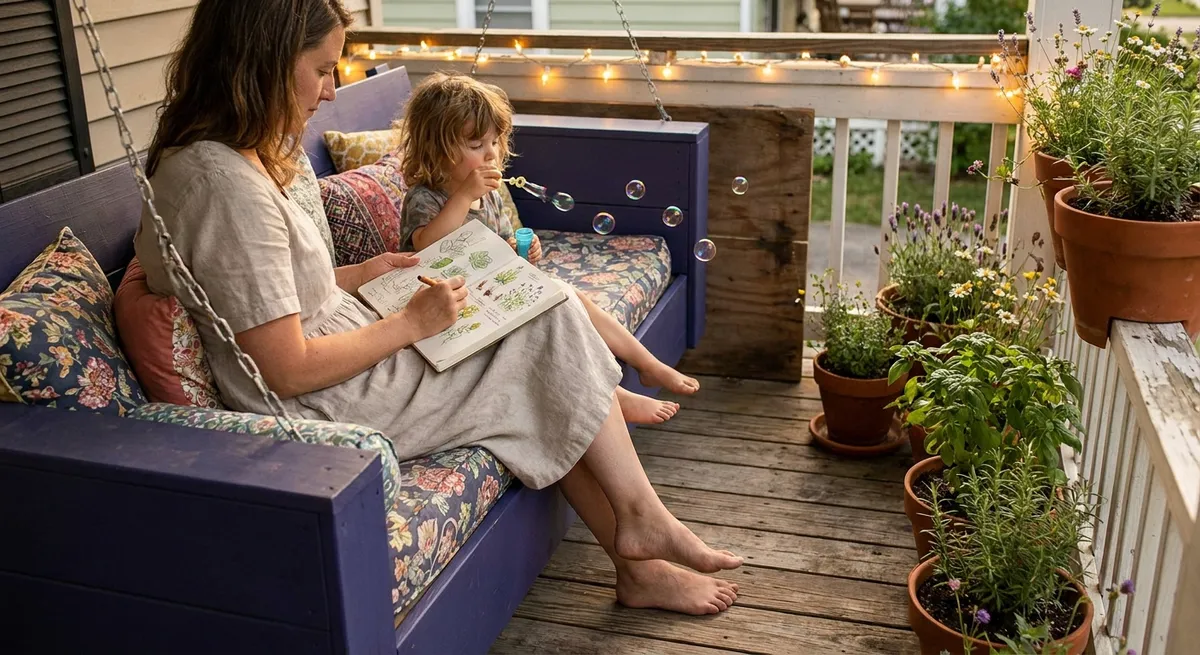
Below are five design ideas that turn any porch—big or small, front or back—into a place where memories aren’t just made, they’re almost inevitable.
1. The Conversation Porch: Designing for Real Connection
Picture a porch where every seat feels like the best one. Not lined up in a polite row against the house, but gathered in a loose circle that says: stay awhile. This is the conversation porch—the kind that pulls friends, neighbors, and family into orbit around one another.
Begin with seating that faces inward: two chairs angled toward a small loveseat, or a pair of rockers turned slightly toward a central table. The layout should feel like a campfire without the flames—everyone can see everyone. Mix textures to make it inviting: a woven outdoor rug underfoot, a smooth wooden coffee table, soft cushions that beg you to sink in. Add a tray that’s always ready to catch a teapot, a pitcher of lemonade, or a scattered hand of cards.
Lighting should flatter and soften, like pre-dusk in a favorite movie. String lights overhead, a pair of lanterns on the floor in the corners, maybe one warm-toned wall sconce. No harsh overhead glare; think candlelight, even if it’s LED.
Then tuck small conversation starters into the corners: a weathered chess set half mid-game, a stack of beautiful books, a vintage radio or Bluetooth speaker waiting with a soft playlist. This porch is designed like a living room that just happens to breathe the evening air—and people will feel that the moment they step outside.
2. The Green Threshold: Turning Your Porch into a Soft Garden Edge
There’s a special kind of magic when a porch feels like it’s slowly being reclaimed by plants—softly blurred at the edges, framed by green, dappled with filtered light. The green threshold porch doesn’t try to shut nature out; it invites it right up to the door.
Start by imagining your porch as the gentle pause between garden and home. Use vertical height to create a living frame: hanging baskets on either side of the entry, trailing vines from ceiling hooks, tall planters that rise like sentinels near the steps. Climbing plants like clematis or jasmine can twine around railings, creating a living balustrade that shifts with the seasons.
Layer your planting: one tall element (a small potted tree or shrub), one medium (herb planters, flowering perennials), and one low (groundcover spilling over the edges of containers). Even the smallest porch can hold a vertical garden—slim shelves, rail planters, or wall-mounted pockets can turn bare walls into green tapestries.
Use plants with purposeful scents and textures: lavender by the steps to brush with your leg as you pass, mint near the chair where you read, a pot of rosemary you can break off while you think. At night, choose solar or low-voltage lights that softly graze leaves and branches, turning shadows into art on the porch floor.
This porch becomes more than an entrance; it’s a living, changing welcome mat that grows, blooms, and rests along with you.
3. The Quiet Work Porch: A Daylight Studio for Ideas and Projects
Some porches are meant for doing nothing. This one is meant for doing the things that matter. The quiet work porch is a gentle workspace—part studio, part study, part sanctuary—where the air itself feels like a co-worker reminding you to look up once in a while.
Begin by claiming one corner and naming it your “porch studio.” A narrow writing desk, a sturdy bistro table, or even a wide console against the wall can become your workstation. Pair it with a chair comfortable enough to linger in, but structured enough that you won’t immediately fall asleep in it.
Light is everything: position the table where you can see the horizon, the street, or the yard without being blinded by glare. If your porch is covered, consider a floor lamp designed for outdoor use or clamp-on task lighting that can angle over your notebook or laptop as the sun shifts.
Edit this space deliberately. A small ceramic cup for pens, a lidded basket to stash notebooks or craft supplies, a tray for your favorite mug and a carafe of water or coffee. Instead of clutter, let a few objects carry meaning: a framed photo on the wall, a pinned inspiration board, a single vase that changes with the seasons—spring branches, summer flowers, autumn leaves, winter greenery.
Sound matters too. The porch already comes with birds, wind, and the distant hum of life. Add a small speaker for soft music or ambient sounds, or lean fully into the unscripted soundtrack of your street or backyard. This porch doesn’t demand you be productive; it simply clears a little space where ideas are easier to catch.
4. The Twilight Porch: Built for Evenings that Stretch On
The twilight porch is designed for the hour when the world softens—the sky in gradient, streetlights humming awake, the air finally gentle. This porch doesn’t peak at noon; it comes alive after dinner, when you can feel time loosening its grip a little.
Start by thinking in layers of glow rather than a single bright lamp. String lights along the ceiling, tuck solar lanterns on the steps, add candles (real or flameless) inside hurricane glass on the table. Aim for overlapping pools of soft light instead of one blinding source. On cooler nights, a small fire bowl, tabletop fire feature, or outdoor-safe heater can anchor the scene with both warmth and visual focus.
Choose textiles that feel like an exhale: plush outdoor cushions, a couple of heavy throw blankets in a basket, a thick rug underfoot to keep the chill from your toes. Darker, moodier colors work beautifully here—inky blues, deep rusts, charcoals—each catching candlelight in a different way.
Design in rituals. A tray set up for evening tea or wine, a lidded jar with matches, a favorite deck of cards or a notebook kept within reach. Wind chimes or small bells in one corner can give the breeze a voice, but keep it subtle so it doesn’t drown out conversation or quiet.
When you step onto a porch like this after sunset, it feels like walking into a small, open-roofed theater where your life gets to be the only performance that matters.
5. The Threshold Gallery: Porches That Tell Your Story Before the Door Opens
Every home has a story, and the porch is the prologue. The threshold gallery porch treats that space like a curated exhibit—not of perfection, but of who you truly are and what you love.
Start with your walls and vertical surfaces as canvas. Install simple outdoor shelves or ledges that can hold a rotating cast of objects: a small sculpture, a cluster of candles, a row of tiny potted succulents, a framed print under glass. Consider a single statement piece—an oversized mirror, a bold outdoor-safe art print, or a handmade sign—that acts as the title card to your story.
Use textiles and color as your language. A patterned rug that reminds you of a favorite trip, cushions in hues tied to your garden or the surrounding landscape, a painted door that declares itself from down the street. You can echo those colors in smaller details—planter glazes, doormat designs, even the binding on your porch throw blanket.
Personal artifacts are what make this more than decor. Display a vintage crate from your hometown as a side table, hang an instrument you actually play (and occasionally take down), mount a board with hooks for sunhats that see real use. A battered watering can, a well-loved pair of boots by the door, a chalkboard with today’s quote—these speak louder than any perfect styling.
At night, spotlight the story gently with focused lighting: a sconce over a piece of art, a small lamp near the door, a string of fairy lights outlining an archway. The goal isn’t to impress strangers—it’s to let your porch quietly introduce you to anyone who steps up, including yourself each time you come home.
Conclusion
Porch design isn’t about chasing a magazine photograph; it’s about shaping a daily experience. A place to talk longer than you planned, to grow something green, to work on what matters, to savor twilight, to tell your story without a single word.
When you design your porch as if it were a chapter in the life you want to live, the space stops being “extra” square footage and starts becoming a faithful witness: to your mornings, your evenings, your projects, your rest.
Step outside with intention, move a chair, hang a light, pot a plant, place a meaningful object, and watch what happens. Sometimes, the smallest change on the porch is what finally opens the door to a bigger, quieter, more beautiful way of living.
Sources
- U.S. Department of Energy – Outdoor Lighting Tips - Guidance on choosing energy-efficient outdoor lighting and creating layered illumination
- University of Minnesota Extension – Container Gardening - Practical advice on selecting and arranging plants for containers and small spaces like porches
- Royal Horticultural Society – Climbers and Wall Shrubs - Information on climbing plants suitable for training along railings and porch structures
- Harvard Health – The Healing Power of Nature - Explores the mental health benefits of spending time in outdoor and semi-outdoor spaces
- American Institute of Architects – Home Design Trends Survey - Insights into residential outdoor living trends and how homeowners are using porches and similar spaces