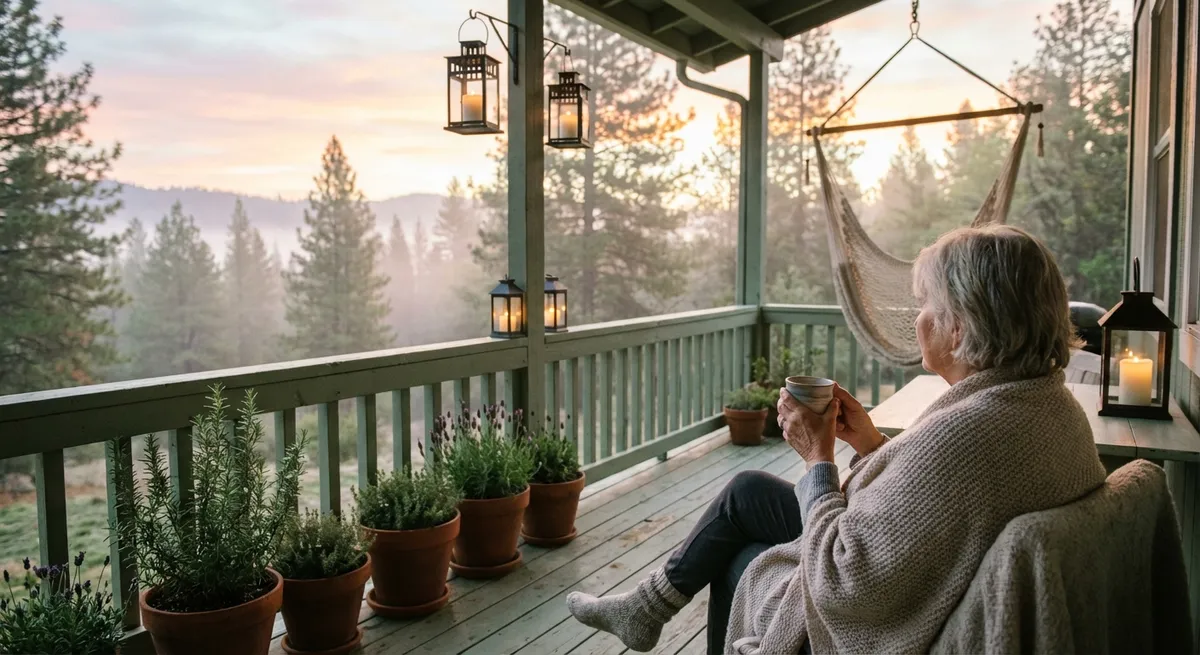
If you love being outdoors, your porch can be more than a pass-through space. It can become the soul of your home’s outside life: a listening room for rain, a reading nook for sunlit afternoons, a gathering place that glows after dusk. Here are five porch design ideas for outdoor living enthusiasts who want their porches to feel like an invitation to linger, breathe, and truly arrive.
1. The Dawn Nook: Designing a Corner for First-Light Rituals
Imagine a porch corner that feels like it wakes up with you—soft, welcoming, and just a little bit magical. Start by choosing the spot that catches the earliest light or the gentlest morning shade. Position a low, deep chair or a small bench so you naturally face the sunrise, the street, or the nearest trees—whatever view makes your shoulders drop and your breath slow.
Layer in textures that feel comforting at the edges of the day: a thick-knit throw tossed over the back of the chair, a small outdoor rug underfoot, a side table just big enough for a mug and a book. If your porch is covered, hang a lightweight outdoor curtain panel on one side; it can soften harsh light, sway in the breeze, and create a sense of being partially cocooned without shutting you away from the world.
Plants make this nook feel alive at dawn. Think pots of herbs you can reach for—mint, basil, rosemary—or a single tall planter of grasses that catch and shimmer with the first light. A small wall-mounted sconce or rechargeable lantern can gently bridge the dark-to-light moments, giving you permission to step outside even before the sun fully rises. Over time, this little nook stops being “decor” and becomes your daily ceremony: wake up, step out, settle in, and let the day find you.
2. The Breezy Threshold: Turning Your Porch Into an Indoor-Outdoor Flow
A well-designed porch doesn’t just sit in front of the house—it connects the inside to the world beyond your door. To create this sense of flow, think like a storyteller moving between chapters: what belongs to the interior, what belongs to the yard, and how can the porch cue both at once?
Start at the door. Use a similar color palette or material on your porch as you do inside—maybe the same wood tone, an echo of your living room colors in the outdoor pillows, or interior-style art framed in weather-resistant materials. This visual continuity tells your brain, “I’m still home,” even as you step outside.
Then, guide the eye outward. Arrange furniture so you naturally face your view instead of the house. A swing or daybed set perpendicular to the door can create a gentle “turning” motion as you step outside, nudging you toward the yard, garden, or street life. Place plants in a loose gradient—smaller pots closer to the house, taller planters or shrubs nearer the railings—so your porch feels like a soft slope leading into the landscape.
Accent lighting can emphasize this threshold. Install a warm fixture near the door in the same style family as your interior lights, then move into more casual, playful lighting—string lights, lanterns, candles—toward the outer edge. At night, the porch becomes a glowing in-between: close enough to the comforts of home, open enough to feel the night air on your skin.
3. The Conversation Circle: A Porch Meant for Stories That Go Long
Some porches are made for passing waves to neighbors; others are meant for the kind of conversation that makes you forget to check your phone for hours. If you crave that second kind, design your porch as a conversation circle rather than a row of chairs facing out.
Begin with a focal point at the center: a low table, a fire bowl rated for outdoor use, or simply a large woven ottoman that can hold drinks and board games. Arrange chairs and benches around it in a loose circle or gentle horseshoe, close enough that people don’t have to raise their voices to be heard. Nothing should feel too “front row” or “back row”—everyone gets a good seat.
Mix seating types to match different moods and bodies: a sturdy, upright chair for the person who likes to perch and gesture; a deep lounge chair for someone who wants to tuck in; a shared bench for side-by-side chats. Add cushions in breathable outdoor fabrics, and don’t be afraid of color—conversation feels easier in a place that doesn’t take itself too seriously.
To keep the circle feeling intimate, use vertical elements. A cluster of potted trees, a trellis with climbing vines, or a half-height privacy screen along one side can make the space feel like a room without four walls. At night, string lights or lanterns hung slightly lower than eye level create a visual “canopy” that everyone naturally leans into.
Over time, this design gently rewrites how your porch is used. It stops being the place you pass through and becomes where birthdays are toasted, decisions are weighed, kids’ questions are answered, and friendships quietly deepen.
4. The Seasonal Canvas: A Porch That Shifts With the Weather and Your Life
Outdoor living enthusiasts rarely want a static space; they want a porch that changes as the seasons and their own rhythms change. Instead of building one fixed look, think of your porch as a flexible canvas that can be dressed differently throughout the year.
Choose a neutral base that can handle all four seasons: weather-resistant furniture with clean lines, a durable rug, simple planters. Then, let the smaller layers do the seasonal storytelling. In spring, drape light throws in fresh greens and blues, add pots of bulbs and flowering annuals, and bring out airy lanterns. In summer, trade in for vibrant cushions, woven baskets for beach towels or outdoor games, and citronella candles that keep the bugs at bay.
Autumn might mean richer fabrics, plaid or earth-toned pillows, little stacks of blankets, and planters brimming with mums or ornamental kale. In winter, if your climate allows, a porch can still be a quiet hideout: add a portable heater or heavy blankets, fir or eucalyptus garlands, and a cluster of candles in hurricane lanterns to create a glow against the early dark.
A seasonal porch is also a reflection of your life’s chapters. Maybe the low table becomes a play surface for kids one year, then evolves into a plant stand for your new gardening obsession, then turns into a board-game hub for teen nights. When you design with intentional simplicity and modular pieces, the porch adapts with you, rather than asking you to adapt to it.
5. The Quiet Observatory: Designing a Porch for Sky, Weather, and Stillness
Not every porch needs to be social. Some are meant to be observatories—the places where you retreat to watch clouds roll, storms build, stars appear, and the neighborhood gently move past. To create this kind of soulful, observational porch, start with one generous, deeply comfortable seat that feels undeniably “yours.”
Place this chair where you can see the widest sweep of sky or the most interesting slice of your surroundings: the curve of the road, a beloved tree, the line where hills meet the horizon. Add a small side table and a stool or ottoman so you can change your posture as the minutes (or hours) go by. If possible, position this seat slightly apart from your main conversation area; a corner, an alcove, or the far end of the porch rail can become your personal lookout post.
Lighting here should be subtle and kind to your eyes: a low amber lantern, a candle, or a downward-facing sconce that leaves the sky dark and easy to see. Avoid harsh, bright bulbs that wash out the stars or glare off nearby windows. A pair of binoculars, a small basket for books or a sketchpad, and maybe a simple throw for chilly nights complete the setup.
This design idea isn’t about impressing guests. It’s about creating a small, steady ritual of paying attention. The more you sit here, the more you start to notice the pattern of birds at certain hours, the way the light hits your neighbor’s roof at sunset, the subtle shift of seasons long before the calendar says they’ve arrived. Over time, your porch becomes not just part of your house, but part of how you experience the world moving around you.
Conclusion
A well-loved porch is never just an architectural feature; it’s a lived-in threshold between your inner life and the wider world. When you design it with intention—crafting a dawn nook, a breezy threshold, a conversation circle, a seasonal canvas, or a quiet observatory—you’re doing more than picking furniture and colors. You’re shaping the way you begin and end your days, the way you gather with people you love, and the way you meet the sky, the weather, and the slow turning of time.
Your porch doesn’t have to be grand to be meaningful. It only has to be yours—tuned to your rituals, your pace, your idea of a beautiful moment. Start with one corner, one chair, one light, one plant, and let the space grow as your life outside grows with it. Before long, you’ll find that the moments you cherish most are often the ones that begin on those simple boards just beyond your front door.
Sources
- U.S. Department of Energy – Patio and Outdoor Space Design – Guidance on outdoor space design, comfort, and energy-efficient choices
- University of Minnesota Extension – Outdoor Rooms and Living Spaces – Educational insight into planning outdoor “rooms” and functional layouts
- Better Homes & Gardens – Porch Decorating Ideas – Practical inspiration and examples of decor, furniture, and seasonal updates
- The Spruce – Front Porch Design and Decorating Tips – Detailed suggestions for styling porches for comfort and curb appeal
- Mayo Clinic – The Benefits of Spending Time Outdoors – Explains health and well-being benefits of outdoor living and time spent outside