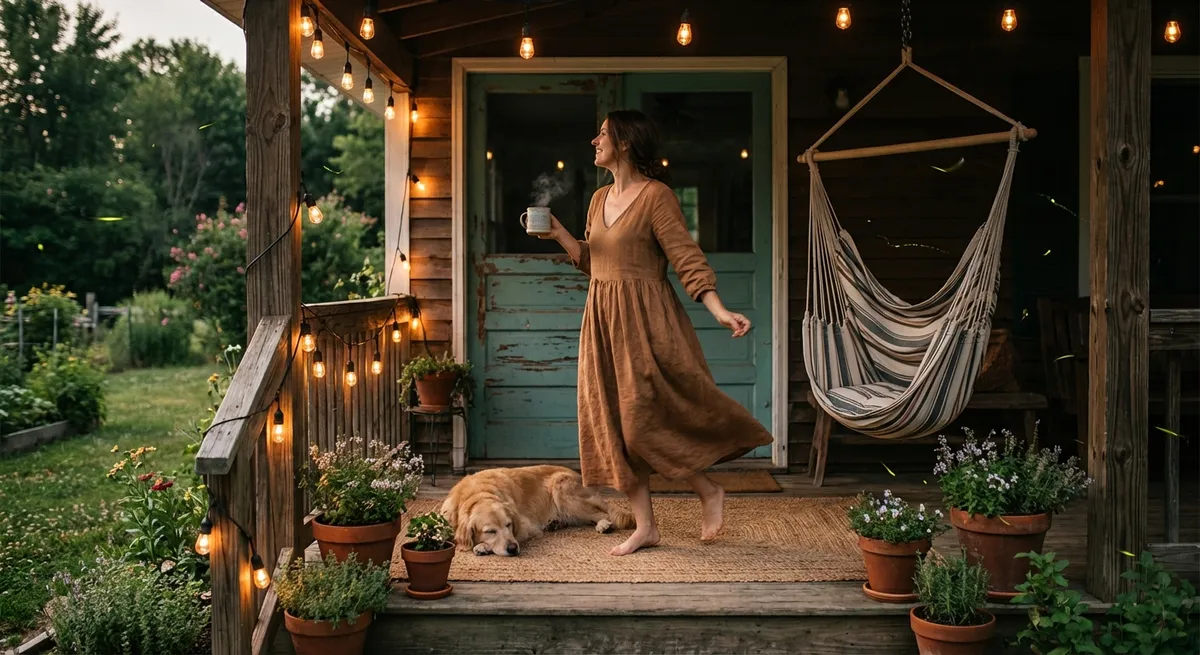
If you’ve ever wanted your porch to feel like a true extension of your spirit—and not just a pass-through—these five design ideas are for you. Each one is less about “decorating” and more about creating a living story that invites you to linger.
Idea 1: The Threshold of First Impressions
Every porch begins with a threshold: the moment you cross from “out there” to “in here.” Designing this transition with intention can transform your entire experience of home.
Start with your front door and the space immediately around it. Choose a color that makes you feel something specific: calm (soft blue or sage), energized (sunny yellow or coral), grounded (deep charcoal or forest green). Let the door be the heartbeat of the porch—bold enough to feel like a decision, soft enough to feel like an invitation.
Frame it with symmetry, even if everything else is eclectic. Matching lanterns on either side, twin planters with seasonal greenery, or a pair of simple stools or baskets can instantly give the porch a sense of order and calm. Add a rug that can handle weather but still feels like something you’d use indoors; suddenly, you’re not just on a slab, you’re on a welcome mat to your everyday life.
Finally, think about the tiny gestures that say “someone lives thoughtfully here.” A slim console shelf with a small vase of clippings from your yard, a brass hook for umbrellas, a woven basket where deliveries can land—these quiet details don’t show off; they simply whisper, You’re home now.
Idea 2: The Reading Nook in the Breeze
There’s a particular kind of silence that only exists outside: not empty, but filled with birdsong, leaves, distant traffic, the soft hiss of your own breath. A porch reading nook lets you sit right in the middle of that living silence and actually hear your own thoughts.
Begin with a chair that asks you to stay. Not just pretty—a chair that supports your back, lets you tuck your legs under, and cradles you without swallowing you. Rocking chairs and gliders are classics for a reason; they echo the rhythm of your own body when you’re lost in a page. Add a lightweight throw for shoulder-chill evenings and a cushion that feels like your favorite spot on the couch.
Lighting is essential. A simple weather-rated wall sconce or a solar-powered lantern can turn twilight into “just one more chapter” time. If outlets are scarce, consider rechargeable, portable lamps—small beacons that can follow you from chair to chair.
Then, create a micro-library within arm’s reach. A small side table or crate with a handful of books, a journal, a pencil cup, and maybe a lidded jar holding earplugs or earbuds. The goal isn’t a perfect Instagram corner; it’s a nook you can tumble into at a moment’s notice, coffee in one hand and a story in the other, while the world moves gently around you.
Idea 3: The Porch as Storyteller of the Seasons
A truly alive porch doesn’t look the same in January as it does in June. It breathes with the weather, changes its textures, and quietly marks the passing of time. Instead of thinking of seasonal décor as “extra work,” design your porch so the seasons become part of its personality.
Choose a base layer that feels timeless: neutral cushions, classic lantern shapes, a natural fiber rug, simple planters in ceramic, terracotta, or matte metal. Then let the smaller elements become your palette of change. Swap out pillow covers, throw blankets, door wreaths, and potted plants as the months move along.
Spring might mean herbs in clay pots, blush and green cushions, and a glass pitcher always ready for lemon water. Summer could bring striped pillows, coastal blues, hanging ferns, and a big basket of rolled-up beach towels. Autumn invites rusts and ochres, candles in hurricane glass, and a stack of flannel blankets that smell faintly of bonfire. Winter, even in warmer climates, can lean into texture—wool throws, evergreen sprigs, warm metallic accents, and a small stash of mugs for cocoa or tea.
By planning your porch as a seasonal storyteller, you create an outdoor space that never feels finished—and that’s the beauty. It evolves as you do, quietly reflecting each chapter of the year.
Idea 4: The Conversation Circle That Keeps People Lingering
Some porches practically beg for one more story, one more laugh, one more “let me tell you about this thing that happened.” If you want your porch to be a magnet for people, design it as a place where conversations naturally find their rhythm.
Start by thinking in circles, not lines. Rather than lining chairs against the wall, pull them toward the center. Arrange seating so everyone can see everyone else: two chairs angled toward a loveseat, or a trio of lounge chairs around a low table. Even on a narrow porch, you can angle two chairs slightly toward each other with a small table between them to signal, We talk here.
Layer in surfaces that welcome real life: a coffee table big enough for a tray of snacks and a scattering of books, plus side tables for drinks. Don’t be afraid of mixing materials—wood, metal, and woven textures together make the space feel gathered-over-time instead of showroom-perfect.
Then add tactile elements that make lingering feel natural: a basket of lightweight blankets, a deck of cards or a board game tucked on a shelf, citronella candles or a discreet fan to keep insects at bay. Consider soft sound, too—wind chimes, a small water feature, or a subtle outdoor speaker with a playlist that feels like your porch’s personal soundtrack.
When the seating is circular, the light is gentle, and people have something to hold (a mug, a card, a story), time has a way of slowing down without anyone noticing.
Idea 5: The Porch That Glows With Your Personal Rituals
The most powerful porches aren’t the ones with the fanciest furniture or the trendiest colors—they’re the ones that quietly hold your daily rituals. If you design from your habits instead of from a catalog, your porch becomes less a showpiece and more a sanctuary.
Ask yourself: What do I want to do out here, really? Maybe it’s a morning ritual—bare feet on cool boards, notebook open, steam curling from your favorite mug. Maybe it’s late-night stargazing, or afternoon sketching, or stretching after a run. For each ritual, build a tiny ecosystem.
For the morning person: a small bench or table at railing height (perfect for a laptop or journal), a comfy chair that faces the rising light, a wall hook for a robe or cardigan, and a lidded tin with tea or coffee pods. For the artist: a rolling cart or storage bench with sketchbooks, watercolor tins, or yarn; a stool that can move with the light. For the stargazer: a reclining chair, a dimmable lantern, a fleece throw, and a simple app on your phone to map the constellations above.
Think of your porch as a stage where your favorite version of you shows up again and again. Over time, the patina on the table, the fraying edge of a cushion, the well-thumbed spine of the porch book—all of it becomes evidence that this isn’t just a pretty space. It’s a practiced ritual of being present.
Conclusion
A porch doesn’t have to be grand, wide, or perfectly styled to change the way you live at home. It only has to be intentional. A welcoming threshold, a chair that knows your shape, a corner that changes with the seasons, a circle that keeps people talking, a nook that holds your rituals—these are the quiet ingredients of a porch that feels like a real “welcome-home moment.”
When you treat your porch as more than an architectural feature and start seeing it as a canvas for how you want to feel, something subtle shifts. The world may still move fast, your days may still be full—but there will always be this one place, just outside your front door, where you can step out, breathe in, and remember: you’re allowed to slow down, to listen, and to simply be.
Sources
- U.S. Department of Energy – Outdoor Lighting Tips - Guidance on safe, efficient outdoor lighting that can enhance porch ambiance
- University of Minnesota Extension – Container Gardening - Practical advice on selecting and caring for plants in porch planters and containers
- Mayo Clinic – The Benefits of Reading for Stress Reduction - Explains how reading and quiet routines (like porch reading nooks) support mental well-being
- Harvard Health Publishing – The Importance of Social Connection - Highlights why conversation-centered spaces, like porch seating circles, matter for health
- North Carolina State University Cooperative Extension – Safe and Comfortable Outdoor Living Spaces - Offers research-based ideas for designing functional, comfortable outdoor areas