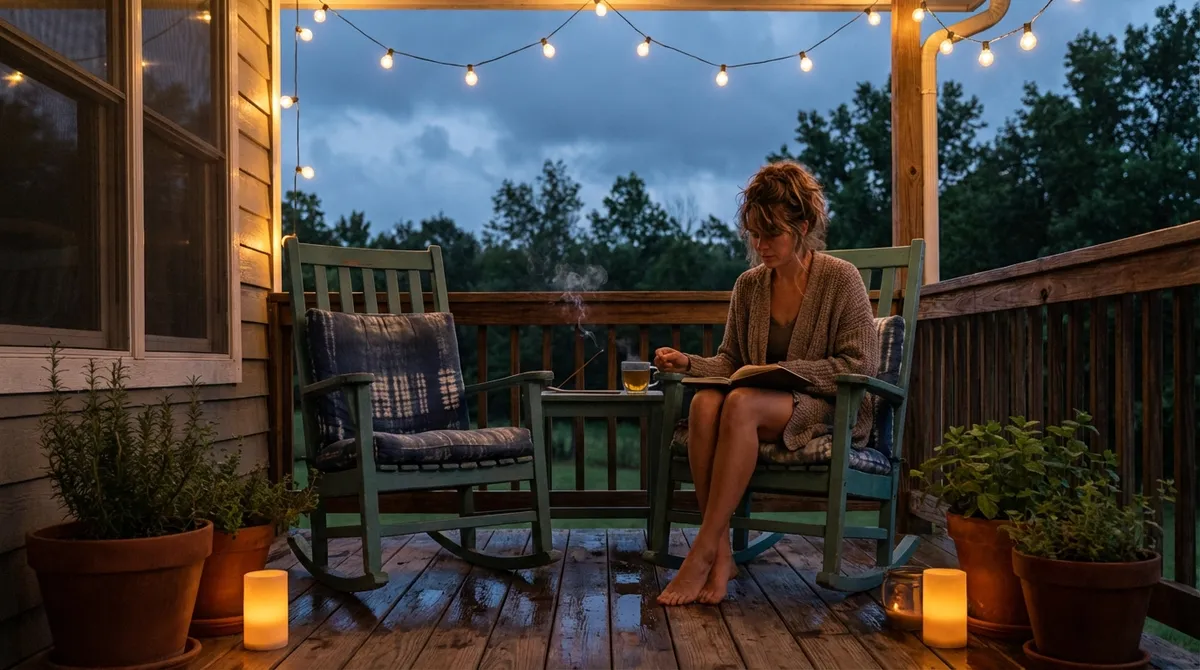
Below are five patio design ideas shaped for outdoor living enthusiasts who want more than “pretty.” These are spaces that hold stories, rituals, and the quiet kind of joy.
1. The Dawn Corner: A Patio That Wakes Up With You
Picture one corner of your patio dedicated purely to early light. Not practical light, but gentle, ribbon-like light that comes in soft and slow. Start by noticing where the first sunbeam lands in the morning; that spot becomes your dawn corner.
Layer a low, cushioned chair or a small daybed where your spine can unwind instead of just sit. Add a tiny café table, big enough for a mug, a notebook, and a single flower in a bud vase. Surround the space with tall, slender plants in containers—ornamental grasses, lavender, or rosemary—so the first wind of the day brushes sound and scent around you.
Soft textiles in pale, sun-washed tones—linen cushions, a cotton throw, a jute rug—make the space feel like a page you haven’t written on yet. Keep lighting minimal here: a single lantern or solar-powered candle, because this patio corner belongs mostly to the hours when the sky is doing the work for you.
Over time, this dawn corner becomes a ritual station: where you stretch, journal, read, or simply sit. A small space, but a big promise—to start each day by stepping outside yourself and into your life.
2. The Storytelling Circle: A Patio Built for Long Conversations
Every patio needs a place where time forgets its schedule. Build a storytelling circle, not around a TV or a screen, but around faces, voices, and the human need to linger.
Arrange your seating in a loose circle or soft horseshoe: low-slung armchairs, a bench layered with outdoor cushions, or even floor-level poufs and thick pillows for a casual, campfire feel. Avoid the “every chair faces the same way” layout. The goal is eye contact, not row seating. Use a wide fire pit or a substantial coffee table as your center anchor—something that invites the placing of hands, drinks, candles, and shared snacks.
Mix materials deliberately: a woven outdoor rug for warmth, a wooden or stone table for grounding, and metal or wicker chairs for texture. Drape one or two outdoor-safe throws over the backs of chairs so guests feel both welcome and unhurried.
If you add lighting, think in halos, not spotlights: string lights overhead, a cluster of LED candles, or a low lantern or two. You want faces lit, not washed out; warmth, not interrogation.
Over time this storytelling circle turns into a memory library—birthdays, late-night confessions, sudden laughter that spills out loud enough to surprise the neighbors. A design choice, yes, but also a quiet rebellion against rushing through your own life.
3. The Green Gallery: Turning Your Patio Into a Living Exhibit
Instead of treating plants as a background, let them be the show. Imagine your patio as a gallery and every pot, vine, and leaf as a living artwork curated over time.
Start with vertical space. Add trellises, wall-mounted planters, or a simple ladder-style plant stand to draw the eye upward. Climbing jasmine, clematis, honeysuckle, or native vines can turn blank fences into botanical murals. For containers, think of them as frames: choose a small palette of colors and materials—perhaps terracotta, matte black, and warm gray—to keep the scene cohesive as it grows.
Mix plant shapes and textures like an artist blends brushes: feather-light grasses next to glossy broad leaves, tiny groundcovers spilling over the rim of a pot near tall, architectural plants like bamboo or yucca (in appropriate climates or containers). Sprinkle in a few herbs—thyme trailing down, basil near the seating, mint in its own contained pot—to add fragrance and flavor to the air and your drinks.
Leave intentional pockets of negative space—an empty corner of deck, a bare stretch of wall—to keep the patio from feeling crowded. Add one or two focal pieces: a sculptural planter, a weathered statue, or a single bold-colored Adirondack chair that stands like a painting in the room.
Every season, rotate a few plants or accents. Your patio becomes a gallery that never quite looks the same twice, a quiet celebration of time passing and life constantly leafing out in new directions.
4. The Creative Nook: A Patio That Makes Things With You
Let your patio become the place where your hands remember what they can do. A creative nook doesn’t have to be big; it simply has to be intentional.
Designate one area as “the making space.” This could be a bar-height console against a wall, a fold-down table mounted to a fence, or a weatherproof table tucked under an overhang. Stock it with whatever supports your kind of creation: a basket with sketchbooks and pencils, a crate of gardening tools and seed packets, a tray with paints and brushes, or even a portable laptop stand and headphones for writing or composing outside.
Choose a chair that invites longer sessions—a seat with a supportive back, a cushion that doesn’t fight you. Add a small shelf or crate nearby for storage, so your tools live on the patio instead of having to be hauled out every time you get inspired. The easier it is to start, the more often you will.
Lighting matters here: consider a directed, warm outdoor sconce or a clamp-on rechargeable lamp so you can keep working into the blue hours. If noise is an issue, a simple tabletop fountain or gentle outdoor speaker can create a sound cocoon that blurs the edges of the world.
Over time, the creative nook becomes a place where you can measure your life not just by days passed, but by things made: pages filled, seedlings started, bracelets woven, ideas outlined. The patio stops being décor and becomes a studio without walls.
5. The Twilight Retreat: Layers of Softness Under an Open Sky
When the day finally unhooks its claws from your shoulders, your patio can receive what’s left of you and hand it back, calmer. Build your twilight retreat around softness and slow light.
Start with seating that encourages reclining, not just sitting: a chaise lounge, a cushioned outdoor sofa, or a hanging chair that rocks gently with the breeze. Choose cushions in dusk tones—slate blue, warm taupe, smoky mauve, deep green—colors that feel like the sky between sunset and nightfall. Layer in an outdoor rug underfoot so bare feet feel welcome.
Lighting is everything here. Use multiple small sources instead of one bright one: solar lanterns on the ground, fairy lights threaded through a railing, a few battery candles on side tables. Aim for a glow that’s more like fireflies than floodlights, so the stars can still do their work above you.
Add sensory details that say, “It’s safe to relax now.” A basket with soft blankets. A tray with herbal tea or a carafe of water infused with citrus or cucumber. A subtle citronella candle or bug-repellent lantern that protects without overwhelming the night air.
Finally, consider a simple ritual: turning on the lights at the same time each evening, stepping outside for at least ten slow breaths, or closing your day with a few minutes of sky-gazing. The twilight retreat isn’t just where you rest—it’s where your nervous system slowly remembers what peace feels like.
Conclusion
Your patio is more than square footage and furniture; it’s a threshold—between inside and out, between busy and still, between doing and being. When you design it with intention, you’re not just choosing chairs and planters. You’re choosing how you want to greet the day, hold your people, grow your ideas, and soften your nights.
Whether you begin with a single dawn corner or transform the whole space into a green gallery, each choice is a quiet declaration: this is a life worth stepping outside for. And the beautiful secret? Once your patio starts whispering back, you’ll wonder how you ever lived without its voice.
Sources
- U.S. Department of Energy – Outdoor Lighting Basics – Guidance on efficient outdoor lighting and using LEDs for ambiance and energy savings
- Royal Horticultural Society – Container Gardening – Practical advice on choosing plants, pots, and layouts for patios and small outdoor spaces
- University of Minnesota Extension – Landscaping with Native Plants – Evidence-based tips on selecting climate-appropriate plants that support local ecosystems
- Harvard Health Publishing – The Healing Power of Nature – Overview of research on how time spent outdoors can reduce stress and improve mental health
- National Gardening Association – Container Gardening Guide – Detailed guidance on soil, watering, and plant selection for healthy patio containers