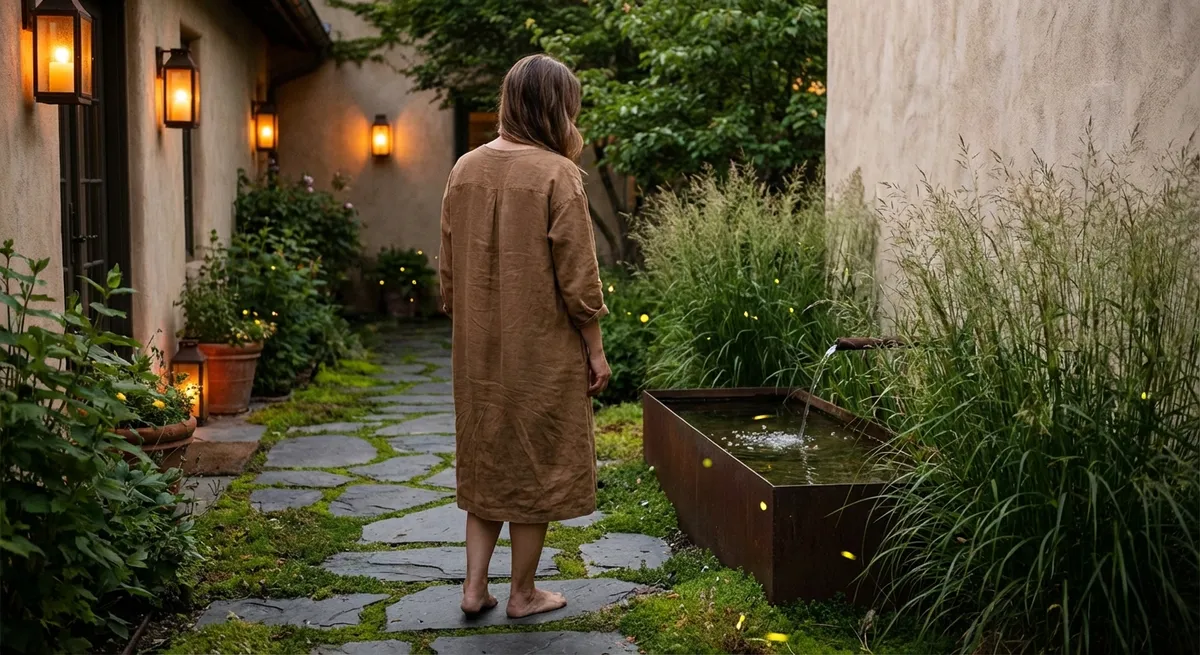
These five landscaping ideas aren’t about chasing trends. They’re about building a backyard that feels like a personal revolution—quiet, grounded, and absolutely yours.
Planting for Movement, Not Just Color
Most gardens are planned like paintings—flat, still, and meant to be admired from a distance. But the landscapes that stay with you are the ones that move. They rustle, sway, shimmer, and whisper when the wind comes through.
Think in layers and motion instead of just “pretty plants.” Tall ornamental grasses like switchgrass or feather reed grass form a soft, waving backdrop. Mid-layer shrubs—spirea, ninebark, or native hydrangeas—create depth and structure. At ground level, low perennials such as sedum, coneflower, yarrow, or creeping thyme fill in the quiet spaces. When a breeze passes through, everything responds.
Movement isn’t only about wind. Plant nectar-rich flowers to invite butterflies and bees. Add berry-producing shrubs to tempt birds into regular visits. Place a small birdbath or shallow water dish where you can see it from your favorite chair. Suddenly, your landscape becomes a living choreography—wings, leaves, petals—each moment slightly different than the day before.
Design paths that curve, not just cut across. A gentle bend framed with tall plants subtly slows your pace and encourages you to look around. You aren’t just walking from point A to B; you’re traveling through a small, changing world that’s always in motion.
The Year-Round Garden: Sculpting Every Season
Many yards peak for two weeks in June and then quietly fade. But outdoor living enthusiasts want something more enduring—a landscape that has something to say in January, April, August, and every month in between.
Start with bones. Evergreen shrubs, small conifers, and trees with interesting branching patterns give your yard a structure that doesn’t disappear in winter. A paperbark maple with peeling cinnamon bark, or a river birch with pale trunks, can be more striking in February than in midsummer.
Then, layer in four seasons of interest:
- Spring: Bulbs like daffodils, crocus, and tulips sneak color in before your perennials wake up. Early-flowering trees like serviceberry or redbud quietly announce the new season.
- Summer: Long-blooming perennials—black-eyed Susan, salvias, catmint, daylilies—carry color through hot months with less effort.
- Autumn: Grasses reach full drama, seed heads catch the light, and foliage turns fiery. Maples blaze, oakleaf hydrangeas glow, and sumac burns red against the fading green.
- Winter: Dried seed heads of coneflowers and grasses gather frost and snow. Red-twig dogwood glows against gray skies, and evergreen groundcovers keep the scene from feeling empty.
Instead of “winterizing” your garden by cutting everything down, consider leaving some seed heads and tall stems. They feed birds, catch snow, and give your off-season landscape a sculptural, poetic feel. Add a simple bench or chair where you can watch the year turn; your garden stops being a summer-only destination and becomes a calendar you live inside.
Fire, Water, and Stone: Elements That Anchor the Outdoors
Some landscapes feel scattered—a few pots here, a flowerbed there. What unifies a yard into a place you want to stay is often one simple thing: a strong anchor. Elements like fire, water, and stone give your space a gravity that pulls you outside, day after day.
A small fire feature—whether it’s a gas fire bowl, a stone fire pit, or a chiminea—extends your outdoor season deep into chilly evenings. Surround it with low, comfortable seating and soft groundcovers nearby, so warmth meets greenery. The glow of flames on leaves and stone turns your backyard into a nightly ritual instead of an occasional treat.
If fire doesn’t fit your life, invite water. It doesn’t have to be a dramatic waterfall; even a compact bubbling fountain or ceramic urn with a recirculating pump can transform the soundscape. Water softens city noise, masks road sounds, and gives your brain something calm to latch onto. Place it near a seating area or just outside a window, where you can hear it even when you’re indoors.
Stone grounds everything. A winding flagstone path, a simple gravel courtyard, a low stacked-stone wall—these quiet, earthy features make plantings feel intentional instead of random. Let thyme creep between stepping stones, spill low sedums over a wall, and edge a small gravel “terrace” with potted herbs. Together, these elements become your outdoor hearth: a place with its own quiet magnetism.
Edible Edges: Blurring the Line Between Garden and Kitchen
The future of outdoor living is not just ornamental; it’s edible. There’s something deeply satisfying about walking barefoot across your yard to pluck mint for tea or tomatoes for a salad. Edible landscaping weaves food into beauty so effortlessly that it doesn’t feel like a chore—it feels like a luxury.
Skip the isolated vegetable rectangle hidden in the back corner. Instead, blur the boundaries. Tuck herbs like rosemary, thyme, and oregano into sunny flowerbeds. Mix colorful Swiss chard or kale among your ornamentals; their leaves look as dramatic as many decorative plants. Add blueberry bushes as foundation shrubs—they give blossoms in spring, berries in summer, and crimson foliage in fall.
Replace a plain boxwood hedge with something that feeds you: espaliered apple trees along a fence, or a line of currants, gooseberries, or raspberries. Turn a standard pergola into a living tunnel by training grapes, hardy kiwi, or climbing beans overhead. The shade becomes edible; the architecture becomes alive.
Consider raised beds framed with beautiful materials—corten steel, cedar, stone—and position them near your main outdoor seating so the garden feels like a backdrop to your meals. When you harvest seconds before you eat, the yard stops being decor and becomes nourishment—visual, emotional, and literal.
Night Gardens: Designing for After the Sun Slips Away
Landscapes are often planned for noon, but many of the most memorable outdoor moments happen when the sun has already left the stage. A night-focused garden invites you to linger, listen, and rediscover your yard all over again.
Choose plants that shine in low light: white and pale flowers that seem to glow—like white echinacea, moonflower, evening primrose, shasta daisies, and white roses. Variegated foliage catches and reflects even subtle light, making your beds feel alive after dark. Fragrant plants—jasmine, nicotiana, lavender, honeysuckle—turn nighttime air into something almost tangible.
Layered outdoor lighting is key. Instead of a single bright floodlight, use warm, low-voltage lights to graze across pathways, uplight the trunks of trees, or softly highlight a stone wall. Aim for 2700K–3000K bulbs for a cozy, fire-like warmth. This isn’t about security brightness; it’s about atmosphere.
Add one sensory anchor: the crackle of a fire, the gentle bubbling of water, the rustle of grasses, or the chorus of crickets encouraged by native plantings. Place a deep, comfortable chair or hammock in a spot where you can see both stars and the soft outline of your landscape. The night garden isn’t about doing—it’s about being. Your yard becomes less of a project and more of a sanctuary.
Conclusion
Transformation in landscaping rarely arrives in one dramatic install. It comes in small, thoughtful choices—the first ornamental grass you plant for movement, the first evergreen that brightens winter, the first herb you pick right outside your back door.
When you think beyond “curb appeal” and start designing for seasons, senses, and daily rituals, your outdoor space stops being a background and becomes part of your story. Step outside, stand still for a moment, and listen. Your yard is already halfway to becoming the place you’ve been imagining. All it needs now are a few quiet revolutions—and your willingness to begin.
Sources
- United States Department of Agriculture – Plants Database – Plant information, native range, and growing conditions for grasses, shrubs, and perennials
- Royal Horticultural Society – Year-Round Interest Gardening – Guidance on planning gardens for four seasons of color and structure
- Cornell University Cooperative Extension – Edible Landscaping – Research-based tips on integrating food plants into ornamental landscapes
- University of Minnesota Extension – Outdoor Lighting for the Landscape – Best practices for creating safe, attractive, and energy-efficient night gardens
- National Wildlife Federation – Creating a Wildlife Habitat Garden – How to design landscapes that attract birds, butterflies, and beneficial insects