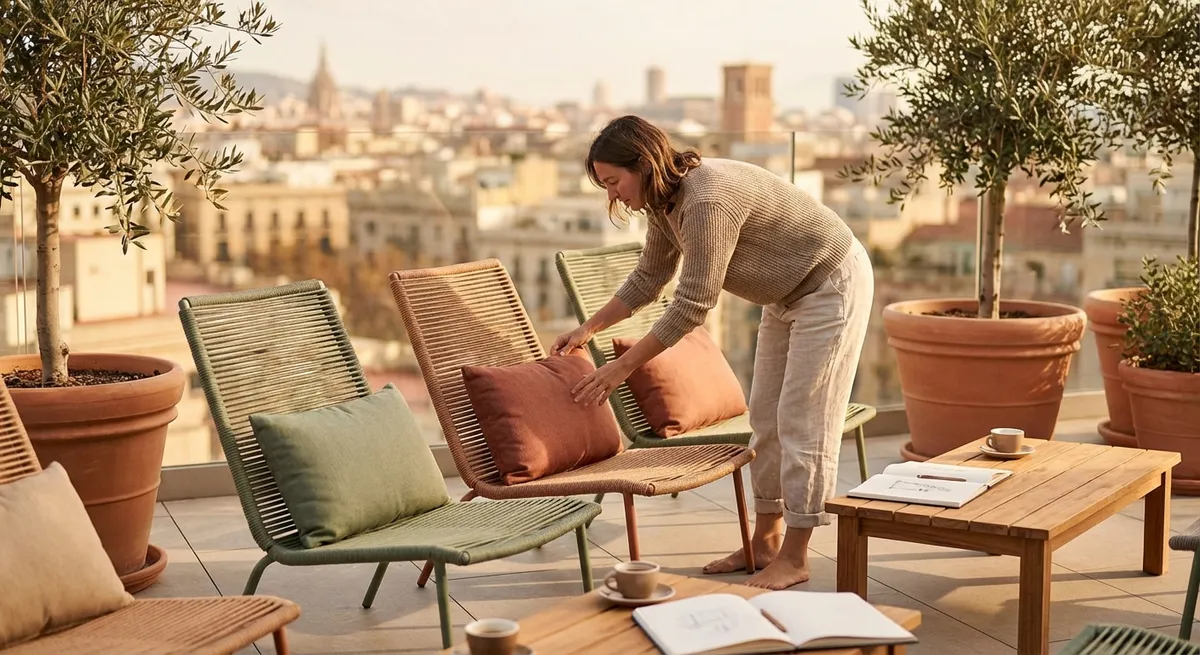
This is your invitation to design for who you want to become, not just for how you currently live. Below are five outdoor furniture ideas that don’t just decorate your space—they reframe your days.
Idea 1: The Conversation Circle That Refuses to Let the Night End
Picture this: not a row of chairs facing the view, but a circle that faces each other. A low, generous outdoor sofa curved into a semi-moon, two deep lounge chairs pulled close, and a sturdy round coffee table anchoring the center. No one has the “best seat”—everyone belongs.
A conversation circle invites people to linger. When seating subtly turns inward, voices soften and phones stay forgotten on side tables. Choose modular sectionals or curved loveseats that can be rearranged, and mix in a couple of lightweight poufs or stools that can be pulled into the ring when one guest becomes five. Use a table that’s wide and solid enough to handle everything at once: a stack of books, mismatched mugs, a candle lantern, the deck of cards that only comes out after dinner.
Look for weather-resistant cushions with performance fabrics; comfort is the difference between a 10-minute chat and a three-hour story. Layer throw pillows in different textures—linen, outdoor velvet, woven rope—so every seat feels like the one you secretly hope no one else chooses. The furniture becomes a quiet promise: if you sit down, time might get away from you.
Idea 2: The Solitude Seat: One Chair That Belongs Only to You
Every outdoor space deserves one throne—not for power, but for peace. This is the chair that holds your unspoken plans, your early-morning thoughts, your end-of-day exhale. It might be a sling chair that leans you slightly back toward the sky, a deep Adirondack cradling you like a patient friend, or a hanging egg chair that floats you just above the ground.
Choose this piece selfishly. Let it be the most comfortable seat outside, unapologetically shaped to your favorite posture—knees curled up under you, legs stretched and crossed at the ankle, or feet firmly planted. Add a small side table within reach for a book, a lemon slice in your water, a journal that has waited too long.
If you can, position your solitude seat toward movement: swaying trees, shifting shadows on the fence, birds that treat your yard like a runway. This helps your nervous system unwind; there’s something deeply human about having a “perch” from which to watch the world. A soft outdoor throw folded on the backrest turns chilly mornings or dusky evenings into moments you don’t have to cut short. You’re not just buying a chair—you’re buying a doorway to time alone that actually feels nourishing.
Idea 3: The Moveable Feast: Tables That Make Meals Wander Outside
Meals taste different in the open air. They slow down. Conversation stretches. The clink of glasses blends with wind and birds instead of kitchen hum. To make that magic possible more often, build your outdoor furniture around a table system that makes it easy to say, “Let’s just eat out here.”
Start with a dining table scaled to your reality. If your space is compact, a foldable bistro table or a narrow, bar-height ledge along a railing can feel like a café for two. If you have room to stretch out, look for extendable outdoor tables that grow when neighbors wander over. Materials matter here: powder-coated metal, teak, or high-pressure laminate tops that wipe clean and don’t mind spilled dressing or the condensation from a pitcher of iced tea.
Instead of identical dining chairs, mix benches and chairs to keep things flexible. A backless bench along one side can hold three kids or two adults and a dog; stackable chairs can appear when needed and disappear when they’re not. Consider a rolling outdoor cart as a supporting actor—a mobile buffet, drink station, or prep counter that turns “carrying everything out” from chore into ritual.
When you set the stage this way, you make it easier for casual meals to drift outdoors without feeling like an event you have to “host.” Pizza boxes on the table, a half-finished puzzle pushed to one side, a weathered linen runner that lives out here all season—it’s not about perfection; it’s about availability. The furniture says, “You can eat here any time.”
Idea 4: Layers of Comfort: Soft Pieces That Turn Stone Into Sanctuary
Hard surfaces are what we build with. Soft ones are what we live on. Rugs, cushions, ottomans, and upholstered outdoor pieces are the translators that turn a bare patio—or even a small, concrete balcony—into a place that feels like it cares about you back.
Start underfoot. An outdoor rug can visually “claim” a slice of porch or deck as its own room without adding any walls. Choose a pattern or color that makes you feel something—calm, energized, grounded—because you’ll see it every time you slide the door open. Place your main seating and table fully on the rug; this simple step instantly makes the space feel intentional instead of accidental.
Next, soften the edges. Add an ottoman that can be a footrest, a spare seat, or an impromptu table with a tray on top. Scatter oversized floor cushions or low poufs that can migrate into sun or shade like friendly planets. Opt for fabrics designed to live outdoors—solution-dyed acrylics and polyesters that resist fading and moisture—so you can relax instead of worrying about clouds.
Texture is where the magic happens: woven resin chairs paired with smooth concrete side tables, nubby outdoor throws against sleek metal frames, cane, rope, and teak all in quiet conversation. These layers make the space feel like it has a story, even if you just unpacked it from boxes last week. Over time, the patina of sun, use, and memory will finish the design in ways no showroom can.
Idea 5: The Flexible Stage: Pieces That Shift As Your Life Does
Life rarely stays arranged the way your furniture catalog thinks it will. Some days you want a yoga mat and silence, other days you want kids building block towers on the deck, and occasionally you want to pull everything back for a backyard movie or impromptu dance floor. Flexible furniture lets your outdoor space say “yes” more often.
Choose pieces on wheels or that are light enough to move without a second person: slim café tables, collapsible benches, nesting side tables, and stackable chairs. Modular sectionals that break into standalone chairs can turn a lounging nook into a circle for book club or game night. Folding sling chairs can live hung on hooks when not in use, then unfurl quickly when more bodies show up than you expected.
Storage is part of this choreography. A weatherproof deck box or storage bench keeps cushions, throws, and games close at hand, so it’s easy to redo the room on a whim. A simple collapsible projector screen or a blank exterior wall plus a portable projector can transform the “living room” into a starlit cinema in minutes.
The goal isn’t to have more furniture; it’s to have furniture that understands your life is many things: quiet, chaotic, social, contemplative. When your pieces are easy to move, your outdoor space can shape-shift with you—new arrangements for new seasons, new hobbies, and new chapters you haven’t even imagined yet.
Conclusion
Outdoor furniture is often sold as objects: chairs, tables, benches, loungers. But what you’re really collecting are possibilities—new ways to gather, to rest, to eat, to notice the sky. A conversation circle that keeps friends talking past midnight. A solitary chair that witnesses your morning coffee for years. A table that coaxes dinner outside just because the light looks beautiful on the plates. Soft layers that make your porch feel like an embrace. Flexible pieces that let your space keep up with your changing life.
You don’t need acres of land or a designer’s budget to begin. Start with one intention—better talks, deeper rest, more meals under the open air—and choose furniture that makes that intention easy. Over time, the arrangement of your chairs and tables will quietly, steadily rearrange your days. Step outside, sit down, and let your life expand to fit the space you’ve made for it.
Sources
- [Environmental Protection Agency – Benefits of Green Spaces](https://www.epa.gov/green-infrastructure/benefits-green-infrastructure) – Overview of how outdoor environments support well-being and community connection
- [Harvard Health Publishing – A Prescription for Better Health: Go Alfresco](https://www.health.harvard.edu/staying-healthy/a-prescription-for-better-health-go-alfresco) – Explores the mental and physical health benefits of spending more time outdoors
- [Mayo Clinic – Stress Management and Relaxation Techniques](https://www.mayoclinic.org/healthy-lifestyle/stress-management/in-depth/relaxation-technique/art-20045368) – Discusses how calming environments, including outdoor spaces, can reduce stress
- [American Society of Landscape Architects – Outdoor Rooms](https://www.asla.org/outdoorrooms.aspx) – Design guidance on creating functional, room-like outdoor living areas
- [Sunbrella Official Site – Outdoor Fabric Guide](https://www.sunbrella.com/outdoor-fabrics) – Information on performance fabrics suitable for outdoor cushions and upholstery