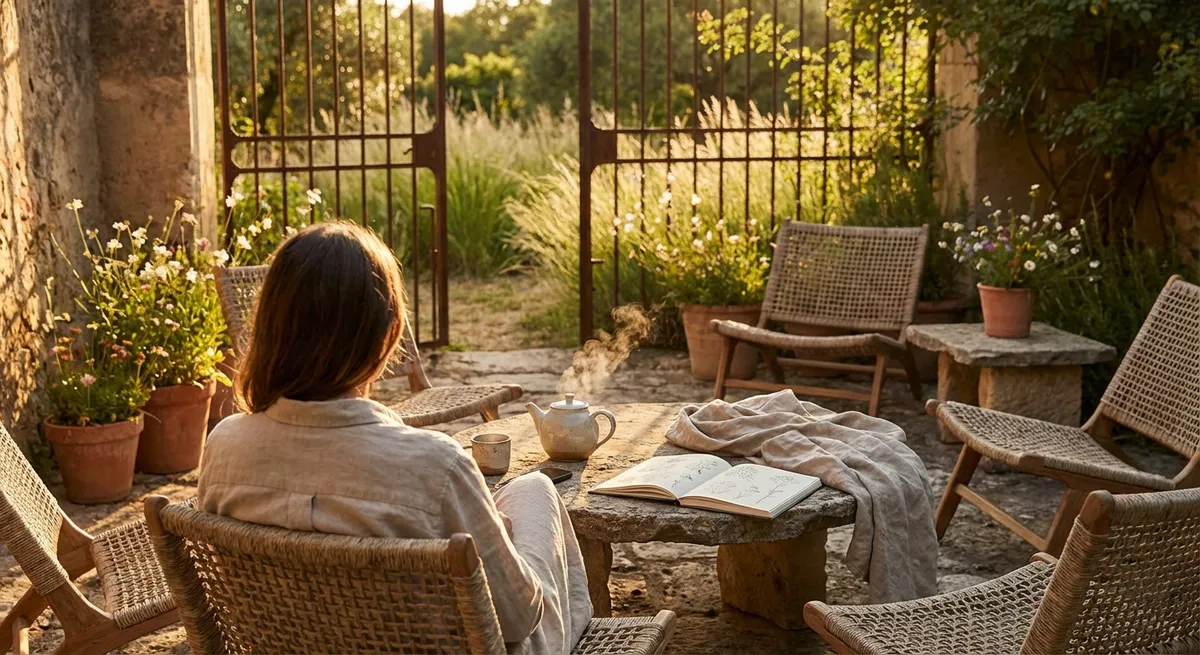
Below are five outdoor furniture ideas crafted not just for comfort, but for the kind of slow, intentional living that outdoor enthusiasts crave.
1. The Dawn Nook: A Chair That Welcomes First Light
Imagine a chair that has a job: greet the sunrise with you. This is your dedicated dawn nook—one thoughtfully placed chair or small seating cluster that faces the eastern sky, a soft throw draped over the back, a side table just big enough for a mug and a notebook.
Choose a chair with a high, gently reclined back and arms you can lean into, preferably in a breathable, weather-resistant fabric like solution-dyed acrylic over an aluminum or teak frame. Add a cushion in a sunrise-inspired palette—muted peach, hazy lavender, or pale gold. Place it where the first light lands on your porch or balcony, even if it’s just a sliver of sky between trees or rooftops.
This isn’t a crowd spot; it’s a single-person sanctuary. The presence of one intentional chair tells your brain: “This moment is mine.” Over time, the ritual becomes stitched into the fabric of the furniture itself—each scrape of the chair on the deck, each soft creak as you lean back, becomes an audible reminder that you showed up for the day.
2. Circle of Stories: Modular Seating That Shapes Connection
Straight lines can feel formal. Circles feel like conversation. Swap the traditional rectangular patio layout for a curved or modular seating arrangement that naturally gathers people face-to-face instead of shoulder-to-shoulder.
Choose a sectional or modular outdoor sofa with pieces you can reconfigure: a gentle crescent around a low table, a semi-circle facing a fire pit, or multiple “pods” for small-group chats. Deep seating with plush cushions invites lingering; opt for performance fabrics that resist fading and mildew so you can say “stay a little longer” without worrying about maintenance.
Layer in floor cushions, poufs, or low stools to make the circle more flexible and inclusive. A mix of heights lets people choose how they want to inhabit the space—curled up low with a blanket or upright with a clear view of the stars. In this layout, the furniture doesn’t just provide places to sit; it stages a sense of belonging, as if every open cushion is an unspoken “pull up a spot and tell me your story.”
3. The Floating Office: A Table That Doubles as Escape
Outdoor furniture for work might sound unromantic—until you realize how radically different email feels when there’s a breeze involved. The key is choosing a table that can shift between “laptop station” and “evening escape” without looking like it’s married to either role.
Look for a compact bistro or café table with a sturdy base and a surface big enough for a laptop, a notebook, and a drink, but small enough that it doesn’t dominate your space. Materials matter: a powder-coated metal or stone tabletop resists coffee spills and weather, while a warm wood chair or woven seat keeps the set from feeling too utilitarian.
Add a portable cushion for comfort and a small tray or basket beneath or beside the table for quick role-changing: during the day it holds work essentials; at night it swaps to candles, a deck of cards, or a book. You haven’t just bought a table—you’ve built a floating boundary between work and rest, anchored only by your intention. When the laptop closes and the candle flickers on that same surface, the message is clear: “The workday is over; this table belongs to your life again.”
4. Soft Architecture: Layered Textures That Frame the Sky
Outdoor furniture doesn’t have walls to lean on, so it has to become its own kind of architecture. Think of every chair, bench, and table as a line in a sketch that frames your view. The magic appears when you layer textures that echo the landscape around you.
Pair a sleek metal-framed lounge chair with a chunky knit outdoor throw. Place a slatted teak bench beside a woven rope side table. Add an outdoor rug underfoot to “anchor” the seating group and visually turn open air into a defined room. Mix hard surfaces—stone-topped coffee tables, concrete stools—with softer elements like oversized cushions and upholstered ottomans.
When you sit down, notice how your body encounters the space: the smooth arm of a chair under your palm, the give of a cushion beneath you, the subtle friction of a rug beneath bare feet. These textural notes create a sense of embrace, even without actual walls. In this way, your furniture doesn’t just decorate the outdoors; it sculpts it into a place that feels instinctively like home.
5. The Daybed Dreamline: One Piece for Every Version of You
If one piece of outdoor furniture could be a whole lifestyle, it would be the daybed. By day, it’s a place to sprawl with a book. By late afternoon, it becomes a napping cocoon. At night, it’s a stargazing platform or an extra “sofa” for friends.
Choose a daybed or deep chaise with generous proportions—wide enough for two, long enough to stretch out fully. Opt for weather-resistant cushions at least 4–5 inches thick to support true lounging, not just polite perching. Overhead, consider a canopy, pergola, or even a freestanding umbrella to diffuse harsh sun and create a sense of enclosure.
Layer it like you would an indoor bed: a base cushion, a trio of back pillows in varying sizes, a lumbar pillow, and a lightweight outdoor throw. Keep a low side table within reach so everything you need—tea, sunglasses, a novel, a glass of wine—can land nearby without breaking the spell. As you use it through different seasons and moments, the daybed becomes a mirror of your life outside: sometimes full of guests, sometimes quietly your own, always ready.
Conclusion
Outdoor furniture is often marketed as “durable,” “weatherproof,” or “low maintenance.” Those traits matter—but they’re not the point. The true purpose of every chair, bench, and table you choose is to hold space: for the deep breath before the day starts, the laughter that spills past sunset, the silence that feels restorative instead of empty.
When you think of your outdoor furniture as a set of invitations rather than just objects, your porch or patio stops being a backdrop and starts becoming a living chapter in your everyday story. The seats are waiting. The sky is already doing its part. All that’s left is for you to step outside and take your place.
Sources
- U.S. Environmental Protection Agency – Choosing Durable Wood for Outdoor Projects – Guidance on materials and finishes that withstand outdoor conditions
- Sunbrella Official Site – Outdoor Fabric Guide – Information on performance fabrics for cushions and upholstery
- American Society of Landscape Architects (ASLA) – Outdoor Living Trends – Insights into how people are using outdoor spaces and furnishings
- Mayo Clinic – Health Benefits of Time Outdoors – Research-backed reasons to create inviting outdoor seating areas
- Harvard Graduate School of Design – Designing for Social Interaction – Concepts around how spatial arrangements (like circular seating) foster connection