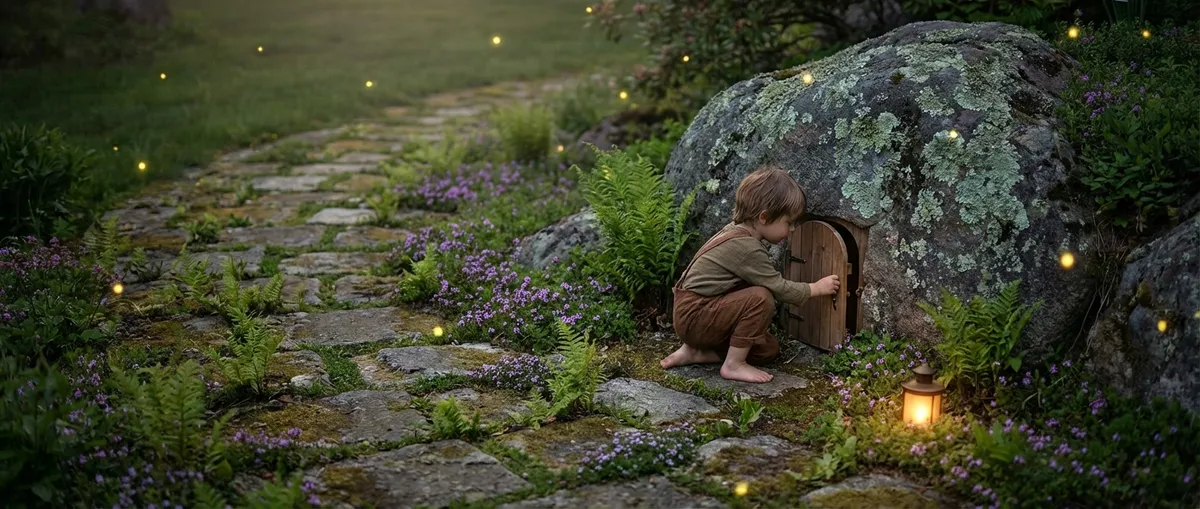
Think of your outdoor space as a place where curiosity is always welcome and time moves a little more slowly. With intention and a touch of boldness, you can turn even the smallest patch of earth into an unfolding experience—one that invites people to wander, linger, and look twice.
Designing for Wonder, Not Just “Nice”
A lot of yards are designed to be tidy. Far fewer are designed to be intriguing.
Landscapes that pull you in usually layer three things: mystery, comfort, and movement. Mystery is the curve in a path or a plant you have to lean in to recognize. Comfort is the bench in just the right pocket of shade or the warm stone that holds the day’s heat at dusk. Movement is not only the way you walk through the space, but also how air, light, water, and wildlife move through it.
Before thinking about individual elements, imagine how you want someone to feel as they cross your lawn or step off your porch. Do you want them to slow down? Explore? Feel sheltered? Energized? Let those emotional cues guide your choices—plant heights, path locations, textures, and focal points—so that your yard is more like a journey than a backdrop.
As you design, think in layers: overhead (canopies, pergolas, branches), mid-story (shrubs, seating, artwork), and ground layer (low plants, stones, moss, mulch). This vertical approach makes even small spaces feel deep and immersive, the way a well-composed photograph draws your eye in beyond the frame.
Design Idea #1: The Meandering Path That Refuses to Be Rushed
Straight paths are for errands. Curved paths are for wandering.
Instead of a single, straight walkway from porch to gate, let your main path bend gently or branch unexpectedly. A soft curve that disappears behind a shrub or arbor creates just enough curiosity to pull you forward: What’s around that corner? Use stepping stones, decomposed granite, brick, or wood slices, and let plants press in slightly from the sides so that the path feels embraced, not exposed.
Flank the walkway with a mix of heights: low groundcovers that spill onto the stones, knee-high grasses that whisper when you brush past, and taller shrubs or small trees that create pockets of enclosure. Nestle small surprises along the way—a wind chime that only rings when breezes are right, a single bold sculpture, or a birdbath tucked partly into shadow.
Lighting can deepen the magic. Rather than blasting the whole path with bright fixtures, use low, warm lights that graze the edges of stones or highlight a particularly beautiful plant. The goal is not to eliminate the darkness, but to partner with it, so the path feels like a gentle invitation instead of a runway.
Design Idea #2: The Quiet Green Room for One (Or Two)
Every outdoor space deserves a place that feels like closing a soft door, even if there are no doors at all.
Create a small “green room” somewhere in your landscape—a nook that feels semi-hidden, where the world thins to birdsong, rustling leaves, and your own thoughts. This might be a bistro table under an arching tree, a bench set into a recessed planting bed, or a single lounge chair facing away from the house toward your favorite view.
Use vertical elements to suggest boundaries without boxing yourself in. Trellises draped in climbing roses or clematis, tall grasses that sway shoulder-high, or a simple lattice screen with vines can create the sense of a room without walls. Underfoot, choose a surface that feels distinct from the rest of the yard—pea gravel, a small deck platform, or reclaimed brick—to signal: you’ve entered a different mood here.
Layer in comfort like you would indoors: a throw blanket in a weather-resistant basket, a side table large enough for a teapot and a book, a lantern or string lights overhead. Plant for scent and texture—lavender to crush between your fingers, thyme between stepping stones, or jasmine that releases fragrance in the evening—so that simply sitting still becomes an experience.
Design Idea #3: The Tapestry Garden That Changes With Every Step
A single flowerbed is decoration. A tapestry garden is an unfolding story of color, texture, and form.
Rather than relying on a few large shrubs and an ocean of mulch, think in terms of plant communities that overlap, weave, and respond to each other. Combine fine, airy textures with bold leaves; place feathery grasses beside glossy broadleaf plants; contrast vertical spires of blooms with low, mounded shapes. When each plant plays against its neighbor, the whole bed comes alive.
Aim for a long season of interest. Choose plants that take turns shining—spring bulbs that give way to summer perennials, late-season grasses that catch the low autumn sun, evergreens that hold the structure when everything else rests. Repeat certain plants or colors throughout the space so your eye can travel easily, but allow for a few deliberate “wow” moments: a fiery-red shrub, a swath of blue catmint, a single sculptural agave or ornamental tree.
For outdoor living enthusiasts, a tapestry garden is best appreciated up close. Place seating right at the edge of your planting—chairs that let you trail your hand through the foliage, a low wall you can sit on with your feet in the thyme. The more you blur the line between where people sit and where plants begin, the more immersive the landscape feels.
Design Idea #4: The Element of Water You Can Hear Before You See
Few things re-tune the mind as quickly as the sound of water. It’s the original white noise machine, but alive and shimmering.
You don’t need a sprawling pond or large waterfall to bring this magic into your landscape. A small, recirculating fountain, a slender rill running alongside a path, or a simple basin where rainwater gathers can become the heartbeat of your outdoor space. The key is placement: put water where it can be heard from your favorite perch—porch swing, patio sofa, or that quiet green room—so it becomes the score to your evenings.
Surround your water feature with lush, slightly wilder plantings to heighten the sense of an oasis. Ferns, hostas, irises, or native wet-tolerant species can soften the edges and reflect in the surface. Stones placed thoughtfully can create gentle cascades or ripples that catch the light.
If wildlife matters to you, design with birds and pollinators in mind. Shallow areas or stones placed at the water’s edge give them safe places to drink and bathe. Over time, your landscape becomes not just a setting, but a refuge—a small, living intersection where your daily rituals intertwine with those of the creatures passing through.
Design Idea #5: The Fire & Shadow Circle for Long, Slow Evenings
Daylight belongs to busyness. Firelight belongs to conversation.
Anchor your yard with a dedicated fire and gathering circle—a place where stories, toasted marshmallows, and quiet stargazing feel as natural as breathing. This doesn’t have to mean a massive built-in fire pit. It can be a freestanding fire bowl or chiminea set within a ring of comfortable, low-slung chairs, benches, or even built-in seating on a raised edge.
Think of the circle as a theater in the round where flame plays the lead role and everyone has a front-row seat. Arrange the seating close enough for shared warmth, far enough for personal comfort. Underfoot, use a material that feels stable and intentionally “other” than lawn: stone, gravel, patterned pavers. A subtle change in elevation—a step up or down into the circle—can make entering the space feel like crossing into a special zone.
Plantings around a fire circle should dance with shadow. Tall grasses that flicker in the glow, broad leaves that catch and toss back the light, and a few sculptural branches reaching into the night sky can turn simple flames into living artwork. Keep at least one sightline open—toward the horizon, a favorite tree, or the moon—so that the circle feels nestled, not closed off. Here, time bends: conversations stretch, phones get forgotten, and the air carries both smoke and the feeling of being exactly where you’re supposed to be.
Conclusion
Landscaping doesn’t have to be grand to be transformative. It only has to be intentional.
When you shape paths that wander instead of rush, carve out a green room where your shoulders finally drop, weave plants into living tapestries, invite water to murmur nearby, and gather people around the glow of fire, you’re not just decorating a yard. You’re composing a life-sized invitation—to slow down, to notice, to belong.
Your outdoor space can become the in-between place where daily life and quiet wonder meet: not quite wilderness, not quite indoors, but a secret world between the stepping stones that always has another story to tell.
Sources
- University of Minnesota Extension – Sustainable Landscape Design – Overview of principles for creating resilient, layered landscapes
- Royal Horticultural Society – Designing a Garden – Guidance on structure, planting combinations, and creating atmosphere outdoors
- U.S. Environmental Protection Agency – Water-Smart Landscaping – Best practices for integrating water features and plantings efficiently
- Cornell University – Creating a Wildlife-Friendly Garden – Practical advice on designing gardens that support birds and other wildlife
- National Fire Protection Association – Outdoor Fire Safety – Safety considerations for backyard fire pits and outdoor heaters