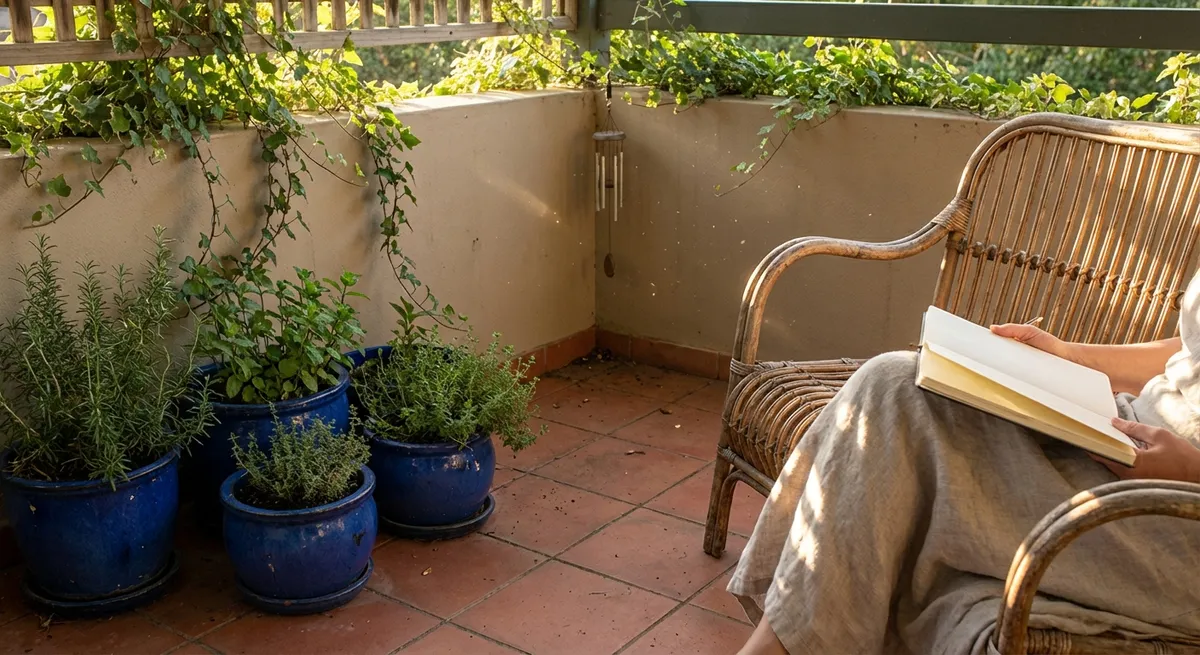
Below are five soul-soothing design ideas to turn your patio into a meaningful little world of its own—alive with color, comfort, and the quiet joy of being exactly where you are.
1. The Dawn Nook: A Corner That Belongs to Your Mornings
Imagine a small corner of your patio tuned entirely to the first light of day. A place where the air is still soft, the world hasn’t started asking anything of you yet, and warmth slowly spills across your feet with the rising sun.
Start by noticing where the earliest light lands. Position a simple chair or small bistro set there—something you can sink into without thinking. Layer it with textiles that feel like a favorite sweater: a cushion with a forgiving, textured fabric, a throw blanket that can live in a basket nearby, and a small outdoor rug underfoot to soften the first step outside.
Anchor this dawn nook with one living thing that marks the seasons with you: a potted olive tree, a tall grass that brushes your arm as you sit, or a flowering shrub that surprises you each spring. Add a tiny landing spot for your mug and your book or journal—a narrow side table, a wall-mounted shelf, even a repurposed step stool.
If you have a louder household or a busy street, consider a small water feature to take the edge off surrounding sounds. The gentle rhythm of moving water can create a private bubble of peace, even in a dense neighborhood. Over time, this dawn nook can become less of a design feature and more of a ritual—your quiet agreement with the day that you will meet it slowly.
2. The Long Table Dream: A Patio Built for Slow Evenings
Some patios are meant for gathering, even if the gatherings are small. Picture a long, simple table stretched across your outdoor space—candles flickering down its center, mismatched chairs pulled in close, the air carrying a blend of fresh herbs, grilled food, and laughter that refuses to go inside.
Choose a dining table that fits your space but doesn’t feel timid. Even a narrow, bench-style table can create the feeling of abundance. Look for durable, weather-resilient materials—treated wood, metal, or composite—and imagine how they’ll age: a little patina can make the table feel storied rather than worn.
Use lighting to choreograph the evening. A strand or two of warm string lights overhead sets an immediate mood, but think about layering: a lantern near the entry, a candle cluster at the center of the table, maybe a rechargeable LED lamp at one end for board games or late-night conversations. Aim for light that flatters faces and quiets the edges of the world.
To keep things relaxed, use textures instead of perfection. A linen runner that can handle a few drips, stone or wood trivets, cloth napkins that feel intentionally “rumpled,” and plates that don’t all match but somehow belong together. If you have room, let herbs pull double duty: rosemary, basil, or mint in pots along the table or nearby can season your food and perfume the air.
The goal isn’t to stage a magazine-ready dinner; it’s to create a place where people don’t glance at the clock. Where dessert happens because someone doesn’t feel ready to say goodbye yet.
3. The Green Pocket: Turning Your Patio Into a Living Patchwork
A patio can become a soft, breathing space without a single blade of in-ground grass. You can turn hard surfaces into a living patchwork, where your eyes always land on something growing, reaching, or blooming just a little differently than the week before.
Think in vertical layers, especially if your space is small. Use a trellis, railing, or simple grid to let vines climb—star jasmine, clematis, or a native climber for your region. Hanging planters can hold trailing plants that spill gently downward, softening hard edges and railings.
On the ground, group containers in clusters rather than lining them up. Mix heights—tall pots with architectural plants in the back, mid-height planters in the middle, and small herb pots or groundcovers up front. This layered approach mimics how plants grow in the wild and creates more depth for the eye.
Let fragrance guide you, not just color. A pot of lavender by your chair, mint near the kitchen door, lemon balm or thyme along a regular walking path. When you brush past them, they release scent like a secret handshake with the space.
If you crave a bit more wildness, add a single large planter dedicated to pollinator-friendly plants—native flowers, coneflowers, milkweed, or bee balm, depending on your region. Even a tiny pollinator oasis can invite butterflies and bees, adding movement and meaning to your patio. Your time outside will start to sync with their quiet choreography.
4. The Shadow Sanctuary: Comfort on the Hottest Days
The patios that stay loved all year know how to handle heat and glare. A shadow sanctuary is less about building a fortress of shade and more about sculpting light—softening it, filtering it, and inviting the breeze to be part of the design.
Start by respecting the sun’s path. Notice where it feels harshest and when. Then choose a flexible form of shade: a retractable awning, a canopy, a sun sail, or a louvered pergola. Even a simple fabric shade stretched between walls or poles can turn a blinding midday space into a usable retreat.
Think about how the shade looks from underneath. Slatted wood or metal allows patterns of light to dance across the floor and furniture, creating a sense of coolness before the temperature even drops. Climbing plants over a pergola or trellis can deepen that effect over time, offering dappled shade that shifts with the day.
Materials matter here. Light-colored surfaces reflect heat, while dark ones absorb it. Choose cushions in breathable, UV-resistant fabrics; add an outdoor rug in a lighter tone to make barefoot walking more comfortable. A ceiling fan or a standing outdoor fan can keep the air moving, making the space feel several degrees cooler than it is.
Finally, create a specific “retreat seat” for the hottest days: a lounger or deep chair under the best shade with a side table and a spot for a cold drink. When the world feels heavy and bright, you’ll know exactly where to go to exhale.
5. The Story Corner: A Patio Space That Changes With You
Some parts of a patio are meant to hold time—to collect little traces of the life you’re living right now. A story corner isn’t just a reading nook or craft table; it’s a shape-shifting zone that can become whatever your current season of life needs it to be.
Begin with a flexible anchor: a small, movable table or sturdy outdoor cart, plus one or two comfortable chairs that can turn toward or away from each other. Add a weather-resistant storage solution—an outdoor chest, a bench with hidden storage, or a simple lidded basket. This is where your “in progress” life can live: sketchbooks, seed packets, knitting tools, a deck of cards, puzzles, or kids’ art supplies.
Great lighting is what makes this corner feel possible at all hours. A focused reading lamp, wall-mounted sconce, or rechargeable lantern lets you turn the space into a late-night reflection zone or a rainy-afternoon craft studio. If you can, give this corner some protection from light drizzle or wind, so it stays inviting when the weather is indecisive.
Surround this story corner with small, personal markers of time passing: a growth chart for kids, a chalkboard or corkboard for notes and quotes, a rotating gallery for polaroids or printed phone photos held by clips or string. Nothing has to be perfect; the beauty comes from the way the space changes with you.
Over months and years, you’ll start to recognize that this small area has quietly documented your life—new hobbies, abandoned experiments, fresh obsessions, and the calm of returning to a well-worn chair that has heard all your thoughts before.
Conclusion
A patio doesn’t need to be grand to be life-changing. It just needs to be honest about what you truly crave outside: slower mornings, lingering evenings, more green in your sightline, deeper shade when the world burns a little too bright, and a corner that keeps evolving as you do.
When you think about your own patio, don’t start with furniture catalogs or paint chips. Start with feeling. How do you want to feel when you step outside—lighter, quieter, more connected, more playful? Let that answer guide where the chairs go, how the plants grow, where the light falls, and what stories unfold there.
With a few intentional choices, even the smallest patio can become a sun-spun corner of your life—holding your quiet joy, day after day.
Sources
- U.S. Department of Energy – Landscaping for Energy-Efficient Homes – Guidance on using shade, plants, and surfaces to manage heat and improve outdoor comfort
- Environmental Protection Agency – Green Landscaping: Greenacres – Information on native plants, biodiversity, and pollinator-friendly landscaping ideas
- Royal Horticultural Society – Container Gardening – Practical advice on creating lush plantings in pots and small spaces
- University of Minnesota Extension – Outdoor Lighting Basics – Overview of outdoor lighting types, placement, and safety considerations
- Mayo Clinic – The Benefits of Spending Time Outdoors – Research-backed insights into how time outdoors supports mental and physical well-being