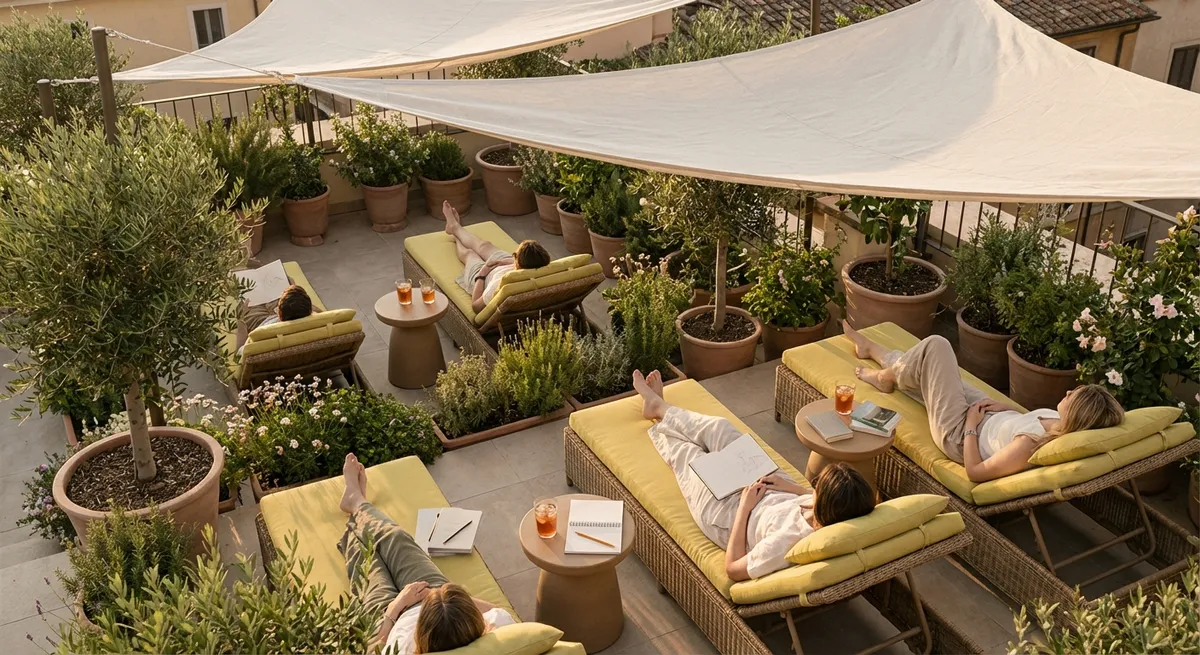
Below are five design ideas that help your outdoor furniture do more than fill a patio—they help it tell a story you actually want to live in.
1. Conversation Circles That Turn Strangers Into Storytellers
Picture this: no “front and back” of the seating, no one stuck at the corner of a rectangular table, no single “best seat.” Just a gentle circle of chairs or low sofas curving toward each other, with a central table or fire bowl like a glowing heart in the middle.
Outdoor conversation circles work best when the furniture encourages eye contact and ease. Deep-seated lounge chairs with arms you can lean into, sectionals that bend into a crescent, or modular cubes that can be pulled into a ring—all of these foster the kind of gathering where time unravels quietly. Opt for mixed textures: woven resin chairs paired with a smooth stone or concrete coffee table, a braided outdoor rug underfoot, and side tables that double as stools when the circle grows.
Soft lighting—lanterns on the ground, candles in hurricane glass, or a string of warm bulbs overhead—finishes the cocoon. Your furniture stops being a collection of pieces and starts becoming a shared campfire, even if all you’ve lit is a single candle in the center of the circle.
2. The Solo Retreat: One Chair, A Small Table, and a Big Exhale
Sometimes the most powerful outdoor design is the smallest: one perfect chair tucked into a quiet corner. Think of this as your personal refuge, designed for one person and one purpose—rest.
Start with a piece that literally holds you: a high-back Adirondack, a gently rocking lounge chair, or a hammock chair that floats just off the ground. Add a small, sturdy side table for a mug, a book, or a notebook. Layer with an outdoor throw and a cushioned seat in a calming color—soft greens, ocean blues, or warm terracotta that mirrors the earth.
Place this mini-sanctuary where the air feels a bit different. Under a tree, beside a railing with a view, or in a corner brushed by ivy. Surround the chair with potted herbs or fragrant plants—lavender, rosemary, mint—so that a deep inhale becomes part of the ritual. This isn’t just “extra seating.” It’s a promise you’re making to your future self: I will sit here, without multitasking, and simply be.
3. Layered Heights: Dining, Perching, and Lounging in One Fluid Space
Some outdoor areas feel small until your furniture learns to dance at different heights. When you use low, mid, and high pieces together, your patio or porch becomes a dynamic landscape instead of a flat grid.
Imagine a low lounge area with a sofa and chaise near the ground, a slightly taller coffee table you can prop your feet on, and to one side a bar-height bistro set that catches the evening breeze. Add in a few ottomans or poufs that hover between chair and coffee table height—mobile ideas of “where to sit” that guests can move around freely.
This vertical variety breaks up the visual monotony and creates little “scenes” within one space: a place to recline and read, a perch to sip and chat, a spot to work with a laptop when the mood strikes. Choose a unified color palette across all heights—perhaps charcoal frames, natural wood surfaces, and oatmeal-colored cushions—so the eye reads it as one cohesive story with multiple chapters.
4. Textured Comfort: Fabric, Wood, and Woven Stories
Outdoor furniture is at its best when you can feel its welcome before you ever sit down. Texture is what turns a bare patio into a lived-in haven, especially when you intentionally mix materials that age gracefully with the weather.
Start with a grounding base like teak, acacia, or eucalyptus—woods that silver softly with time—or powder-coated aluminum in a matte finish. Layer on woven elements: rattan-style resin chairs, rope-wrapped chair backs, or a wicker loveseat that brings a gentle, handmade feel. Underfoot, unroll an outdoor rug with a subtle pattern, something that bridges the natural world and the indoors—a faded kilim motif, or a muted geometric that echoes tiles or brick.
Cushions and textiles are where you can whisper your personality into the space. Choose performance fabrics in sun-washed tones—sand, clay, seafoam, rust—and add a few patterned pillows as punctuation marks. Don’t forget tactile finishes: a knit-look outdoor throw, tufted cushions with visible stitching, or fringe on a bench cushion. Over time, as sun and shadow play across these surfaces, the space will feel less like an outdoor showroom and more like a memory in progress.
5. Transforming Tables: Furniture That Adapts With Your Day
Your outdoor space doesn’t live just one life; your furniture shouldn’t either. The most magical pieces are the ones that shapeshift—expanding, folding, stacking, or hiding useful surprises inside.
Consider a dining table with hidden leaves that let a weekday table for two stretch into a weekend feast. Look for coffee tables with lift-tops that convert into laptop perches or impromptu dining surfaces. Benches with hinged lids can store cushions, games, or extra throws; nesting tables slide out during parties and tuck away when the night quiets down.
Modular sectionals that can be reconfigured— chaise on the left one day, on the right the next—help your space evolve with the seasons and the company you keep. When furniture flexes with your life, you’re more likely to use the space often and in different ways: early-morning journaling, midday work, twilight gatherings, late-night stargazing.
In the end, adaptability isn’t just about saving square footage. It’s about saying to your outdoor world, “You get to change. And I’ll change with you.”
Conclusion
Outdoor furniture is often sold as objects—chairs, tables, loungers—but what you’re really collecting are possible futures: evenings of unplanned conversation, afternoons of deep rest, mornings that start quietly enough for you to hear your own thoughts.
By creating conversation circles, carving out a solo retreat, playing with layered heights, celebrating tactile materials, and choosing pieces that transform with your day, you’re not just designing a porch or patio. You’re composing a living, breathing sanctuary where your best hours have room to arrive.
Step outside, look at the space you have—even if it’s a narrow balcony or a compact porch—and ask a different question: not “What can I fit here?” but “What kind of life do I want to live here?” Then let every piece of furniture become your answer, one beautiful, intentional choice at a time.
Sources
- U.S. Department of Energy – Outdoor Living Spaces and Comfort – Discusses how outdoor elements and materials affect comfort, sun, and wind, useful when planning furniture placement.
- Sunbrella – Guide to Performance Outdoor Fabrics – Explains durability, fade resistance, and care for outdoor textiles and cushions.
- HGTV – Outdoor Room Design Ideas – Visual inspiration and practical tips for arranging outdoor furniture into functional zones.
- University of Minnesota Extension – Outdoor Living Spaces – Educational overview of designing outdoor areas for comfort, use, and aesthetics.
- American Society of Landscape Architects (ASLA) – Outdoor Living Trends – Professional insights into current trends in outdoor living and flexible outdoor furnishings.