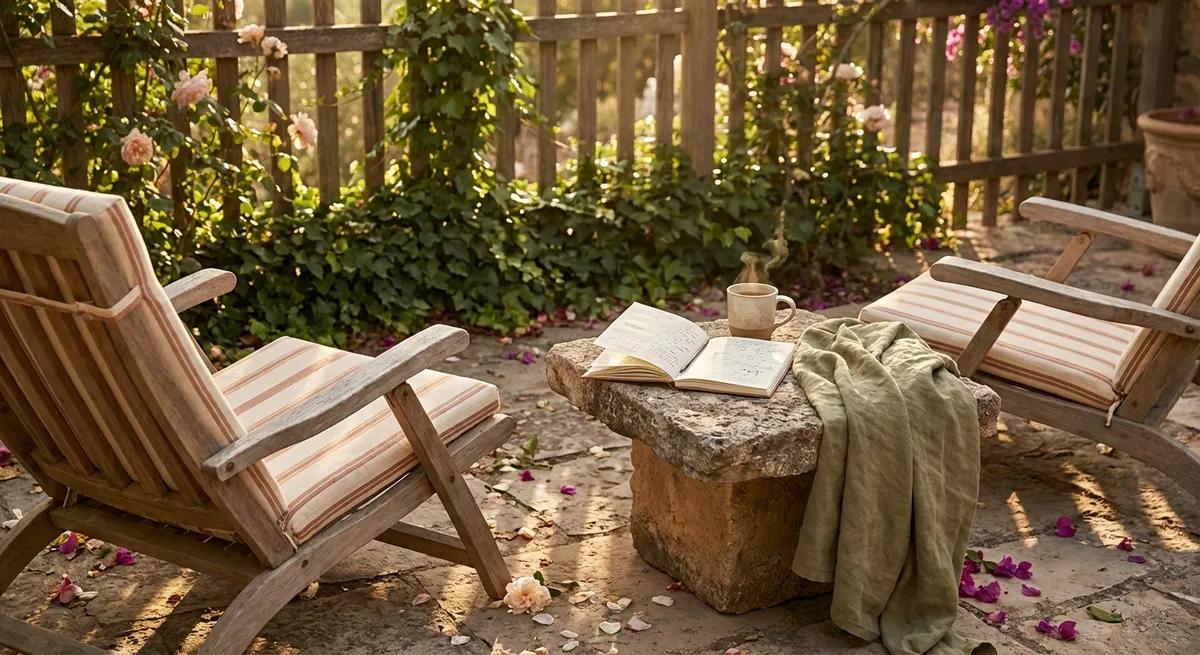
Outdoor living isn’t about building a “perfect” patio. It’s about creating a space that feels so unmistakably like you that every time you step outside, it feels like returning to a favorite chapter. Let’s shape that chapter with five design ideas that turn furniture into storytellers.
1. The Conversation Circle: Furniture That Knits People Closer
Pull your seating into a circle and you instantly change the rules of how people relate. No one is at the head, no one is pushed to the edges. It becomes a democratic landscape of shared stories and eye contact.
Imagine low, deep lounge chairs or a curved sectional embracing a central fire bowl or round coffee table. Add layered poufs and floor cushions that can float in and out as more friends drift over. Choose fabrics in warm, sun-washed tones—terracotta, sand, muted sage—colors that look like they’ve already soaked in a few summers.
A conversation circle also invites different tempos of gathering. In the afternoon, it’s a soft place to read with your feet tucked under you. At dusk, it becomes a glowing harbor, especially if you tuck lanterns at different heights around the edges. Consider side tables that are easy to move so that every seat can host a book, a drink, or a votive candle.
The circle has a quiet magic: it says, “Stay a while.” And staying a while is how ordinary evenings slowly become the memories you return to.
2. The Outdoor Daybed: Your Permission Slip to Do Nothing
Some furniture is practical. An outdoor daybed is unapologetically indulgent—and that is exactly why you need it.
Picture a wide, cushioned platform tucked against a wall or railing, layered with pillows in different textures: linen, slub cotton, a single woven throw that looks like it came straight off a coastal breeze. Overhead, a simple pergola or a canopy of string lights softens the space, transforming it from “extra seating” into a personal retreat.
If you have a small balcony, a compact chaise with a few oversized pillows can serve the same purpose. It only needs to be big enough for you to stretch out with a book, or lie on your back tracing constellations in the sky.
A daybed quietly reorders your priorities. It tells your brain that rest belongs outside—not just inside. It becomes your sanctuary for Sunday naps, your front-row seat to summer storms, your place to watch daylight slip into blue hour. Add a narrow bench or trunk at the foot to store extra blankets and to hold a tray for tea, iced coffee, or a single glass of something cold and slow.
In a world obsessed with hustle, an outdoor daybed is a small, beautiful act of rebellion.
3. The Expandable Table: A Stage for Everyday Rituals
Outdoor tables are more than places to eat; they are anchors for rituals. The expandable table—the one with hidden leaves or clever extensions—holds a special power: it can grow as your life does.
On weekdays, it might be a two-person breakfast station with only the center leaf in place, a spot for coffee mugs and an open laptop while birds announce the morning. On weekends, you pull the sides out, drop in the extra leaves, and suddenly it becomes a long, generous runway for shared meals, board games, and birthday candles.
Choose materials that gently weather with grace: teak that silvers over time, powder-coated steel that stands up to rain, or responsibly sourced hardwood sealed for outdoor life. Pair the table with a mix of seating—chairs with backs for languid dinners, a bench on one side for flexible seating, maybe a single statement chair that feels almost like a throne for your honored guest…or your tired self after a long day.
What makes this table powerful isn’t its engineering; it’s its adaptability. It’s there for the one-plate lunch and the twelve-plate feast, for solo journaling and surprise celebrations. It’s a reminder that your home doesn’t just hold your life—it flexes to meet it.
4. The Green-Tucked Lounge: Furniture That Blooms With the Garden
When your furniture and your plants become collaborators, the whole space comes alive. Instead of treating seating and greenery as separate zones, let them wind into each other.
Imagine a low sectional hugged by planters at each end, overflowing with herbs you can reach from your seat. A slender console behind a sofa becomes a long planter box for lavender, basil, or ornamental grasses that sway and rustle with every breeze. Side tables do double duty as stands for potted olive trees or ferns.
This “green-tucked” approach softens every edge. A metal chair seems warmer when a climbing vine drapes along the nearby railing. A simple bench feels intentional when framed by tall, feathery plants or a rustling bamboo screen.
Use furniture finishes that harmonize with your plant palette: warm woods with silvery-green foliage, black metal with bold, glossy leaves, pale stone with soft, muted blooms. By nesting your seating inside the garden rather than beside it, you turn sitting outdoors into a full sensory event—scent, sound, touch, and sight all alive at once.
You’re not just creating a place to sit. You’re creating a place to belong to the landscape around you.
5. The Moveable Moments: Pieces That Let You Rewrite the Space
The most exciting outdoor rooms are the ones that never stay exactly the same. Furniture with wheels, lightweight frames, folding mechanisms, or stackable designs invites you to treat your patio like a creative studio.
Think of a pair of slim lounge chairs you can roll from sunny corners in the morning to shady spots by late afternoon. Folding bistro chairs that live against the wall most days, then multiply around the table when friends text, “We’re on our way.” Nesting tables that scatter for snacks and drinks during gatherings, then pull back together as a sculptural side table afterwards.
Modular furniture—sectionals that break into individual chairs, ottomans that can be coffee tables or footrests—means you can design for the moment instead of locking yourself into a single layout. Today’s movie-night configuration might not be right for tomorrow’s yoga session at dawn.
When your outdoor furniture is moveable, your space becomes playful. You’re no longer “done” decorating; you’re in a constant, gentle dance with the weather, your mood, your guests, and the season. There’s joy in knowing your porch or patio can be reborn just by shifting a few pieces around.
Conclusion
Outdoor furniture is often sold as a collection of objects: chairs, tables, benches, loungers. But when you step back, you realize it’s really a collection of possibilities.
A circle of chairs becomes a safe harbor for conversations that matter. A daybed becomes a passport to rest. An expandable table becomes a keeper of rituals. Green-tucked seating becomes a living, breathing sanctuary. Moveable pieces become tools for rewriting your space whenever your life turns a new corner.
Your outdoor space doesn’t need to be big, fancy, or flawless. It just needs to feel like a place where your next chapter can begin—with sunlight on your face, a good seat beneath you, and the feeling that just outside your door, your life is quietly, beautifully unfolding.
Sources
- [American Society of Landscape Architects – Outdoor Living Trends](https://www.asla.org/NewsReleaseDetails.aspx?id=6132) - Insights into how people are using outdoor spaces and popular design directions
- [Mayo Clinic – The Health Benefits of Spending Time Outdoors](https://www.mayoclinic.org/healthy-lifestyle/adult-health/expert-answers/outdoors/faq-20057957) - Research-backed reasons why investing in outdoor living areas matters
- [U.S. Environmental Protection Agency – Environmentally Preferable Purchasing: Furniture](https://www.epa.gov/greenerproducts/furniture) - Guidance on selecting sustainable, durable furniture materials
- [University of Minnesota Extension – Creating Outdoor Rooms](https://extension.umn.edu/landscape-design/creating-outdoor-rooms) - Practical design principles for structuring outdoor living areas
- [Harvard Graduate School of Design – Designing for Well-Being](https://www.gsd.harvard.edu/2019/07/designing-for-well-being/) - Explores how thoughtfully designed spaces can support mental and emotional health