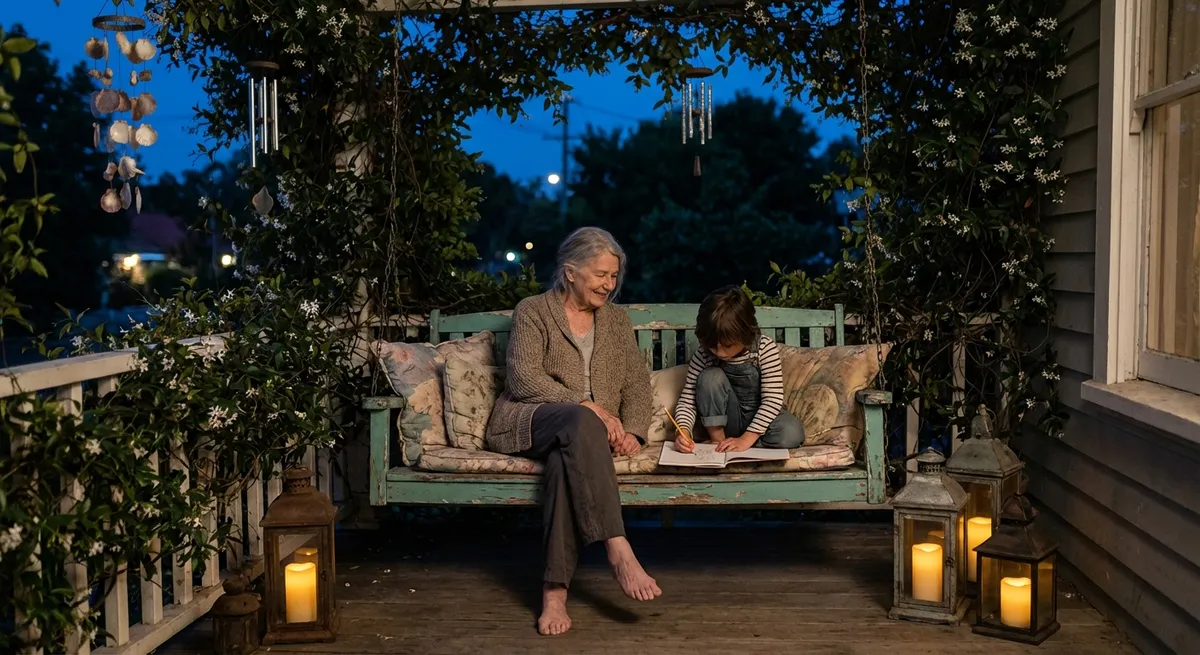
Begin With a Feeling, Not a Floor Plan
Before you think about railings or rug sizes, begin with a single question: How do you want to feel when you step onto your porch? Rested? Energized? Protected? Wide open to the sky?
Let that feeling become your design compass. A restful porch might lean into low, deep seating, filtered light, and soft, nubby textiles that invite bare feet. An energizing porch could welcome brighter patterns, upright chairs, and a small standing bar where coffee and conversation flow. Consider your climate and rhythm of life: Do you crave shade at 3 p.m., or sun at 9 a.m.? Do you want a front-row seat to street life or a private cocoon facing the garden?
Allow your porch to act as a threshold between your inner and outer world. Use color to bridge that gap: echo a hue from your living room—perhaps a pillow color or a painted vase—on the porch, so stepping outside feels like a continuation of home, not a departure. When you lead with feeling, the practical decisions stop being overwhelming and start becoming obvious: every choice either serves that feeling… or it doesn’t.
Idea 1: The Conversation Arc
Imagine a porch where no one has to shout across a table, where stories don’t get lost in the gap between chairs. The “Conversation Arc” is less a furniture set and more a choreography: pieces arranged to keep eyes meeting, voices soft, and laughter circling the space instead of escaping into the yard.
Start by orienting seating in a loose curve instead of a straight line—an L-shape softened by an extra chair, a semicircle of lounge chairs, or a bench flanked by two swiveling chairs. Add a low, generous coffee table or clustered side tables in the center to hold drinks, a candle, a bowl of peaches. This creates a visual “campfire,” even if you never light an actual flame.
Layer textures that invite lingering: a woven outdoor rug to define the arc, pillows in varying sizes for propping and perching, a throw blanket or two for those reluctant-to-end evenings. If your porch is small, even two chairs angled slightly inward with a tiny table between them can become a miniature listening circle. Design the space as if the most important thing that will happen here is a conversation that runs late—and your porch will prove you right.
Idea 2: The Reading Nook Under Open Air
There’s a particular magic to reading outside: the book in your hands, the world quietly unfolding beyond the pages. To create a true reading porch, design as if the main resident will be a half-finished novel and a mug cooling slowly beside it.
Begin with one anchor piece: a deep chair, daybed, or hanging swing that supports your whole body without demanding perfect posture. Think thick cushions, a slightly reclined back, and armrests wide enough for a cup of tea or a notebook. Position this nook to capture the best light—morning sun for early readers, or soft evening glow for twilight chapters. If you can, angle it so your view is restful but not distracting: a slice of garden, the sway of a tree, the quiet choreography of your neighborhood.
Lighting turns this nook from a morning favorite into an all-day companion. Add a warm-tone outdoor sconce, a plug-in lantern, or a string of fairy lights framing the area—not to flood it with brightness, but to create a gentle halo. Keep a small basket nearby with a throw, a bookmark, and maybe even a pair of reading glasses. Over time, this simple corner may become a sanctuary where you measure the seasons by what you’re reading.
Idea 3: The Senses-First Sanctuary
Design a porch that doesn’t just look good in photos, but feels like a full-body exhale when you step outside. A senses-first sanctuary asks: What does my porch sound like, smell like, feel like underfoot? Answer those questions, and you’ll create a space that lingers in memory longer than any trend.
For sound, consider adding layers: the soft rustle of ornamental grasses in pots, a small fountain with a gentle trickle, wind chimes tuned to low, mellow tones. If you’re in a busy area, these sounds can soften the edges of traffic noise, turning chaos into a kind of distant hum. Scent can be as simple as potted herbs—rosemary, basil, lavender—or a single fragrant climber like jasmine or honeysuckle climbing a trellis nearby.
Touch might be the most underrated luxury. Choose materials that invite contact: a smooth wooden railing warm from the sun, a stone tabletop that cools in the evening, a rug that feels pleasant against bare feet. Use weather-friendly cushions that are soft, not stiff, and mix in natural textures like linen, cotton, and rattan. When you design for senses first, your porch stops being just a backdrop and starts becoming an experience your body recognizes as “home.”
Idea 4: The Seasonal Shape-Shifter
Life changes with the seasons, and your porch can, too. Instead of locking yourself into one single layout, design a flexible “shape-shifter” porch that evolves as the weather—and your needs—change throughout the year.
Choose furniture that’s light enough to move and modular enough to reconfigure. A pair of lounge chairs can push together into a makeshift daybed in summer, then pivot toward the yard for fall leaf-watching. Nesting tables can separate for parties or tuck together for more floor space. Use rugs and textiles as your seasonal signals: bright, breezy fabrics in warm months; richer, earthier colors and thicker textures when the air turns crisp.
Consider storage as part of the design. A beautiful outdoor trunk or bench with hidden storage can hold blankets, lanterns, or extra cushions, making seasonal transitions quick instead of daunting. In winter, your porch might become a place to sip something warm and watch the snow; in spring, it’s where muddy boots pause and flowers wait to be planted. By planning for change from the beginning, you give your porch permission to grow with you instead of becoming a static set piece.
Idea 5: The Little Rituals Corner
Not every moment on your porch has to be grand. Often, it’s the tiny, everyday rituals that give the space its soul: the first sip of coffee, five minutes of stretching, a quick journal entry at dusk. Dedicating a corner of your porch to these quiet practices can transform small habits into anchors of your day.
Pick a spot that feels tucked-in yet accessible. A simple bistro table and chair, a single rocking chair with a side table, or even a floor cushion by a railing can become your ritual zone. Ask yourself which small, repeated act you’d like to protect: daily sketching, watering plants, morning meditation, or evening reflection. Then design for that choice. A small shelf or wall-mounted ledge can hold a notebook and pen; a hook can keep a lightweight blanket at arm’s reach; a low stool can double as a plant stand and a perch for a cup.
Add one tiny object that signals “this is my moment”: a candle you only light during your ritual, a bell you ring before you sit, a single plant you tend daily. Over time, this corner becomes more than décor—it becomes a conversation between you and your day, a place where you check in with yourself before stepping back into the world.
Conclusion
Your porch doesn’t need to be large, perfect, or magazine-ready to matter. It only needs to be honest about who you are and generous about how you want to live. When you design with feeling as your north star, when you honor conversations, books, senses, seasons, and small rituals, your porch stops being a pass-through and becomes a companion.
Step outside and look at your space with fresh eyes. Imagine the stories that could unfold there, the quiet that might finally catch up with you, the people who might feel more at home in your presence because your porch made room for them. Build a porch that listens—and in its stillness, you may find it hands your own life back to you, a little clearer, a little softer, and utterly your own.
Sources
- American Society of Landscape Architects (ASLA) – Outdoor Living Trends - Insight into how people are using outdoor spaces and current design priorities
- University of Minnesota Extension – Creating Outdoor Rooms - Practical guidance on planning comfortable, functional outdoor living areas
- HGTV – Porch Design Ideas - Visual inspiration and examples of different porch layouts and styles
- This Old House – Porch Planning Guide - Detailed considerations for designing and arranging a porch space
- Better Homes & Gardens – Outdoor Room Ideas - Ideas for turning porches and patios into inviting “rooms” with furniture and decor