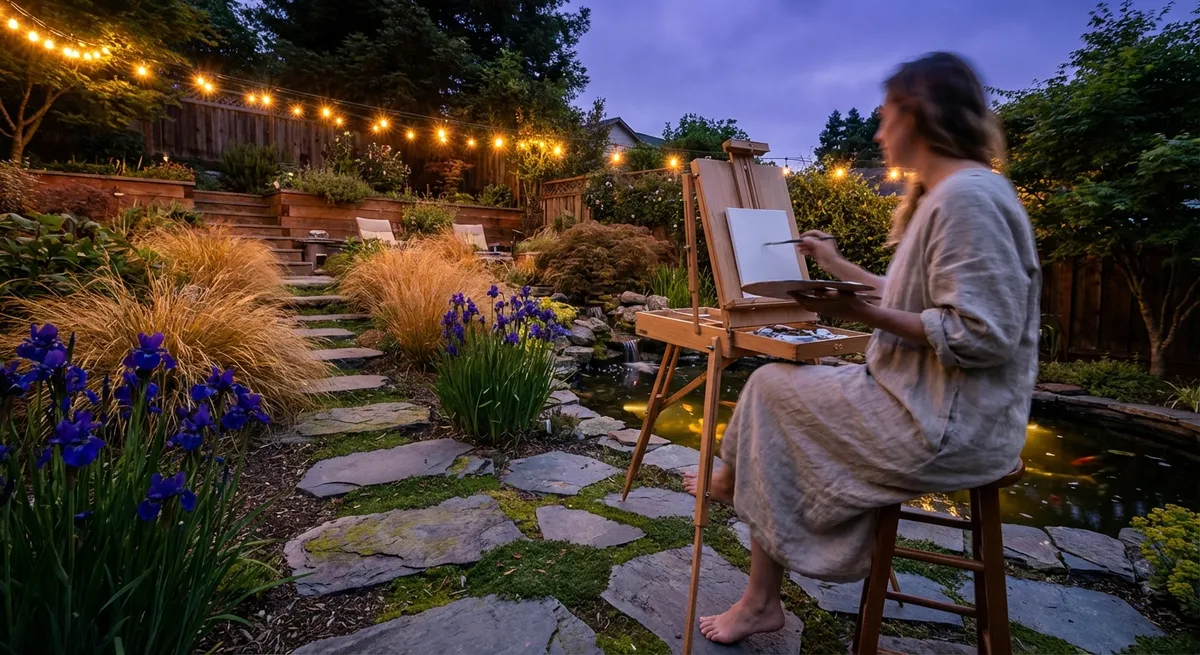
Think of your outdoor space as a living canvas. With a few intentional strokes—texture, light, scent, and movement—you can turn bare ground into a backdrop for everything you love most about being outside.
Idea 1: The Layered Green Room
Imagine stepping out your back door and feeling like you’ve walked into a soft, leafy room—walls hinted at by plants instead of drywall, ceiling suggested by tree branches and sky. A “green room” is about crafting gentle boundaries with layers of planting, so your yard feels intimate without feeling closed in.
Start by thinking in three heights: the towering “ceiling” of trees or tall shrubs, the mid-height “walls” of ornamental grasses or flowering bushes, and the low “floor” of groundcovers and perennials. Mix textures—feathery grasses next to glossy leaves, tiny flowers offset by bold, broad foliage—to keep your eye moving. Use curved planting beds instead of rigid straight lines; they guide your walk like a subtle invitation to wander.
Add a focal point at the heart of this green room: a weathered bench, a sculptural planter, or a birdbath that glints with sky. Tuck in herbs like rosemary or lavender along the path so every step brushes up a bit of scent. Bit by bit, you’ll notice that this space doesn’t just look lush—it feels like somewhere you go to reset, the way you might slip into a favorite reading nook.
Idea 2: The Night Garden That Wakes Up After Sunset
Landscapes often bow out when the sun goes down, but a night garden whispers, “Stay.” It’s designed to come alive in the low light—where fragrance deepens, pale blooms glow, and you can feel the day loosen its grip.
Choose plants that shine after dark: white and pale-colored flowers like moonflower, evening primrose, white coneflower, or shasta daisies. Their lighter petals catch even the smallest bit of ambient light, appearing to float against the dusk. Add night-scented favorites—jasmine, nicotiana, or honeysuckle—near the places you sit so the fragrance finds you before you even notice the blooms.
Layer in subtle lighting: low-voltage path lights tucked among plants, warm string lights woven through branches, or a single lantern beside a chair. Avoid harsh floodlights—aim for a soft, storybook glow that lets shadows keep their mystery. The result is a space where conversations stretch later, where you notice crickets instead of clocks, and where your yard becomes part of your evening ritual instead of disappearing into darkness.
Idea 3: The Seasonal Story Path
Instead of treating your yard as “one big space,” let a simple path turn it into a story you can walk through. A seasonal story path is less about straight lines and more about unfolding chapters—each bend introducing a new mood as the year moves along.
Begin with the route: a gentle curve from porch to back gate, or a loop that returns you to your starting point. The path itself can be decomposed granite, stepping stones set in moss, or even mown grass edged with flowers. Then, think in seasons. Early spring might greet you with bulbs—daffodils and tulips peeking up near the beginning. Summer turns up the volume with coneflowers, black-eyed Susans, and ornamental grasses waving at knee height. Autumn answers with blazing shrubs, rustling leaves, and late-flowering asters.
Tuck in tiny “moments” along the way—a stump that holds a potted fern, a single chair in a pocket of shade, a wind chime that rings when you pass. Over time, you’ll find yourself walking this path just to see what’s changed today: which buds opened, which leaves burned red, which birds decided to perch on the fence. Your landscape becomes less of a backdrop and more of a story you’re co-writing with the weather.
Idea 4: The Edible Border That Feels Like a Secret
Edible gardens don’t have to live in neat vegetable rows. An edible border blurs the line between beauty and harvest, tucking flavor into the edges of your space until your yard quietly becomes a pantry.
Line your beds or fences with blueberry bushes, currants, or thornless blackberries; their blossoms charm in spring, their berries delight all summer. Weave herbs into your flower borders—sage with its silvery leaves, thyme spilling over stone, basil standing upright among zinnias. Plant rainbow chard or purple kale for dramatic foliage that looks as ornamental as any designer plant.
Use vertical space by training beans or cucumbers up an arbor, letting them cast a dappled shade over a bench or gateway. You’ll find that your daily walk outside comes with small surprises: a ripe strawberry hiding under leaves, the sudden realization that your border smells like lemon balm after a rain. The act of stepping outside shifts from observation to participation—your landscape offers not just views, but flavors you can fold right into dinner.
Idea 5: The Soundscape Sanctuary
Landscapes are often planned with eyes in mind, but sound is the sense that quietly adjusts our mood. A soundscape sanctuary is a piece of your yard tuned like an instrument: to catch breezes, invite birds, and soften the static noise of everyday life.
Start by listening. Is your home near a busy street, a school, or a quiet cul-de-sac? Use dense plantings of evergreens or tall grasses along noisy edges; they won’t erase sound, but they break and blur it. Then, add intentional music. A small bubbling fountain or rain chain turns water into a constant, calming presence. Bamboo, reeds, or tall grasses like switchgrass and feather reed grass rustle and hiss softly when the wind comes through.
Hang wind chimes thoughtfully—light metal for bright, tinkling tones; wood or bamboo for deeper, meditative notes. Place bird-friendly plants—native shrubs, seed-bearing flowers, and a shallow basin of water—within view of where you like to sit. Slowly, your sanctuary fills with its own soundtrack: the water’s murmur, the leaves’ hush, the birds’ commentary. It becomes a place where you go not just to look at your yard, but to hear your life settling into a gentler rhythm.
Conclusion
Landscaping can be far more than a checklist of plants and materials. It’s an invitation—to linger, to notice, to live a little more often under open sky. When you shape your yard with intention, you’re not just improving curb appeal; you’re creating a stage where everyday moments feel a touch more sacred.
Whether you’re layering a green room, coaxing a night garden to life, walking a seasonal path, harvesting from a hidden border, or listening to a sanctuary of sound, each choice is a brushstroke on your living canvas. Over time, your outdoor space starts answering back: with shade when you’re tired, fragrance when you need comfort, and small, unplanned joys in every corner you’ve cared to shape.
Your yard doesn’t have to be perfect to be powerful. It just has to feel like a place where you’re glad to be—again and again, season after season.
Sources
- U.S. Forest Service – Landscaping for a Healthy Planet - Overview of environmental and personal benefits of thoughtful landscaping
- Royal Horticultural Society – Designing a Garden - Practical guidance on layout, planting structure, and creating atmosphere outdoors
- University of Minnesota Extension – Sustainable Landscape Design - Evidence-based principles for layering plants, paths, and focal points
- National Wildlife Federation – Garden for Wildlife - Tips on planting for birds, pollinators, and sound-rich natural habitats
- Missouri Botanical Garden – Evening and Moonlight Gardens - Plant and design ideas specifically for night and moonlit gardens