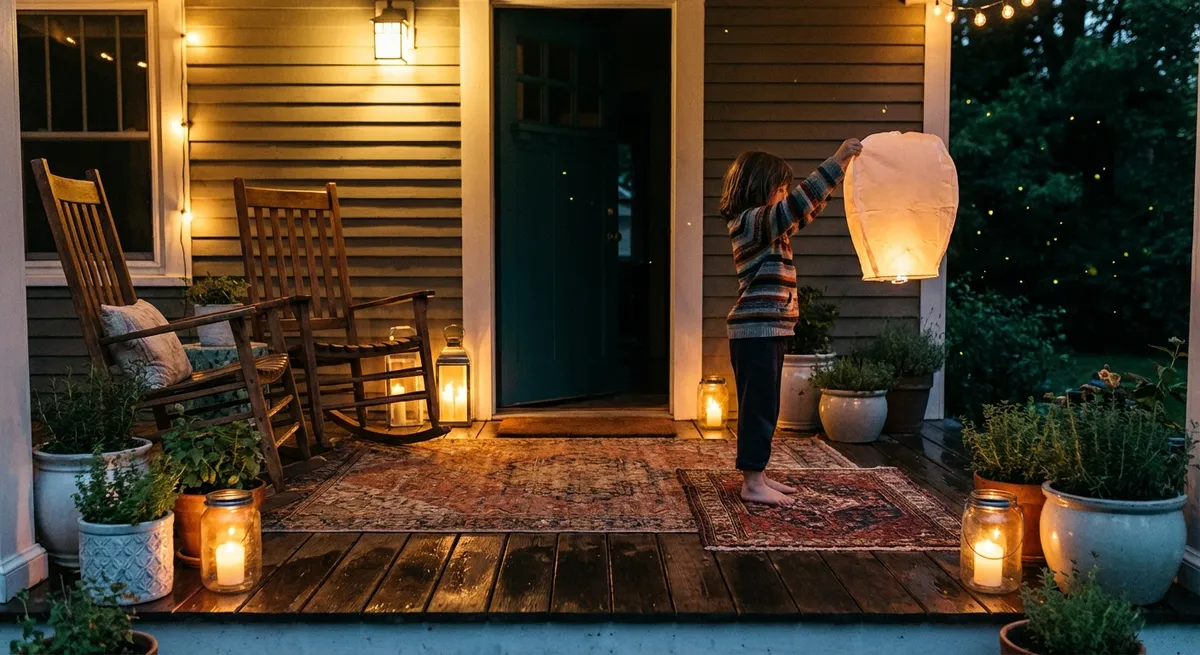
The Storyteller Porch: Layers of Time and Texture
Some porches feel like they’ve been listening for decades. They hold echoes of late-night talks, storm-watching afternoons, and barefoot summer mornings. You can design that feeling, even if your home is new.
Start with layers: a weathered wood bench, a woven rug, maybe a vintage trunk that doubles as a table. Mix new pieces with found objects—an old lantern, a chipped ceramic vase, a framed black-and-white photo of your town from years ago. These items don’t have to match; they have to converse.
Choose a warm, forgiving color palette—soft clays, nutmeg browns, linen whites, and inky blues. Let patina be part of the plan. A copper bell that dulls with rain, untreated teak that silvers in the sun, a clay pot that hairline-cracks and grows more beautiful with every season.
Add a small “story corner”: a low stack of outdoor-safe books or magazines, a notebook tucked in a drawer for visitors to leave notes, a framed quote on the wall that feels like a welcome. With each layer, your porch stops being a just-passing-through space and starts becoming a place where time slows down—and occasionally, stops to tell you a story.
The Morning Sanctuary: A Porch That Greets the Sun
Mornings on the porch might be the most underrated luxury of all. No flights. No fancy gear. Just you, the day, and a place to sit while the world wakes up.
Design your porch as if the sunrise is a guest you’re expecting. Notice where the first light touches—then put your favorite chair there. Choose seating that invites long, slow sits: a deep outdoor armchair, a cushioned bench with a high back, or a swing that rocks just enough to quiet your thoughts.
Let the textiles do the whispering. Think oatmeal-colored cushions, soft striped throws, and a woven jute or outdoor sisal rug underfoot. Add a tiny side table that’s exactly the right height for a mug, a notebook, or nothing at all. Something about the right table says: I made space for you to pause.
Greenery is your co-host. A tall planter with herbs you can run your hands through—rosemary, lavender, mint—turns each breath into something intentional. If you face a busy street, consider tall grasses or a row of potted shrubs as a living privacy screen. Morning light filtering through leaves has a way of smoothing the sharp edges of a day before it even begins.
Most important: define a “no rush” zone. Maybe it’s a rule that the first drink of the day—coffee, tea, or sparkling water—must be finished out here. One nonnegotiable, daily ritual can quietly transform your porch into a personal sanctuary.
The Night Porch: Soft Glow, Quiet Drama
When the sun steps back, your porch can step into a different kind of magic. The right night design doesn’t shout; it breathes—soft pools of light, gentle shadows, and that feeling that something good might happen, even on an ordinary Tuesday.
Start by layering your lighting the way you’d layer music in a playlist. Overhead lights on a dimmer become your base track. Add string lights or festoon bulbs for a soft, festive lilt. Finish with quiet highlights: a candle lantern on the steps, a small solar uplight on a favorite plant, a warm bulb in a wall sconce that makes the door glow like a welcoming beacon.
Choose warm color temperatures—around 2200K–2700K—so you get that campfire glow instead of a harsh spotlight. The goal isn’t visibility; it’s atmosphere. Think “moonlight plus candlelight” rather than “parking lot.”
Consider materials that look even better at night: brushed brass hardware, dark-stained wood, deep navy or charcoal painted trim. These tones drink up the darkness and offer it back as drama. A bowl of smooth river stones, a ceramic vase with a single branch, or a black metal lantern can become quiet focal points after dark.
If your climate allows, keep a basket of nighttime comforts: rolled-up throws, a couple of lanterns, and maybe a deck of cards. Night porches aren’t for scrolling; they’re for lingering—sharing secrets, spotting constellations, or just watching the neighborhood exhale.
The Green Threshold: A Porch That Breathes With the Garden
Some porches feel like they belong as much to the garden as to the house. They blur edges, inviting petals, leaves, and birdsong right up to your front steps. This is where your porch becomes a green threshold—a soft border between built and wild.
Think vertical first. Use railing planters, hanging baskets, and slim trellises to lift the greenery into your line of sight. Vines like clematis, jasmine, or climbing roses can be trained along wires or posts, turning structural elements into living sculptures. If you’re in a colder climate, try annual vines you can reimagine every year.
Anchor your space with a few strong, sculptural plants in sizable pots: an olive tree in a container, a tall grass like miscanthus, a statement fern in a dark ceramic planter. Between them, weave in herbs and pollinator-friendly flowers—lavender, salvia, coneflower—so your porch hums with quiet life.
Consider your senses. Fragrant plants near the door, rustling grasses near your chair, something soft for bare feet on the floor. A small water feature, even a tabletop fountain, can gently mask urban noise and create an instant sense of retreat.
You don’t need a huge footprint to pull this off. Even a narrow apartment stoop can host a vertical herb wall, a few railing planters, and one perfect chair. The key is continuity—let colors or materials echo from the garden to the porch: the same terracotta repeated three times, the same fern pattern in a pillow and a plant. Suddenly, your porch isn’t just next to nature; it’s in league with it.
The Gathering Nook: Intimate Spaces for Everyday Connection
Not every outdoor gathering has to be a full backyard production. Sometimes the sweetest moments happen in small clusters—two people, three chairs, a shared blanket, and the easy conversation that shows up when the effort is low.
Design at least one true “nook” into your porch—an arrangement that says, Sit. Stay. Talk. This could be two chairs angled slightly toward each other with a small table between, a corner L-bench packed with cushions, or even a deep porch swing wide enough for two.
Think in circles, not lines. Circular or oval tables, round ottomans, and curved seating help people naturally face one another. If your porch is narrow, push furniture to the edges and add one small movable stool that can shift to wherever the conversation is happening.
Use textiles deliberately to soften both sound and mood. Outdoor curtains that can be tied back on breezy days and drawn for privacy, a layered combination of pillows in different sizes, and one slightly oversized throw that practically begs to be shared. These textures take the echo out of the space and replace it with warmth.
Finally, create a tiny “welcome tray” that lives on your table or shelf: a carafe, a couple of tumblers, a small dish for snacks, maybe a deck of cards or a simple game. When guests drop by, you’re never more than thirty seconds from turning a quick hello into an actual moment. A true gathering nook doesn’t require planning; it simply waits, ready.
Conclusion
Your porch is more than a front step or a back exit. It’s your home’s first sentence and its final whisper—a pause between worlds where you can choose how you want to feel before you go in or head out. Whether you lean toward layered nostalgia, quiet mornings, luminous nights, garden-thick thresholds, or intimate nooks, the most powerful design move is intention.
You don’t need a big budget or a sprawling veranda to create threshold magic. Start with one corner, one ritual, one comfortable chair in exactly the right spot. Let your porch evolve season by season, memory by memory. Over time, it won’t just be a place you pass through; it will be the place you return to—again and again—because it feels unmistakably, beautifully like home.
Sources
- Environmental Protection Agency: Green Infrastructure – Guidance on incorporating vegetation and natural elements into built spaces for environmental and aesthetic benefits
- Harvard Graduate School of Design – Designing for Wellbeing – Insights on how thoughtfully designed spaces can support mental and emotional wellbeing
- Mayo Clinic: The Benefits of Spending Time Outdoors – Research-backed information on how outdoor environments reduce stress and improve mood
- Royal Horticultural Society – Gardening for Wildlife – Practical ideas for using plants and outdoor features to attract pollinators and enhance garden life
- U.S. Department of Energy: Outdoor Lighting Basics – Recommendations on outdoor lighting types, color temperatures, and energy-efficient choices