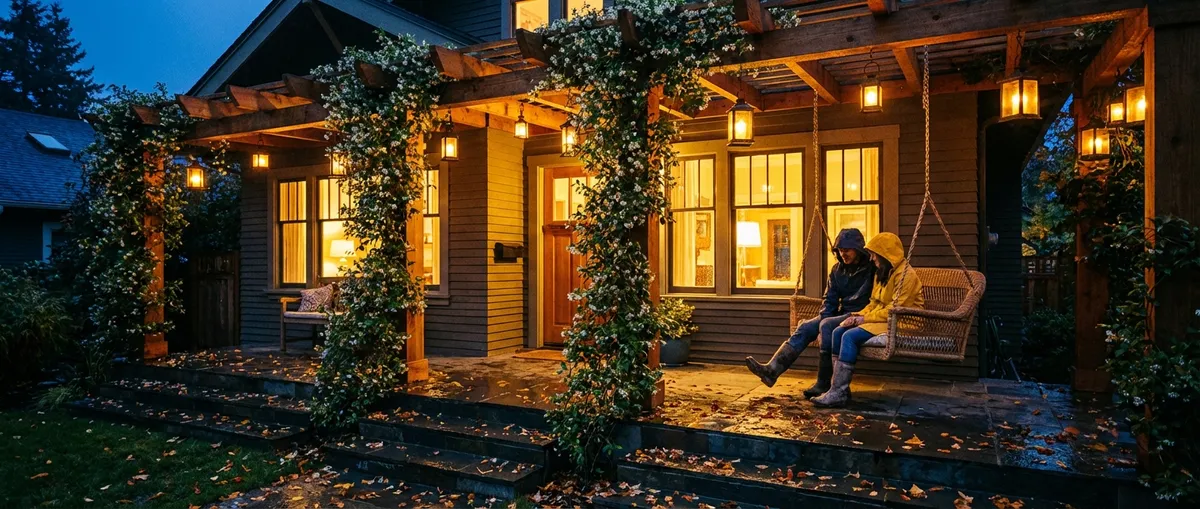
Designing this space isn’t about perfection—it’s about intention. When you craft your porch with care, you’re not just decorating; you’re choreographing how people feel the moment they arrive, and how you exhale every time you step outside.
Below are five design ideas outdoor-living lovers can use to turn any porch—front, side, or back—into a place that doesn’t just look good, but lives beautifully.
1. The Slow Arrival Porch: Layered Seating That Invites You to Pause
A “slow arrival” porch is designed so no one rushes through it. Instead of a straight shot from driveway to door, you create tiny reasons to linger—a chair angled toward the view, a small table that seems to whisper, set your keys down and stay a while.
Start by choosing one main seating anchor: a porch swing, a daybed, a pair of deep lounge chairs, or a built-in bench under a window. Then layer in secondary seating—stools that double as side tables, a single rocking chair near the railing, or a slim bench along a wall. The variety lets people pick their favorite “speed”: curled up, upright and chatting, or briefly perched.
Play with shapes and textures. Pair a linen cushion with a chunky knit throw, rattan chairs with a metal side table, a teak bench with soft outdoor pillows. The contrast keeps the eye moving and makes the porch feel collected over time, instead of staged in a single afternoon.
Finally, orient at least one seat outward, toward the street, courtyard, or yard. This is your “watch the world go by” spot—the place for early-morning coffee, evening check-ins with neighbors, and those private, quiet moments when life finally slows to your breathing.
2. The Dawn & Dusk Porch: Light That Changes With the Day
A great porch doesn’t just exist in daylight; it transforms as the sun moves. To design for both dawn and dusk, think in layers of light, each one with a mood and a purpose.
Start with a gentle, practical base layer: soft overhead lighting with warm-toned bulbs (around 2700K–3000K) so faces look inviting and the space feels calm. Add a dimmer if you can; your porch will shift from “welcome home” brightness to “nightcap glow” with a simple slide.
Then, introduce accent lighting. Lanterns on steps, string lights draped along the ceiling, or solar stake lights near the edges all create a sense of depth. Candle-style LEDs in hurricane lanterns add romance without the worry of open flame. Think of these as your twilight storytellers—they draw people out after sunset.
Finally, create at least one small, intentional pool of light: a reading lamp beside a chair, a sconce next to the door, or a battery-powered lantern on a side table. This is where someone can curl up with a book or journal while the rest of the porch fades into gentle shadow. In the early morning or late evening, that single pool of light can feel like a private universe.
By curating light that shifts from practical to poetic, your porch becomes not just a space you pass through, but a place you seek out at very specific, magical times of day.
3. The Secret Garden Porch: Living Greenery as Architecture
When you bring plants onto your porch, you’re not just decorating—you’re building living walls, archways, and rooms out of leaves and branches. The right greenery can make even a small porch feel like a retreat wrapped in its own quiet ecosystem.
Use vertical space first. Hang planters from the ceiling beams with trailing vines that cascade downward—think ivy, pothos (in shaded, protected areas), or hardy trailing annuals. Add trellises or slim plant stands where a railing or wall feels too bare. Climbing plants can soften hard lines and create natural privacy screens.
Next, build a “green edge” at eye level and below. Large pots with small trees or shrubs—like dwarf citrus in warmer climates or potted hydrangeas and boxwoods in cooler ones—anchor corners and frame views. Medium containers with herbs, ferns, and pollinator-friendly flowers bring scent and movement. When the wind moves through them, your porch doesn’t just look alive; it sounds alive.
Don’t forget scent and texture. Lavender in a pot near a favorite chair, a jasmine vine near the entry, or basil and mint within arm’s reach of your outdoor table can turn every breath into a reminder that life outside is richer, slower, and more deliciously present.
Over time, your porch plants begin to tell a story. You remember which summer the hydrangea first bloomed, which winter the rosemary survived, which evenings the jasmine’s fragrance reached all the way to the sidewalk. The porch stops being a border between inside and out and becomes part of the landscape itself.
4. The Storyteller’s Porch: Layers of Textiles, Color, and Memory
A storyteller’s porch doesn’t shout; it hums with quiet details. It’s the place where patterns and colors feel like chapters, and every textile holds a little piece of your life.
Start underfoot. An outdoor rug instantly defines the “room” and changes the energy of your porch. A striped rug can elongate a narrow space; a bold, patterned one can disguise footprints and add drama; a neutral woven rug sets a calm, coastal tone. Pick something that makes you want to walk barefoot, even if you rarely do.
Now add fabrics with intention: cushions, throw pillows, and blankets in a palette that makes your shoulders drop when you see it. You might choose sun-faded blues and sandy neutrals for a harbor feel, earthy terracottas and olive greens for a grounded, rustic mood, or monochrome tones with one wild accent color. Mix patterns—florals with stripes, solids with geometrics—as long as they share a color thread.
Layer in small, resonant objects: a ceramic bowl from a trip that now holds keys, a vintage tray for drinks, framed art that can handle humidity, a woven basket with rolled-up throws. These are the details guests notice when conversation pauses. They turn a generic porch into your porch.
Most importantly, leave space for the story to grow. An empty hook waiting for a future wind chime, a bare corner for a plant yet to be discovered, a blank bit of wall for art you haven’t met. A porch that can evolve over time is a porch that stays alive with possibility.
5. The Seasons-in-Motion Porch: A Flexible Layout That Never Stays Still
Outdoor lovers know that no two months outside feel the same—and your porch can echo that rhythm if you design it to shift with the seasons. Instead of treating furniture and decor as permanent, think of them as a cast of characters you can rearrange as the story changes.
Start with a core layout that’s easy to pivot. Choose modular seating, lightweight side tables, or folding chairs you can store nearby. In summer, you might push furniture outward to create open space for flow, games, or yoga stretches at sunrise. In cooler weather, pull pieces close together, anchoring them near an outdoor heater or clustered rug to form a cozy, cocooned conversation zone.
Build a “seasonal kit” you can rotate: breezy cotton pillows and sheer curtains in spring, striped beach towels and bright lanterns in summer, richer-toned pillows and boucle or wool throws in autumn, greenery and textured neutrals in winter. Store everything in clearly labeled bins or baskets so swapping takes minutes, not hours.
Let the porch reflect what life outside is asking for. On long, bright evenings, add a bar cart or drink station. During rainier stretches, tuck a small, covered basket of books, puzzles, or sketchpads nearby. In colder months, lean into warmth: stacked firewood (if you have a fire feature), insulated mugs, and lanterns clustered for glow.
When your porch can transform with each chapter of the year, stepping onto it never feels routine. It becomes a living calendar—a place where you can feel the turning seasons not just through a window, but under your feet and in the way the furniture seems to rearrange itself to meet you where you are.
Conclusion
A porch is more than an entrance; it’s an invitation—to pause, to notice the air, to look up from your screen and out toward something wider. When you design it with heart, you’re not just crafting a pretty backdrop for photos. You’re making a stage for unremarkable moments that turn out to be the ones you remember most.
Layer the seating so arrivals slow down. Let dawn and dusk shape your lighting. Grow a small world of leaves and petals just outside your door. Tell your stories in textiles and textures. And give your porch permission to move with the seasons, just like you do.
In the end, the magic isn’t in the furniture or the color palette. It’s in the way you use this in‑between place—to breathe, to connect, to step outside and realize that home doesn’t end at the door. It spills onto the boards, over the railing, and out into the open air.
Sources
- U.S. Department of Energy – Lighting Choices to Save You Money - Helpful guidance on bulb color temperature and energy-efficient lighting options for porches and outdoor spaces
- University of Minnesota Extension – Container Gardening - Practical advice on selecting and caring for plants in containers, useful for porch planters and vertical greenery
- Royal Horticultural Society – Plants for Pollinators - Lists and tips for choosing porch-friendly plants that support bees and other pollinators
- HGTV – Front Porch Ideas & Designs - Inspiration and examples of different porch layouts, seating, and decorative approaches
- Better Homes & Gardens – Outdoor Rugs Buying Guide - Information on choosing durable, weather-resistant rugs to define and soften porch spaces