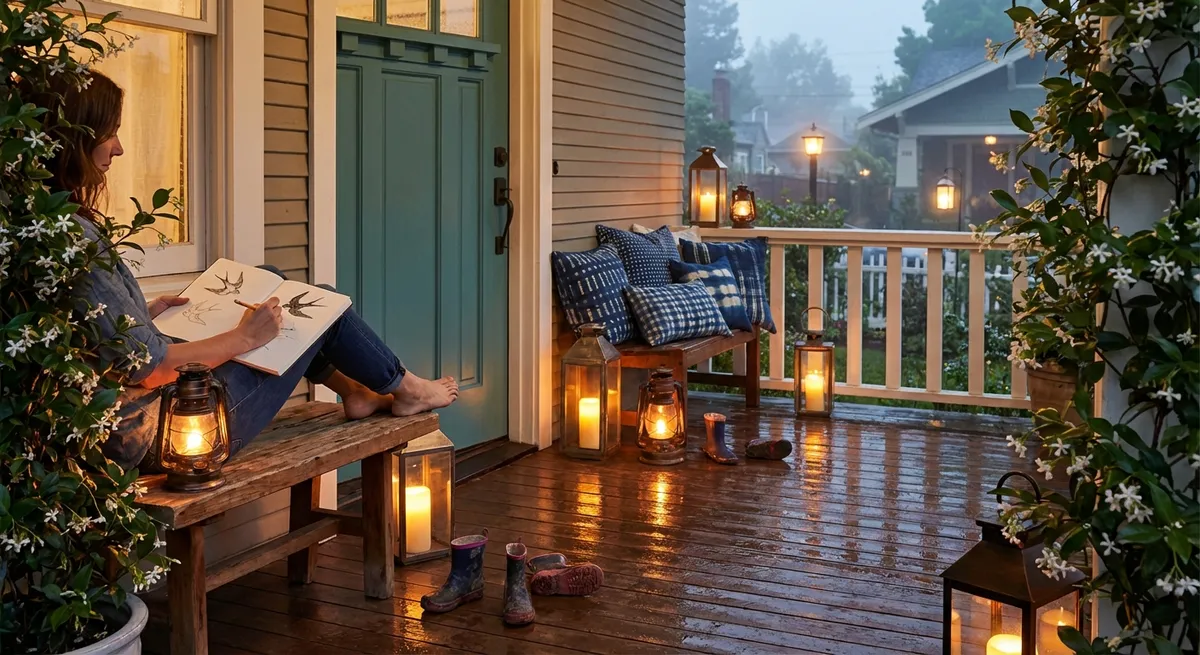
Below are five porch design ideas to help you shape a space that feels alive, generous, and deeply yours—no matter how big (or small) your square footage.
1. The Dawn Nook: Designing for Your First Light Rituals
Imagine a corner of your porch that belongs to the earliest part of the day—before emails, before headlines, before the world makes its first request of you. Designing a “Dawn Nook” is about honoring those quiet minutes with purpose and beauty.
Start with the light. Notice where the morning sun first touches your porch and let that be your anchor. Place a compact bench or a single, generous lounge chair in that pool of early light. Layer it with a cushion in a soft, sunrise palette: muted corals, pale blues, or warm creams that echo the sky as it’s waking up. Add a slim side table just big enough for a mug, a notebook, and a book that doesn’t demand much—poems, essays, maybe a bird guide for the visitors in your trees.
Plant life becomes your co-host here. A single tall planter with herbs like rosemary or mint turns every passing breeze into aroma therapy. If your porch is small, hang one slim planter on the railing with trailing plants that soften the hard edges and catch the light as it filters through.
Lighting is important, even for morning. A warm, low-watt lantern or wall sconce will carry you through those days when dawn is late and your thoughts are early. Let this nook be deliberately uncluttered—a place where your mind can land without tripping over yesterday’s to-do list. Over time, this small design choice transforms into a daily ritual: you, the rising light, and a space that expects nothing but your presence.
2. The Conversation Porch: Circles, Not Rows
Some porches are made for watching the world pass by. Others are built for drawing people in. The “Conversation Porch” is designed entirely around eye contact, shared stories, and the kind of talking that somehow only happens outside.
Instead of lining furniture against the house wall, bring it inward and into a loose circle or soft U-shape. Think of your porch floor as a campfire clearing—chairs and benches face each other, not the street. Mix seating types: a small love seat or settee for close conversations, plus a couple of individual chairs for guests who like a bit of personal space. Add weather-resistant floor cushions or poufs that can be pulled into the circle when the evening expands and more friends arrive.
At the heart of the arrangement, place a low table or oversized ottoman that invites shared use: a place to rest a tray of drinks, spread a deck of cards, or pile up a few favorite books and a board game. A textured outdoor rug beneath the cluster instantly signals, “This is a room, not just a porch.” Choose patterns that feel playful or comforting—woven stripes, subtle geometrics, or something that echoes your home’s architecture.
Don’t forget sound. Hang one small wind chime tuned to a soft, gentle scale or position a compact outdoor speaker nearby for background music that hums quietly instead of shouting. Finish with layers of soft light—string lights draped thoughtfully, not tangled; a table lantern or two; maybe a candle in a hurricane glass. This porch doesn’t ask you to be entertained; it invites you to be engaged—with the people sitting just a few feet away.
3. The Green Gallery: Turning Your Porch into a Living Exhibit
For outdoor living enthusiasts, a porch can become a curated gallery of growing things—a living exhibit that changes with the seasons and rewards each small act of care. The “Green Gallery” is less about a single statement and more about creating a layered, immersive experience.
Think in vertical planes, not just floor space. Use wall-mounted planters, narrow shelving, or lattice screens to create a backdrop of leaves and blooms. Hang a few trailing plants—like ivy, pothos (in the right climate and conditions), or flowering annuals—in staggered heights so your eye meets greenery at every level. If you have railings, treat them like picture frames and place slim planters or window boxes along the edges.
Balance texture and form: pair the glossy leaves of a rubber plant or philodendron (if suitable for your porch conditions) with the feathery softness of ferns or ornamental grasses. Add one sculptural plant—perhaps a dwarf tree in a tall planter or a dramatic succulent arrangement—to act as a focal point. Even a narrow porch can feel lush with just a few carefully chosen specimens.
Consider how your plants will look at night. Soft, upward-facing spotlights can turn a single tree or tall plant into a quiet, theatrical moment, while tiny solar stake lights tucked into planters make leaves glow from within. If your climate allows, mix in edible elements—pots of basil, thyme, chives, or cherry tomatoes—so your porch isn’t just beautiful, it’s generous.
Finally, frame a single “view moment”: arrange your plants so that when you sit in your favorite chair, you look through a layered portal of leaves toward a particular sight—the street, the sky, a sunset, or simply the open air. Your porch becomes not only a place where plants live, but a place where you feel vividly, gratefully alive beside them.
4. The Weather Watcher’s Retreat: Embracing Rain, Wind, and Sky
Some people head inside when the weather shifts. Others lean in, step onto the porch, and listen. If you’re the kind who loves the rumble of distant thunder or the way wind rearranges the trees, design your porch as a “Weather Watcher’s Retreat”—a safe front-row seat to everything the sky is doing.
First, shelter is key. If your porch is covered, consider adding outdoor curtains or bamboo shades that can be drawn to soften strong sun, filter sideways rain, or block wind without closing you off from the world. These shifting layers turn your porch into a responsive space—different in the bright rush of afternoon than in a rainstorm’s blue-gray hush.
Choose seating that welcomes lingering, not perching: a deep chair with a high back, a swing that gently rocks, or even a suspended daybed if your structure allows. Add blankets in natural fibers and an outdoor basket where they live, always ready for cooler air. A small, weather-resistant side table offers a place for hot tea on a cold day or a cool drink on a stormy summer evening.
Sound is central here. If you love rain, consider a rain chain instead of a traditional downspout; it guides water in visible, musical streams, turning a functional necessity into a natural instrument. A small, durable barometer or weather station on the wall can make your porch feel like a tiny observatory—your personal outpost for watching pressure drop and clouds gather.
At night, use light sparingly so the sky remains the star. A couple of low, warm lanterns around your feet are enough; let the porch ceiling and the open air above stay dark so you can track lightning flickers, shifting clouds, or a slow parade of stars. Over time, your Weather Watcher’s Retreat becomes the place where you meet each season not as an inconvenience, but as a visiting storyteller with something new to say.
5. The Threshold Atelier: A Porch for Making, Mending, and Dreaming
A porch can also be a studio—the threshold where imagination slips outside and gathers a bit of sunlight on its way to becoming real. The “Threshold Atelier” is for sketchers, knitters, writers, tinkerers, and anyone who feels creativity stir the moment fresh air touches their skin.
Start with a flexible work surface. A slim, fold-down wall-mounted table or a lightweight outdoor café table can do double duty: open when you’re in the mood to make something, fold or slide away when you’re not. Keep a weather-resistant storage box or bench nearby for art supplies, journals, yarn, small tools, or whatever materials fuel your particular form of magic.
Lighting matters here not only for mood but for clarity. Aim for layered lighting: one bright, focused task lamp or clamp light for close work, plus softer ambient light that keeps the rest of the porch warm and inviting. During the day, position your work spot to catch indirect natural light—it’s kinder to the eyes and truer to color.
Let inspiration hang where you can see it. A small corkboard or magnetic board with sketches, color swatches, travel postcards, or clipped phrases can live on the porch wall, protected from direct rain. Add a plant or two specifically to ground you while you work—a bonsai, a tiny potted tree, or even a single, dramatically shaped leaf in a vase.
Finally, design in a pause: a comfortable chair or cushion just a few steps away from your work table, facing out toward the world. This is where you sit when you need to think without doing. A porch-based atelier flows between attention and reflection, making and musing, hands busy and hands still. Over time, that porch rail becomes the place where half-finished ideas catch a breath of wind and suddenly know what they want to be.
Conclusion
A porch doesn’t have to be grand to be transformative. It can be a single chair angled toward the sunrise or a small forest in pots. It can be a listening post for rain, a round table for late-night laughter, or a tiny studio where projects finally find the space they’ve been waiting for.
What matters most is that your porch feels like an intentional threshold—a place where the inside you and the outside world meet on gentle terms. When you shape this space with care, it quietly reshapes your days in return: more time outside, more unhurried conversations, more sky, more breeze, more presence. And that, more than any specific design choice, is what outdoor living is really about.
Sources
- Environmental Protection Agency – Green Infrastructure: Residential Practices – Overview of residential green practices, including landscaping and plantings that can inspire porch-friendly greenery and drainage-aware design.
- American Society of Landscape Architects – Outdoor Rooms – Professional insights on creating functional, comfortable outdoor “rooms” that inform layout, seating, and spatial planning for porches.
- University of Minnesota Extension – Creating Outdoor Living Spaces – Research-based guidance on designing outdoor spaces with attention to climate, comfort, and use patterns.
- Harvard Health – The Healing Power of Nature – Explains the physical and mental health benefits of time spent outdoors, reinforcing the value of investing in livable porches.
- National Weather Service – Weather Safety – Practical information on staying safe while enjoying weather from your porch, especially in storm-prone areas.