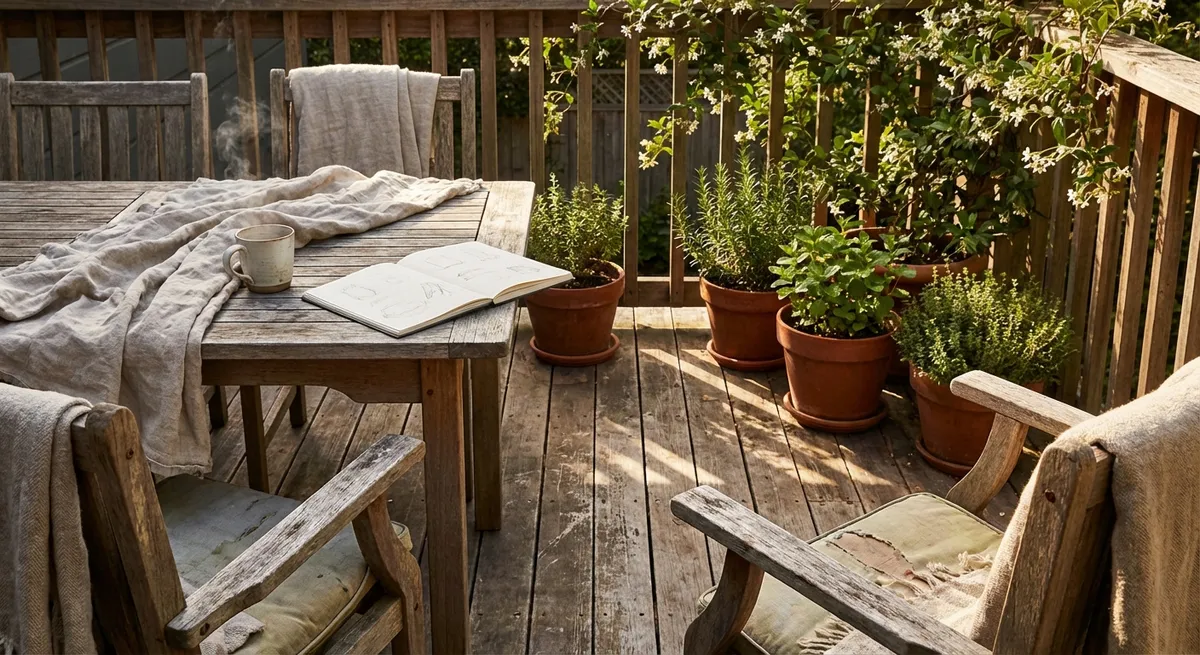
You’re not just choosing chairs and tables. You’re choosing how your days will sound, where your evenings will land, and what your in-between hours will feel like on your skin. Let’s design for that.
Below are five outdoor furniture ideas that don’t just fill a space, but invite a life.
1. The Conversation Curve: Seating That Pulls People Closer
Straight lines say, “Sit down.” Curves say, “Come in.”
Instead of lining up outdoor chairs like a waiting room, think in gentle arcs and circles. A curved sectional, a half-moon bench hugging a low fire table, or a cluster of mismatched chairs facing inward can turn any patio or porch into an instant gathering spot. When people naturally face each other, conversations unspool more easily—soft questions, honest stories, long silences that feel comfortable instead of awkward.
Layer cushions in natural tones—sand, stone, clay—and let one or two bolder colors signal joy: a deep ocean blue, a rust red, a moss green. Add a round outdoor rug beneath it all to visually anchor the furniture and subtly say, “This is our little universe right here.”
Think of this setup less as seating and more as an embrace. Any time you walk outside and see the curve waiting, you’ll know your day still has time for connection.
2. The Slow Table: Dining Sets Built for Long, Wandering Meals
Fast meals belong indoors. Outside is where dinner stretches and twists, where dessert happens simply because no one wants to stand up yet.
Choose a dining table that feels generous rather than perfect—a weathered wood farmhouse-style table with visible grain, a matte metal table with rounded edges that catch the light, or a tiled surface with hand-laid patterns. These details invite touch, which means people will linger. Imperfection helps too: a knot in the wood, a subtle patina, chairs collected over time instead of bought in a single matching set.
Pair the table with seat cushions that welcome you for hours, not minutes. Consider two end chairs with arms for extra comfort and a bench along one side so kids, friends, and last-minute guests can slide in together. Overhead, a simple pendant lantern, string lights, or a cluster of paper lanterns can turn the table into a glowing island when the sky goes dark.
When your outdoor dining area feels like a place to stay instead of a place to eat, every meal becomes a small celebration, even if it’s just toast and tea under a cloudy sky.
3. The Reading Nest: A Solo Sanctuary in the Open Air
Everyone deserves one chair that is utterly, unapologetically theirs.
Design a small reading or daydreaming nook with a single statement piece of furniture: a deep lounge chair, a hanging egg chair, a cushioned swing, or a daybed wide enough to fall asleep on by accident. Position it where it can borrow beauty—facing a tree, a garden bed, a sliver of skyline, or even just the soft geometry of your fence catching afternoon shadows.
Surround this nest with small comforts: a side table for books and glasses, a lightweight throw for evenings when the breeze turns thoughtful, and a lantern or solar-powered lamp for twilight pages. If you’re working with a balcony or compact porch, vertical solutions like wall-mounted shelves for plants and books can expand the feeling of the space without taking up floor area.
This isn’t just “a place to sit.” It’s the space that reminds you you’re allowed to pause, to watch clouds instead of screens, to hear your own thoughts without interruption. Outdoor furniture can hold that permission for you, patiently, every single day.
4. The Soft Border: Benches, Planters, and Pieces That Shape Space
Not all furniture needs to shout “Look at me.” Some of the best pieces quietly shape how you move, gather, and breathe outside.
Think of benches that double as low borders—running along a deck edge, wrapping a tree, or hugging the perimeter of a patio. These create extra seating for parties and subtle boundaries for daily life. Planter benches, in particular, are magical: the built-in greenery wraps around you as you sit, softening hard edges and blurring the line between “furniture” and “garden.”
Outdoor consoles, slim sideboards, and narrow shelves can define zones too—one side for lounging, the other for dining, with the furniture acting like a gentle divider rather than a wall. Use these surfaces for candles, potted herbs, speakers, or stacks of outdoor-safe blankets.
When furniture becomes part of the architecture of your yard—guiding the eye, marking transitions, opening or closing views—you get a space that feels designed but still free, structured but still wild enough to hold surprise.
5. The Shape-Shifter: Modular Pieces for Lives That Keep Changing
Outdoor living rarely looks the same two years in a row. Jobs shift, kids grow, hobbies evolve, and sometimes the best nights are the ones you didn’t see coming. Your furniture can be ready for all of it.
Modular outdoor sectionals let you create a long lounge one weekend and separate chairs the next. Lightweight stools can be side tables, extra seating, or plant stands. Nesting tables glide into the scene when you need more surfaces, then tuck quietly away. Folding or stackable chairs stand by for unexpected guests and tuck into a corner when it’s just you and the crickets.
Choose materials built for weather and for movement: powder-coated aluminum that’s easy to lift, resin wicker that resists fading, performance fabrics that shrug off rain and spills. Every piece you don’t have to baby gives you more freedom to actually live outside—impromptu movie nights, sketching sessions, yoga at sunrise, brunch that expands as neighbors wander over.
Shape-shifting furniture says yes for you before you even know what you’ll ask of it.
Conclusion
Outdoor furniture is often treated like a checklist: a table, some chairs, maybe a lounge if there’s space. But when you slow down and ask, “What kind of life do I want to live out here?”, the answer changes everything.
Curved seating pulls people closer. Generous tables hold time, not just plates. Single chairs become sanctuaries. Benches and consoles sketch invisible lines that make small spaces feel intentional and large spaces feel intimate. Modular pieces flex with the seasons of your life.
You’re not just furnishing a porch or a patio. You’re composing a landscape for your daily rituals, your best conversations, your quiet recoveries. Start with one idea that speaks loudest to you, build slowly, and let your outdoor furniture become what it’s always capable of being: a home for the hours you’ll remember most.
Sources
- American Society of Landscape Architects – Outdoor Living Trends - Professional insight into how people are designing outdoor living spaces today
- Better Homes & Gardens – Outdoor Furniture Buying Guide - Practical advice on materials, durability, and layout considerations
- House Beautiful – Patio Furniture Ideas - Inspiration and examples of creative outdoor furniture arrangements
- Consumer Reports – Best Patio Furniture for Your Outdoor Space - Research-based guidance on performance, maintenance, and weather resistance
- University of Minnesota Extension – Outdoor Living Spaces - Educational resource on planning and designing functional outdoor areas