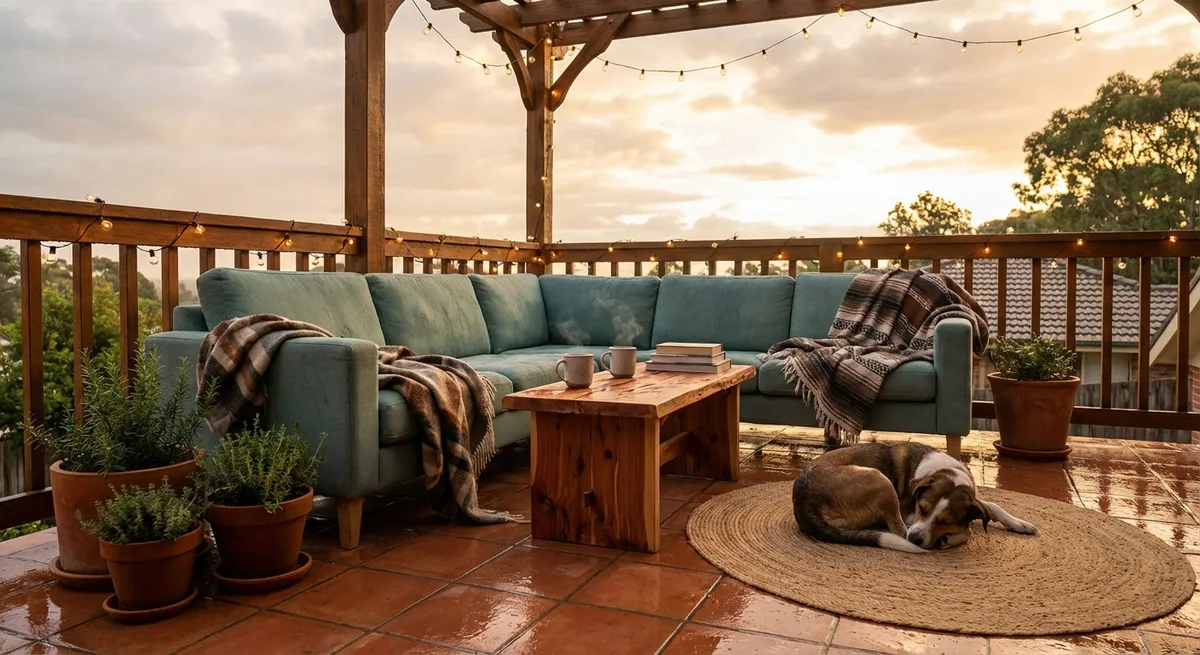
Below are five design ideas to help you shape an outdoor space that feels less like décor and more like a life you want to step into every day.
1. The Slow-Morning Lounge: Low, Soft, and Sun-Warmed
Imagine stepping outside before the house wakes up. The air is still cool, the light is soft, and there’s a chair waiting that feels like it remembers you. For slow mornings, think low, deep seating that invites you to linger rather than perch.
Choose outdoor sofas and lounge chairs with cushions thick enough to feel like indoor furniture but wrapped in weather-ready fabrics. Opt for curved silhouettes—rounded arms, soft edges, poufs instead of rigid side tables—to signal ease and comfort. Layer in textures: a woven rattan frame, a slatted wood coffee table, a knit outdoor throw, a tray for your mug and notebook.
Place this lounge zone where it can catch early light but still offer shade as the sun rises: under a pergola, awning, or large umbrella. Add one unexpected piece—a rocking chair, a hammock chair, or a chaise that lets you put your feet up. This becomes your mini-retreat, no travel required, a daily invitation to sit down before the day starts sprinting.
2. The Long-Table Life: Dining That Stretches Into Evening
Outdoor dining furniture can do more than host a barbecue; it can quietly turn weeknights into something worth remembering. Picture a table long enough for extra chairs to slide in, surfaces that welcome candle wax, water rings, and crumbs from loaves torn by hand.
Look for a dining table made from teak, powder-coated aluminum, or high-quality resin—materials that hold up to weather and wipe down easily. Benches on one side can maximize seating and keep things casual, while a mix of chairs on the other side gives everyone a “favorite spot.”
Think about how the table will feel at different times of day. String lights overhead, lanterns along the center, or a fire bowl nearby can pull meals late into the night. Keep a small outdoor cabinet, bench with storage, or deck box close by stocked with extra cushions, blankets, and stackable stools so more people can always be added to the circle.
Over time, the table will collect a patina—tiny marks of birthdays, rushed breakfasts, and last-day-of-summer dinners. That’s its real beauty: the furniture is ready to be imperfect, so you don’t have to be precious with the life happening around it.
3. The Moveable Stage: Lightweight Pieces That Follow the Sun
Not every outdoor space has a fixed “destination.” Sometimes you’re chasing light, dodging wind, or sliding into the single patch of shade on a hot afternoon. For that, you need furniture that can move when you do.
Focus on lightweight, stackable, and foldable pieces: café chairs, bistro tables, small nesting side tables, and slim loungers with handles or built-in wheels. Powder-coated metal, high-quality plastic, and aluminum can often be shifted with one hand. Choose a consistent color palette—maybe all white with pops of terracotta, or soft greens and charcoal—so even when you rearrange, everything still feels intentional.
Think of your outdoor area as a stage set that can change scene by scene. In the morning, pull two chairs and a tiny table into the sun. Midday, tuck the same pieces under a tree. At night, gather them near your fire pit or closest outlet for a plug-in lantern. Your furniture becomes a toolkit, not a fixed layout, and your space can respond to the weather, the season, and your mood.
This approach is especially powerful for small balconies or shared yards: you’re not stuck with one layout; you’re free to reimagine your outdoors as often as you like.
4. The Quiet-Work Corner: A Desk Where Birds Are the Background Noise
There’s a special kind of focus that only appears when you’re outside, just far enough away from the screen glow and the laundry pile. Creating an outdoor work or creative corner is less about buying a traditional “desk” and more about choosing pieces that support deep attention.
Start with a table that’s large enough for a laptop or sketchbook but small enough not to dominate the space: a compact bistro table, a narrow console, or even a wall-mounted fold-down surface on a balcony. Pair it with a chair that supports your back—something you’d happily sit in for an hour—ideally with a cushion and armrests.
Add one or two details that signal, “This is where you do your meaningful work.” Maybe it’s a small outdoor rug that defines the zone, a planter with herbs or a favorite flower nearby, or a standing lamp rated for outdoor use. Consider a shade solution, like a sail shade or umbrella, to keep glare off screens and keep you comfortable.
When you sit down here, you’re not just working—you’re rewriting what “being at your desk” looks like. You’re trading overhead fluorescents for sunlight through leaves, hallway chatter for wind, and it changes the energy you bring to whatever you’re creating.
5. The Firelit Circle: Seating That Holds Every Kind of Conversation
Fire draws people the way stories do. Around flames, voices drop, time loosens, and even the most ordinary Tuesday can feel a little cinematic. To build a firelit gathering space, think in circles and layers.
Arrange chairs, loveseats, or built-in benches around a central fire element—whether it’s a gas fire pit, wood-burning bowl, or tabletop fireplace. For comfort and flexibility, mix fixed seating (like a deep loveseat or two generous armchairs) with easily movable stools, poufs, or low side tables that can double as extra seats.
Choose materials that can handle ash, sparks, and the occasional splash—stone, metal, ceramic, or heat-resistant composite for the fire area, with cushions made from outdoor performance fabric. Keep a basket of blankets nearby so guests can tuck in as the temperature drops.
The circle doesn’t have to be perfect; it just needs to feel like everyone can see everyone else. In this kind of layout, stories bounce easily, chess boards and card games can appear on low tables, and laughter doesn’t have to travel far. The furniture becomes a quiet promise: there will always be a place for you here when the night gets cool and the stars come out.
Conclusion
Outdoor furniture is more than a checklist of chairs and tables; it’s a language you speak with your space. Low lounges say, “Stay a while.” Long tables say, “There’s room for you.” Movable pieces whisper, “Change is welcome here.” Work corners say, “Your ideas deserve fresh air.” Firelit circles murmur, “Let’s talk a little longer.”
When you choose each piece as if you’re choosing a moment you want more of—slow mornings, shared meals, quiet focus, deep conversations—you’re not just decorating outdoors. You’re building a life that keeps inviting you back outside, again and again, to live it fully.
Sources
- Consumer Reports – Buying Guide to Outdoor Furniture – Overview of durable materials and weather-resistant options for outdoor furniture.
- University of Arkansas Cooperative Extension – Outdoor Living Spaces – Guidance on planning functional outdoor living areas and furniture placement.
- HGTV – Outdoor Furniture Ideas – Visual inspiration and examples of different outdoor furniture styles and layouts.
- Better Homes & Gardens – Outdoor Room Design Tips – Practical tips for creating cohesive, comfortable outdoor rooms with furniture and accessories.
- Sunbrella – Performance Fabric Guide – Information on outdoor performance fabrics and why they matter for long-lasting cushions and upholstery.