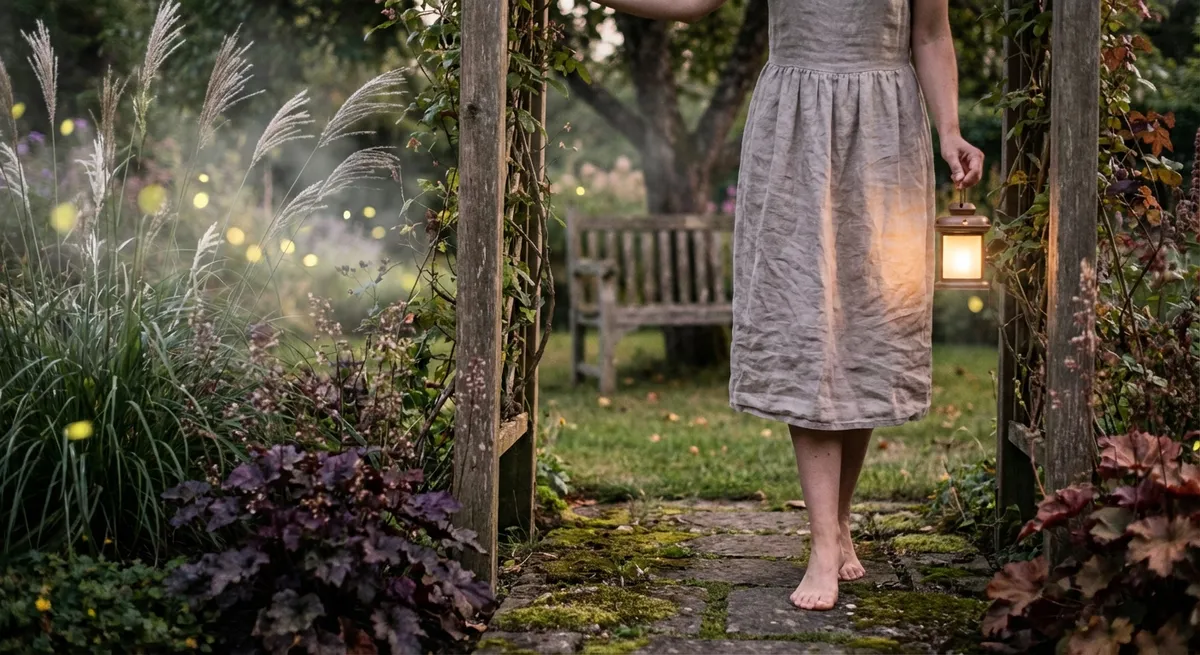
These five design ideas are for outdoor living enthusiasts who want more than “curb appeal.” They’re for people who want their space to whisper: stay a little longer.
1. The Slow Path Garden: Turning Walkways Into Journeys
Most paths are designed to get you from A to B as quickly as possible. But what if the journey was the destination?
Imagine a path that curves instead of rushes—soft arcs that reveal your yard a little at a time. Along the edges, low, fragrant plants like creeping thyme and lavender brush your ankles as you pass. A small bench appears halfway down the path, as if waiting for you to sit and listen to the world for a minute. Lighting is gentle and low, guiding your steps instead of announcing them to the neighborhood.
Design your own slow path by mixing materials: stepping stones set in moss or gravel, a section of brick that feels timeless underfoot, maybe a wooden boardwalk where the ground dips. Let taller plants gently frame the narrow parts of the path, so every turn feels like entering a new “room” in your garden. A slow path doesn’t just connect spaces—it changes your pace, your breathing, and your mood.
2. The Green Room Under the Sky: Living Walls and Soft Screens
Outdoor living becomes magical the moment you stop feeling like you’re “on display” and start feeling like you’re inside a green, breathing room.
Instead of a plain fence, picture a living screen: climbing roses looping through wire, ivy softening sharp corners, or espaliered fruit trees stitched flat against a wall like green embroidery. You can layer this with trellises, tall grasses, or bamboo to blur the edges of your space, so it feels cocooned rather than fenced in.
A “green room” works beautifully around your seating area. Place a cozy chair or outdoor sofa so it faces planted walls instead of parked cars or neighboring windows. Pot up tall planters with ornamental grasses that rustle like whispers in the breeze. Suddenly, your backyard is not just outdoors—it’s a room with no ceiling, where the sky plays the role of chandelier and shifting clouds become your art.
When you define your boundaries with plants instead of solid walls, your space feels soft, private, and alive. It invites lingering, long conversations, and quiet morning rituals with a mug in your hands and dew on your toes.
3. The Element Garden: Fire, Water, and the Spaces Between
Some landscapes look nice. Others sound and feel like somewhere you want to stay forever. The difference often comes down to the elements—fire, water, air, and earth—woven together with intention.
Imagine a small, modern fire bowl tucked into a gravel corner, where flames flicker against a backdrop of slate or brick. Around it, low, sturdy chairs invite people to circle up and lean in. Just a few steps away, a simple water feature—maybe a ceramic urn with a recirculating pump—offers a constant, gentle murmur that softens traffic noise and quiets your thoughts.
Let plants echo the elements: silver foliage and blue flowers near water to cool the space, sun‑loving herbs and hot‑colored blooms near your fire zone to turn up the warmth. Use stone, wood, and metal in balance so each material has its moment—cool river rock underfoot, warm cedar under your hand, a steel planter catching the late sun.
The magic is in the contrast: warmth and coolness, stillness and movement, crackling fire and whispering water. Thoughtfully layered, your yard becomes a living meditation on balance—one that’s just as ready for a lively gathering as it is for a solitary, star‑staring night.
4. The Edible Tapestry: Food, Flowers, and Everyday Wonder
There’s something deeply satisfying about stepping outside and plucking part of your dinner from the landscape. Edible landscaping turns your yard into a tapestry of color, texture, and flavor, without looking like a traditional vegetable patch.
Instead of lining up raised beds in rows, imagine herbs drifting along a stone path, strawberries spilling over the edges of a container, and blueberry bushes framing your seating area with spring blossoms and autumn color. Mix edible plants with ornamentals: purple basil nestled beside marigolds, kale threaded through a border of pansies, chives poking up between perennials.
Fruit trees—apple, pear, fig, or citrus where the climate allows—can be pruned as sculptural centerpieces. Replace a few standard shrubs with berry bushes or currant hedges. Even a tiny balcony can host pots of cherry tomatoes, mint, and dwarf citrus that perfume the air.
The more you blend beauty and utility, the more your yard becomes an invitation to touch, taste, and explore. Every walk outside becomes a small harvest, every season a new chapter in a story where you’re not just an observer—you’re a participant.
5. The Seasonal Stage: A Yard That Changes Like a Story
The most unforgettable landscapes don’t look the same every month. They rise and fall, glow and fade, just like the rhythms of your own life.
Imagine your space in chapters. In early spring, bulbs you planted months ago slip quietly through the soil—snowdrops, crocuses, daffodils turning cold mornings into small celebrations. As spring deepens, perennials wake up; your trees leaf out and cast dappled shade over a reading chair. By summer, the garden is in full voice—pollinators zigzag through coneflowers and salvia, and the air buzzes with life.
Come autumn, grasses turn bronze and gold; seed heads stand tall and architectural against low, slanting light. You swap bright cushions for earth‑tones, maybe add a thicker throw by the fire pit. Even in winter, your landscape can hold shape: evergreen shrubs, bare branches that cast intricate shadows, a single red berry bush bright against snow or frost.
Plan your yard like a performance with rotating scenes: spring tenderness, summer abundance, autumn reflection, winter stillness. When you choose plants and features with the seasons in mind, your landscape stops being a static picture and becomes a living, changing companion to your year.
Conclusion
Landscaping isn’t reserved for sprawling estates or perfect climates. It’s a creative act available to anyone with even a sliver of outdoor space and a willingness to experiment. When you slow your pathways, soften your boundaries with green, invite in the elements, weave food into your flowers, and think in seasons instead of weekends, your yard transforms from “outside” into “a place that holds you.”
You don’t need perfection to begin. Start with one curve in a path, one corner of living wall, one pot of herbs by your favorite chair. Let your landscape grow with you—one whispered pathway, one green room, one small, brave idea at a time.
Sources
- University of Minnesota Extension – Sustainable Landscaping - Guidance on plant selection, paths, and environmentally friendly design principles
- Royal Horticultural Society – Creating a Garden for All Seasons - Practical tips on planning year‑round interest in a landscape
- USDA National Agroforestry Center – Edible Landscaping and Agroforestry - Information on integrating food‑producing plants into designed spaces
- Cornell University – Water Features in the Landscape - Research‑based overview of designing and maintaining water elements
- Colorado State University Extension – Fire Pits and Outdoor Fireplaces - Safety and design considerations for incorporating fire into outdoor living spaces