Designing for Feeling, Not Just for Looks
Before you pick a single plant, ask a different kind of question: How do I want this space to feel? Calm like a Sunday nap? Energizing like a city walk? Magical like a hidden forest?
When you design for feeling, you start to notice different layers. Texture becomes as important as color—soft grasses against smooth stone, glossy leaves beside rough bark. Sound joins the conversation: the hush of wind through bamboo, the steady trickle of water, the rustle of wildlife at the edges. Scent becomes a memory-maker—lavender by the steps, rosemary brushing your leg as you pass, jasmine waiting to greet you after dark.
Instead of chasing a “finished” yard, imagine a space that evolves with you. Plants that grow fuller each year, corners that change purpose with the seasons, paths worn into the lawn where you naturally like to walk. A landscape like this doesn’t demand perfection; it invites presence.
Idea 1: The Meandering Path That Slows You Down
Straight lines get you there faster. Curves make you notice the journey.
Design a path that intentionally refuses to rush you. Let it wander—not just from door to gate, but from one small experience to the next. Maybe it begins at your back steps, slips past a low herb border, bends around a flowering shrub, and ends at a quiet seat tucked near the fence.
Use materials that feel good underfoot and age gracefully: pea gravel that crunches softly as you walk, flagstone with moss year by year edging closer to the center, decomposed granite that brings a warm, earthy color to the ground. Frame the path with plants of varying heights: kneecap-high lavender or catmint brushing your calves, taller grasses that sway at eye level, and a few anchor shrubs that catch the light.
This kind of path turns your yard into a small adventure. It gives children a “route” for their imaginations, gives adults a place to walk while thinking, and gives every guest the sense that they’re being gently guided into something special rather than just stepping into “the backyard.”
Idea 2: A Layered Planting Border That Feels Like a Soft Horizon
Instead of a flat, single line of plants along the fence, imagine your borders as landscapes in miniature—small, layered vistas that shift through the seasons.
Start with a backbone: a few carefully chosen shrubs or small trees that provide structure in every season—evergreens, graceful deciduous trees with interesting bark, or shrubs that bloom briefly but dramatically. In front of them, plant a middle layer that changes shape and color: flowering perennials, ornamental grasses, and foliage plants with contrasting leaves—silver next to deep green, feathery beside broad.
Closest to the path or lawn, add groundcovers and low growers that spill and soften the edge: creeping thyme between stepping stones, sedum that catches sun, woodland phlox that glows in spring. This layered approach creates depth, even in a small yard, making your boundary feel like a destination, not an afterthought.
As the light moves across the day, these layers hold surprise—backlit grass plumes in late afternoon, dew beading on low leaves, blooms that seem to appear overnight. Your “edge” becomes a soft horizon that’s endlessly watchable.
Idea 3: A Small-Scale Sanctuary for Pollinators and Birds
A landscape comes fully alive when it’s shared. When butterflies drift in, bees move from bloom to bloom, and birds stake out the branches as their own, your yard stops being a separate space and starts to feel like part of a wider, breathing world.
Devote even a modest corner to a pollinator- and bird-friendly pocket habitat. Choose nectar-rich flowering plants that bloom in succession from early spring through fall: early bulbs and wildflowers, midsummer coneflower and bee balm, late-season asters and goldenrod. Mix in native plants specific to your region; they tend to be tougher, more resilient, and especially loved by local wildlife.
Add a simple water source—a shallow birdbath, a small bubbler fountain, or even a stone dish with pebbles for butterflies to safely sip from. Include a few plants that offer berries or seeds, and let some ornamental grasses stand through winter so birds can forage. A fallen log or a small brush pile in an unobtrusive corner can become a tiny wildlife hotel.
This isn’t just ecological goodness—it’s joy in slow motion. Morning coffee becomes a front-row seat to goldfinches balancing on stems, bees tracing invisible routes, and dragonflies catching light. Your landscape turns into a refuge, for them and for you.
Idea 4: A Night Garden That Wakes Up After Sunset
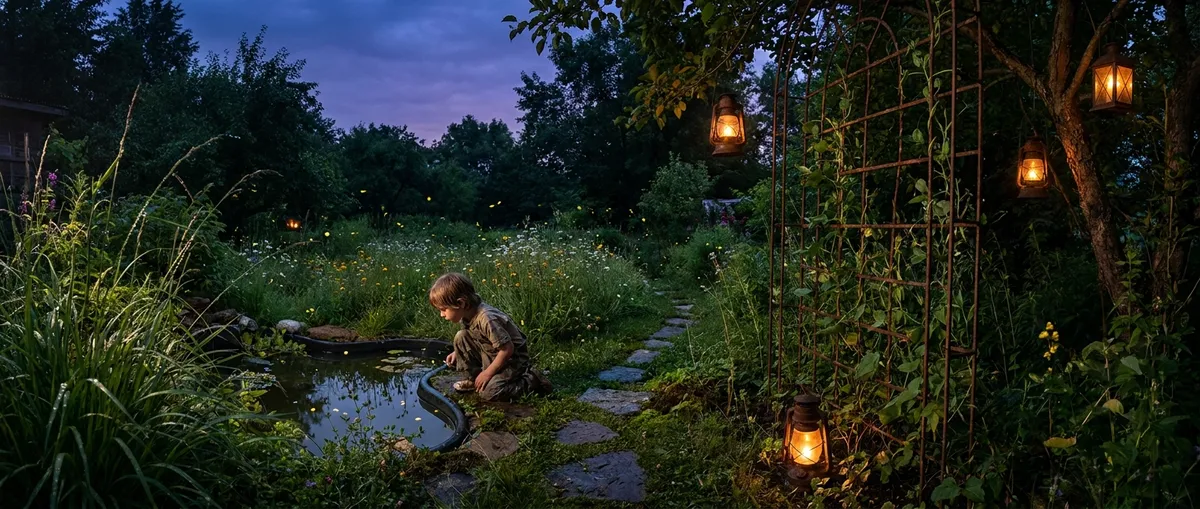
So much of outdoor design focuses on the daytime, yet some of the most magical moments happen after the sun slips away. A night garden is less about what you see in full, and more about what appears in fragments: a glow of petals, a silhouette of leaves, the gentle pooling of warm light.
Plant with dusk in mind. White and pale-colored blooms—like moonflower, white phlox, Shasta daisies, or luminous hostas—reflect even the faintest light. Silver foliage, variegated leaves, and grasses with pale seedheads catch the moon or garden lighting in unexpected ways. Include a few fragrant night-bloomers near your seating area so scent becomes part of the after-dark experience.
Layer in subtle lighting: low-voltage path lights skimming across gravel, string lights woven through a pergola, a lantern on a side table, a small spotlight catching the trunk of a favorite tree. Let the dark keep its mystery; don’t flood it. The goal is to create little pockets of glow, with shadows deep enough to feel intimate rather than exposed.
In this garden, conversations linger. Books stay open for just one more page. The day softens out here, and your landscape becomes a gentle transition between busyness and rest.
Idea 5: A “Moveable Room” for Seasonal Living
Instead of treating every inch of your yard as fixed, imagine one flexible zone that changes personality with the seasons—a “moveable room” defined more by mood than by walls.
In spring, maybe it’s a potting corner: a simple table or bench, a cluster of terracotta pots, seed trays, and a low stool surrounded by fresh greens and bulbs just breaking the soil. By summer, that same footprint becomes a summer lounge—outdoor rugs underfoot, a low table for cold drinks, a few large container plants framing the space. Come fall, it transforms into a fire-side circle with portable fire pit, blankets, and lanterns.
Design the landscaping around this idea of change. Keep the backdrop steady—shrubs, trees, perennial borders—but leave a clearing at the center that can flex with your life. Use large containers, movable screens, and lightweight furniture that can be rearranged. Plant a few “seasonal anchors” nearby: a maple that flames in autumn, a hydrangea that dazzles in summer, bulbs that announce the shift into spring.
This approach invites you to interact with your yard, not just look at it. Your landscape becomes responsive—ready to be remixed as your interests, gatherings, and rituals evolve.
Conclusion
Landscaping isn’t about impressing the neighbors or chasing a photo-perfect yard. It’s about shaping a piece of earth into a place where you actually want to be—where your shoulders drop as soon as you step outside, where time behaves differently, where ordinary days feel just a touch enchanted.
Maybe you start with a single meandering path, a pollinator corner, or a small night garden visible from your favorite chair. Over time, these choices weave together into something larger: a landscape that doesn’t just decorate your home, but deepens your life there. Your outdoor space doesn’t have to be grand to be powerful; it just has to be intentional, a little wild at the edges, and unmistakably yours.
Sources
- Environmental Protection Agency – Green Landscaping - Overview of sustainable landscaping practices and benefits for stormwater and ecology
- National Wildlife Federation – Garden for Wildlife - Guidance on creating pollinator- and bird-friendly yards using native plants
- Royal Horticultural Society – Designing a Garden - Practical design principles for layering plants, paths, and outdoor “rooms”
- Cornell University – Pollinator-Friendly Gardening - Research-based advice on planting for pollinators through the seasons
- U.S. Department of Energy – Outdoor Lighting Basics - Best practices for efficient, effective outdoor lighting suitable for night gardens