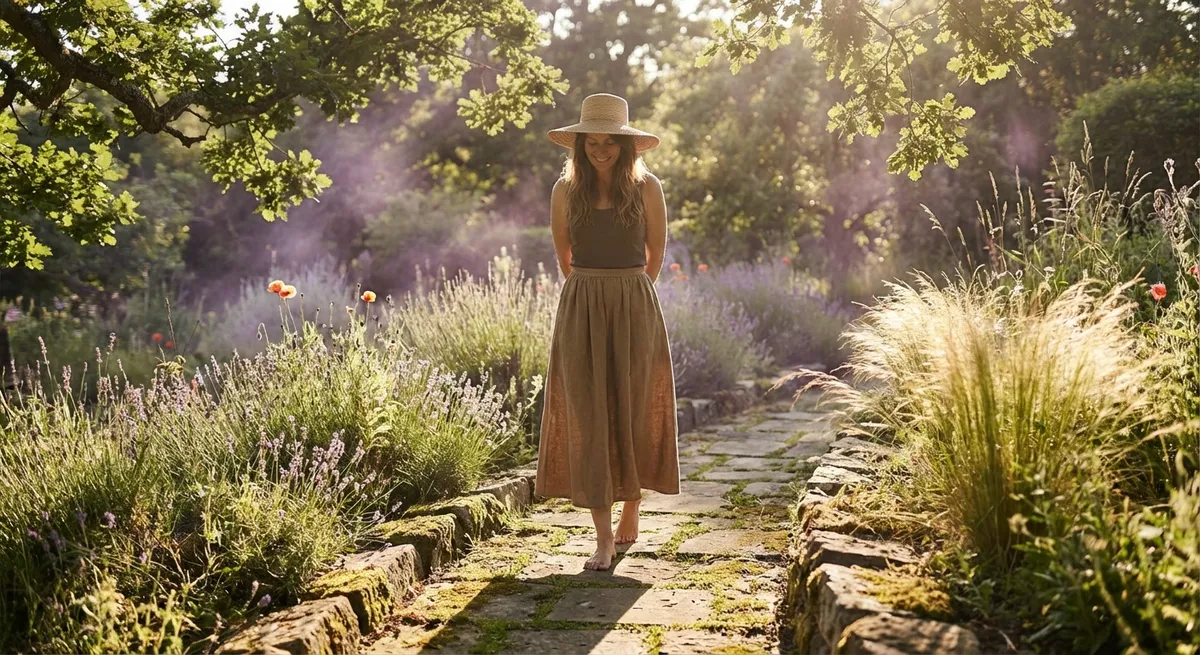
This is landscaping as invitation: to wander, to linger, to feel more at home in your own small piece of earth.
Let Your Yard Tell a Story (Instead of Just Filling Space)
Most yards are treated like blank canvases that need to be “filled.” A bed here, a tree there, a mulch line drawn dutifully along the fence. Functional, yes. But storyless.
Instead, imagine your outdoor space as a book you walk through.
Where does the “first chapter” begin when someone steps outside? Do they see everything at once, or is there a gentle reveal? A curve in a path, a taller shrub framing a view, a tree that filters the light so the yard feels like it opens gradually instead of all at once. Visual rhythm matters: tall, then low, then open; light, then shade; soft, then textured. These contrasts keep the eye curious and the mind engaged.
Think in scenes, not sections. A stepping-stone path near the house might feel lively and social, surrounded by herbs and flowers buzzing with pollinators. Farther back, the “quiet chapter” can unfold: softer plant palettes, more space between elements, and perhaps a single focal point—a small tree, a bench, a sculpture—that gives your gaze somewhere to rest.
When you design this way, every part of the landscape has a purpose in the story of how you live outdoors.
Design Idea #1: The Meandering Path That Slows Down Time
Straight paths are for getting somewhere. Meandering paths are for becoming somewhere.
Instead of one direct line from patio to back gate, consider a gently curving path of gravel, pavers, or stepping stones that nudges you to walk just a bit slower. Allow plants to soften the edges—low thyme spilling onto the stones, sedges whispering along the borders, maybe small solar lights tucked low to guide late‑evening footsteps.
A path like this works in almost any size yard:
- In a compact space, a slight curve and varying widths create the illusion of distance.
- In a larger yard, a path can “edit” the wide open: bending between planting islands, wrapping around a tree, or skirting past a small seating nook.
The key is proportion. Let the path feel human-scaled—wide enough that two people can walk side by side comfortably in a main route, and narrower where you want a more intimate, single-file feel. Give the path a destination, however simple: a chair under a tree, a birdbath, a gate, or a framed view of the horizon.
The goal isn’t just getting from A to B. It’s turning that short walk into a daily ritual: a walk to reset your shoulders, clear your thoughts, and remember to look up.
Design Idea #2: Layered Planting That Feels Like a Living Tapestry
Landscapes that feel lush and immersive share one trait: they’re layered vertically, not just spread out flat. Instead of a row of plants at one height, imagine your beds as layered tapestries—from groundcover to canopy.
Think in three or four vertical “bands”:
- Ground layer: creeping thyme, clover, sweet woodruff, low sedums
- Middle layer: salvias, coneflowers, ornamental grasses, lavender
- Shrub layer: hydrangeas, viburnums, blueberries, roses, native shrubs
- Canopy layer: small ornamental trees, multi-stemmed serviceberry, Japanese maple, or a shade tree where space allows
When these layers overlap, your yard feels deeper than it is. Even a narrow side yard can become an intimate garden corridor with tall, airy grasses behind flowering perennials and a low carpet of groundcovers at your feet.
For outdoor living enthusiasts, layered planting does something subtle but powerful: it creates privacy without hard walls. Tall, feathery grasses can function like see‑through curtains, softening views to neighboring yards. Shrubs and small trees offer a sense of shelter around patios and seating zones, making them feel tucked‑in, even in urban settings.
Let your plant palette tell a mood story: spirited and bright (golds, purples, fuchsias), serene and calm (blues, silvers, whites), or woodland quiet (deep greens, burgundies, mossy tones). The right mix becomes a living backdrop that changes with light, weather, and time of day.
Design Idea #3: A Fire-and-Shadow Corner for Long Evenings
When the sun slips down, a well-designed corner of the yard can transform into an outdoor hearth—no grand built-in required. Fire and shadow add drama, intimacy, and just enough wildness to remind you that you’re truly outside.
Choose a spot that feels slightly set apart—a far corner of the lawn, the transition between lawn and garden, or the edge of a gravel zone. Add a low, weather-resistant fire feature: a metal fire bowl, gas fire table, or even a stone-ringed portable pit placed over a nonflammable surface.
Then let the plants do the mood lighting.
Tall ornamental grasses sway and catch the firelight, casting moving shadows. Silvery-leaved plants like lamb’s ear or Russian sage glow softly at night. Darker foliage—smoke bush, ninebark, purple basil—becomes velvety and mysterious around the perimeter. If space allows, a single small tree or large shrub can become the “ceiling” of this zone, branches reaching in to hold the warmth.
Layer in comfort: weatherproof cushions, a small side table for mugs and glasses, an outdoor throw. With each element, you’re not just creating a place to sit—you’re crafting a reason to stay outside for one more story, one more song, one more shared silence.
Design Idea #4: A Functional Garden That Feels Like an Edible Gallery
Food gardens don’t have to live in a segregated “utility corner.” When designed deliberately, they become some of the most beautiful, engaging parts of a landscape—and some of the most social.
Imagine raised beds edged in corten steel or cedar, arranged like geometric artwork, with gravel or brick paths between them. Line the edges with low herbs: thyme, chives, oregano, and creeping rosemary. Let tall plants like tomatoes, pole beans, or climbing cucumbers reach up trellises that double as sculptural elements.
To keep things visually elegant and inviting:
- Repeat shapes: square or rectangular beds in a simple grid or pleasing offset pattern.
- Echo colors: terracotta pots, warm-toned mulch, copper plant tags.
- Mix textures: leafy greens, spiky chives, feathery dill, glossy peppers.
Place this “edible gallery” somewhere visible from your favorite outdoor seating area. Watching it change over the season becomes a slow-motion performance—seedlings stretching, flowers humming with bees, fruits and vegetables shifting from green to ripe.
For outdoor living enthusiasts, this kind of garden doubles as hospitality. Guests can help harvest herbs for dinner, pluck strawberries as they wander, or snack on snap peas right off the vine. The landscape becomes interactive, not just decorative.
Design Idea #5: A Quiet Threshold Between Home and World
The most overlooked landscape zone is often the one that matters most: the area immediately outside your door. This is the emotional “airlock” between your interior life and the wider world.
Instead of treating it as a bare doormat to the yard, consider crafting it like a small sanctuary.
Add a single, comfortable chair or bench where the first light or last light of the day lands. Surround it with scent: pots of basil and mint, a small cluster of lavender, jasmine or honeysuckle on a trellis. Keep at least one evergreen element in view so this threshold feels alive even in winter.
Soft underfoot materials—a small outdoor rug, a smooth paver, a wood step—signal that this is a place to pause, not just pass through. A container tree or tall shrub in a pot can frame the view and give a sense of enclosure without blocking the world entirely.
This is where you sip the first coffee, send that final text, tie your shoes, or sit for two minutes before heading into a full house. Landscaped with intention, it stops being “just the back step” and becomes a micro‑retreat: the smallest possible outdoor room with the largest possible emotional impact.
Let Your Landscape Evolve With You
Landscaping is not a one-and-done masterpiece; it’s a living collaboration between you and time.
Plants will surprise you. Paths will wear in where you didn’t expect. A corner you thought would be purely ornamental might become your favorite reading spot. Let these changes guide your next small move—a new planting, a shifted chair, a re-routed stepping stone.
Start with one idea: a meandering path, a layered border, a fire corner, an edible gallery, or a quiet threshold. Let that single change rewrite how you use the space. Then build outward from there, following how you actually live outside, not just how you thought you might.
In the end, the most successful landscape isn’t the one that looks perfect in photos; it’s the one that keeps calling you back out the door—morning after morning, season after season—into a yard that feels less like a project and more like a life unfolding on the land.
Sources
- U.S. Forest Service: Benefits of Urban Trees - Explores how trees and planted spaces support well-being, shade, and comfort in outdoor areas
- Royal Horticultural Society – Garden Design Principles - Practical overview of layout, paths, and planting structure that underpin many of the ideas in this article
- University of Minnesota Extension – Perennial Garden Design - Guidance on layering plants, choosing heights, and creating year-round interest
- Harvard T.H. Chan School of Public Health – Nature and Mental Health - Discusses how time in thoughtfully designed outdoor spaces can support mental health and stress relief