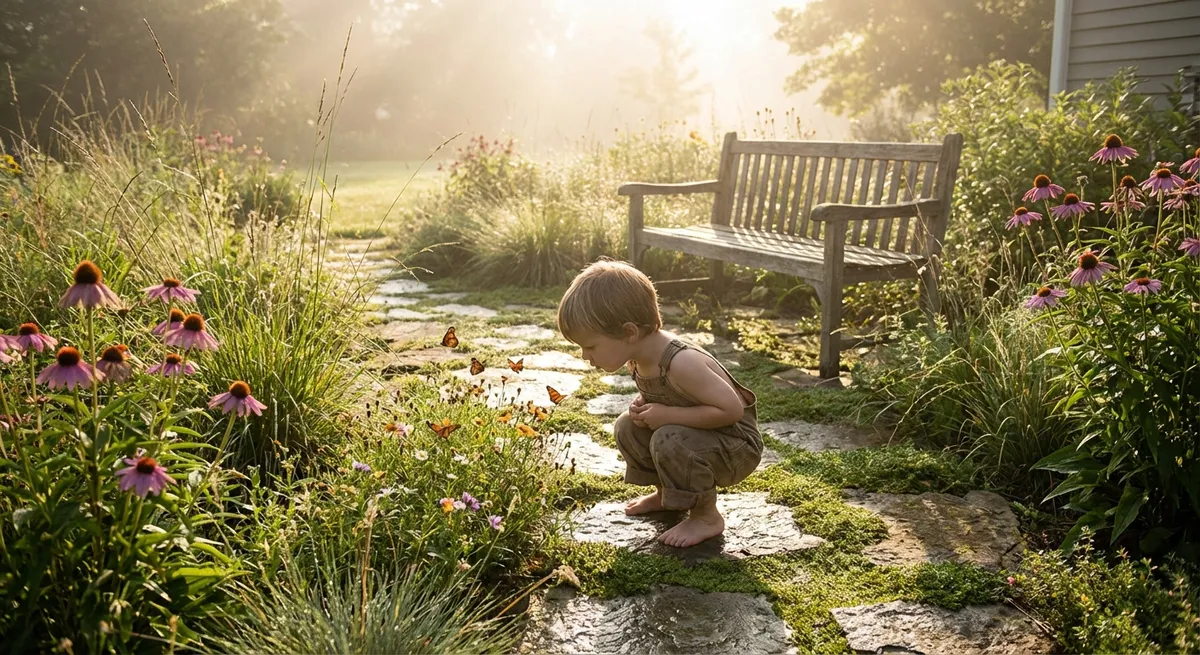
This is your invitation to loosen the lines, soften the borders, and design a landscape that feels like it’s exhaling right along with you.
Designing for Feeling, Not Just for Looks
Before thinking about plants or furniture, ask a quieter question: How do I want to feel when I step outside? Grounded? Energized? Protected? Curious?
When you start with emotion, landscaping becomes less about impressing the neighbors and more about crafting personal rituals. A curve in a path isn’t just “a design choice”—it’s a way of slowing down your walk to the garden. A small grove of trees isn’t just “shade”—it’s a sanctuary where your mind naturally lowers its voice.
Consider these emotional anchors as you design:
- Arrival: What’s the first moment your body relaxes? Maybe it’s stepping from hard flooring onto wood, gravel, or grass. Shape that threshold with intention.
- Pause: Where does your gaze naturally stop? Give that spot something worth landing on—a tree, a sculpture, a cluster of tall grasses.
- Wonder: How can you keep a little mystery alive? Not seeing everything at once invites you to explore: a half-hidden corner, a turn in the path, a tree whose upper branches you only really notice at dusk.
Landscaping done this way feels less like arranging objects and more like choreographing experiences.
Idea 1: The Meandering Path That Slows Time
Straight lines rush you. Curves invite you to linger. A meandering path, even in a small yard, changes your entire relationship to space. You’re no longer just crossing your yard—you’re taking a tiny journey.
Use materials that speak softly: decomposed granite, pea gravel, stepping stones surrounded by creeping thyme, or reclaimed brick set just a bit imperfectly. Let plants soften the edges—low-growing herbs, sedges, or groundcovers that gently spill into the walkway.
Key elements to consider:
- Narrow, then wide: Slight shifts in path width can create moments of intimacy and openness, like breath in motion.
- Layered planting: Keep lower plants close to the path, with taller grasses or shrubs leaning in beyond them, so the path feels hugged, not crowded.
- Destination points: A bench under a tree, a birdbath, a single large boulder, or a potted citrus can become a subtle “goal” that draws you forward.
Even in a tiny space, three or four curves and one honest destination turn a “side yard” into a story you walk through every day.
Idea 2: A Pollinator Haven That Hums With Life
There’s a special kind of joy in stepping outside and hearing a garden that’s truly alive: bees threading through lavender, butterflies skimming over coneflowers, hummingbirds hovering at salvias. A pollinator-focused landscape doesn’t just support ecosystems—it turns your yard into a living, moving, shimmering artwork.
To create this, think in layers and seasons:
- Native first: Choose flowers and shrubs that are native to your region; they’re often the most nourishing and resilient for local pollinators.
- Bloom succession: Aim for something in bloom from early spring through late fall: early bulbs and wildflowers, summer perennials, fall asters and goldenrods.
- Color zones: Group plants in drifts of color—pockets of purple (lavender, liatris), bursts of yellow (coreopsis, black-eyed Susan), pools of red and orange (monarda, blanket flower). Pollinators find these easier to see and navigate.
- Water and refuge: A shallow stone bowl of water with pebbles for perching, plus a few untidy corners with leaves or hollow stems, give insects shelter and rest.
This kind of landscaping asks you to share your yard with the unseen work of the world—and in return, it fills your days with movement and quiet, unforced wonder.
Idea 3: A Low-Light Glow Garden for Late Evenings
Not every garden is meant for full sun and midday lounging. Some of the most soulful outdoor spaces come alive when the sky fades—porches that bloom at dusk, side yards that belong to moonlight, quiet corners that only make sense after dinner.
Designing a glow garden means you’re landscaping for shadows, reflection, and subtle light:
- Pale and silver plants: White blooms and silvery foliage—like lamb’s ear, dusty miller, white hydrangeas, jasmine, or moonflower—catch what little light remains and gently shine back.
- Gentle lighting: String lights, low path lights, lanterns on steps, and candles in hurricane glass can outline shapes without flattening the mood. Keep it warm, not glaring.
- Reflective surfaces: Glazed ceramic pots, a small still water bowl, or even a soft metallic accent reflect starlight and lantern light in unexpected ways.
- Fragrance at night: Certain plants become more fragrant in the evening—night-blooming jasmine, honeysuckle, nicotiana. Place them where you naturally sit or walk after dark.
The result is an outdoor room that feels like a shared secret between you and the night sky—perfect for late talks, gentle music, or the kind of silence that finally lets you hear your own thoughts.
Idea 4: A Ground-Level Lounge Framed by Green
Instead of starting with a deck or a patio slab, imagine your seating area as something lightly cradled by the landscape. A ground-level lounge feels less like an “add-on” and more like a natural clearing—a place the plants have agreed to give back to you.
Start by choosing a surface that feels good underfoot: compacted gravel, large pavers with groundcover in between, or even a simple outdoor rug over level ground. Then, build a green frame around it:
- Plant a soft perimeter: Tall grasses, loose shrubs, or multi-stem small trees can define the edge of your lounge while keeping it breathable.
- Use height asymmetrically: Let one side be higher—maybe a slim tree or tall bamboo—to create a sense of shelter without boxing you in.
- Mix textures, not just colors: Pair feathery grasses with broad-leaved plants, smooth-leaved shrubs with something a bit wild and shaggy. Texture is what makes your eyes want to stay.
Add low furniture that invites lingering—deep chairs, floor cushions, a low table for books and drinks. This is less a “living room outside” and more a modern-day campfire circle, with the plants as participants instead of background props.
Idea 5: The Edible Patch That Still Feels Like Poetry
Edible gardens don’t have to look like vegetable rows marching in formation. With a bit of intention, you can fold food into your landscape so seamlessly that your yard looks like a lush garden—only with snacks.
Think of your edible space as a tapestry, not a farm:
- Blend ornamentals and edibles: Kale and chard with bright stems, artichokes with giant sculptural leaves, blueberries that blush red in fall, rosemary and sage with fragrant foliage—these can sit right alongside ornamental grasses and flowers.
- Vertical and layered: Train cucumbers or beans up simple trellises, tuck strawberries along path edges, hide lettuces beneath taller plants that offer light shade in summer.
- Container clusters: Citrus in large pots, herbs near the door, a small fig in a container by the seating area—clustered containers make harvests easy and add structure.
- Seasonal rituals: A spring salad harvested three steps from your porch, summer berries eaten before they ever make it inside, autumn herbs hung to dry by the back door—these rituals turn “yard work” into an embodied part of your year.
An edible landscape keeps you in conversation with your space. You start to notice the shift of light, the arrival of frost, the timing of rain—because you’re co-creating with the land, not just decorating it.
Letting Your Landscape Breathe With You
The most memorable outdoor spaces don’t feel finished; they feel in motion. Plants grow and reseed. Paths settle and soften. You make small edits in every season. The relationship deepens.
You don’t need a huge yard, a big budget, or perfect gardening skills to begin. You only need to ask, What kind of life do I want to live out here? Then let your design ideas—meandering paths, humming gardens, night-glow corners, green-framed lounges, edible patches—grow from that question.
When your landscaping starts to breathe with you, stepping outside doesn’t feel like “using your yard.” It feels like coming home to the part of your life that’s been waiting in the open air.
Sources
- Lady Bird Johnson Wildflower Center – Native Plant Information Network - Extensive database on native plants, helpful for pollinator and regionally adapted landscaping.
- U.S. Fish & Wildlife Service – Pollinators - Guidance on supporting pollinators through garden and landscape choices.
- Royal Horticultural Society – Gardening with Wildlife - Practical advice on designing gardens that welcome birds, insects, and other wildlife.
- University of Minnesota Extension – Sustainable Home Landscaping - Research-based recommendations for sustainable residential yard design.
- EPA – Green Landscaping: Greenacres - U.S. Environmental Protection Agency resources on environmentally friendly landscaping practices.